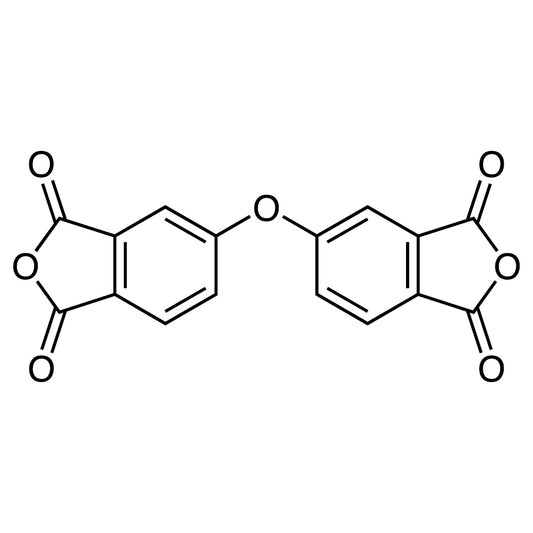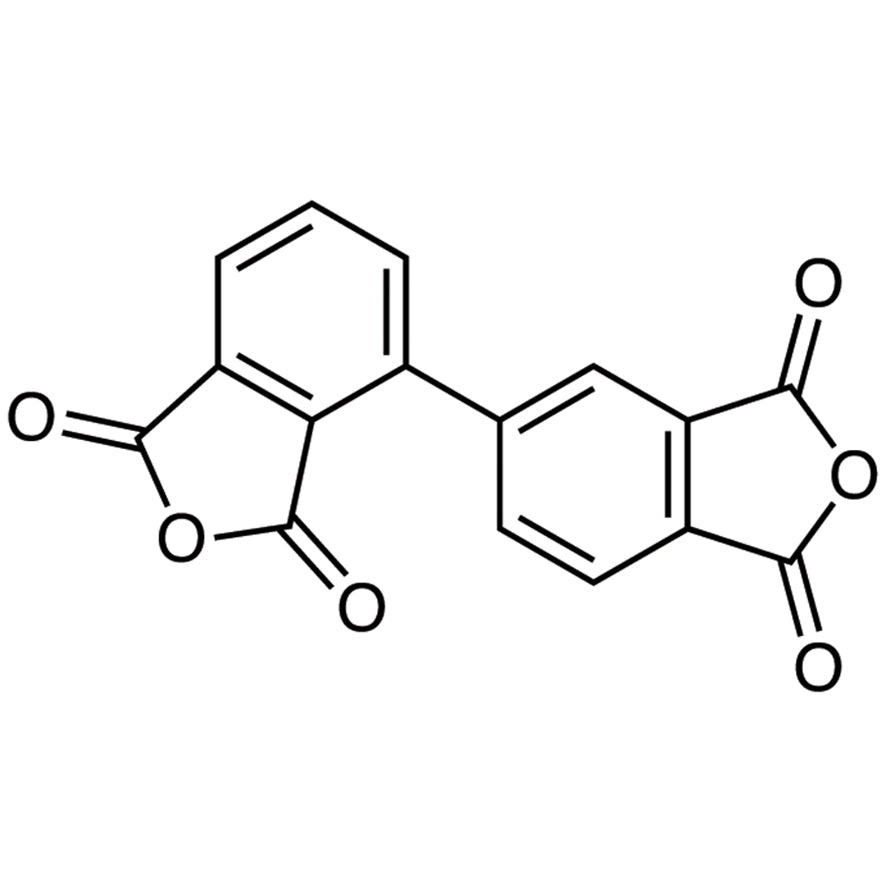
3,4'-Biphtalic Anhydride is a chemical compound widely used in scientific experiments, particularly in the fields of material science and polymer chemistry. It serves as a key reagent in the synthesis of various polymer compounds, especially in the production of epoxy resins and composite materials. In the laboratory, this compound functions as a monomer, playing a crucial role in polymerization processes by forming complex and stable chemical structures. Its presence enables the development of advanced materials with specific functional properties, making it an essential component in modern chemical research.
The reactivity of 3,4'-Biphtalic Anhydride, particularly towards amines and hydroxides, makes it a preferred choice for specific chemical reactions. Its ability to form ester or anhydride bonds allows it to interact with a wide range of substrates, enhancing its versatility in laboratory applications. The presence of anhydride groups in its molecular structure further contributes to its chemical flexibility, enabling it to be used in diverse synthetic pathways. These properties make it a valuable tool for researchers aiming to develop new materials with tailored characteristics.
In Indonesian laboratories, 3,4'-Biphtalic Anhydride is commonly used in material research, polymer chemistry, and composite development. It is frequently employed by local research institutions and industries to support experimental work and the creation of new products requiring specific chemical properties. Its reliability and effectiveness in various applications have made it a standard reagent in many scientific settings across Indonesia.
TCI brochures (PDF)
- Raw Materials for Polyimide Synthesis 2026-05-11 · p. 2
- Monomers 2025-05-28 · p. 38
Related TCI products
- TCI B4262 2420-87-3 4,4'-Biphthalic Anhydride (purified by sublimation)
- TCI B1326 2420-87-3 4,4'-Biphthalic Anhydride
- TCI I0856 38103-06-9 4,4'-(4,4'-Isopropylidenediphenoxy)diphthalic Anhydride
- TCI P2421 17828-53-4 4,4'-(1,4-Phenylenedioxy)bisphthalic Anhydride
- TCI O0423 1823-59-2 4,4'-Oxydiphthalic Anhydride (purified by sublimation)
- TCI O0384 50662-95-8 3,4'-Oxydiphthalic Anhydride
- Polymer synthesis and composite material development due to its role as a monomer in forming stable chemical structures.
- Epoxy resin production because of its ability to form ester and anhydride bonds with various substrates.
- Material science research for creating advanced polymers with specific functional properties.
- Chemical reaction experiments involving amines and hydroxides due to its high reactivity.
- Industrial applications in the development of new products requiring tailored chemical characteristics.
| Brand | TCI |
|---|---|
| CAS number | 36978-41-3 |
| Molecular formula | — |
| Purity | — |
| Category | Materials Science > Polymer/Macromolecule Reagents > Monomers |
| Pack sizes | Available in standard laboratory quantities |
| Physical form | Solid powder |
| Storage | Store in a cool, dry place away from moisture and direct sunlight |
3,4'-Biphtalic Anhydride should be stored in a cool, dry environment to maintain its chemical integrity. It is recommended to keep it in airtight containers to prevent exposure to moisture and air, which can affect its reactivity. Due to its chemical nature, it should be handled in a well-ventilated area, and appropriate personal protective equipment should be worn. Avoid contact with skin and eyes, and ensure that it is stored away from incompatible substances such as strong bases or acids. Regular monitoring of storage conditions is essential to ensure the material remains suitable for laboratory use.
—
Produk Terkait
-
4,4'-BiphthalicAnhydride(purifiedbysublimation) TCI B4262
Regular price Rp 4.347.000,00Regular priceRp 3.039.750,00Sale price Rp 4.347.000,00 -
4,4'-BiphthalicAnhydride TCI B1326
Regular price From Rp 1.298.850,00Regular priceRp 908.250,00Sale price From Rp 1.298.850,00 -
4,4'-(4,4'-Isopropylidenediphenoxy)diphthalicAnhydride TCI I0856
Regular price From Rp 1.431.150,00Regular priceRp 1.016.400,00Sale price From Rp 1.431.150,00 -
4,4'-(1,4-Phenylenedioxy)bisphthalicAnhydride TCI P2421
Regular price From Rp 2.994.600,00Regular priceRp 2.109.450,00Sale price From Rp 2.994.600,00 -
4,4'-OxydiphthalicAnhydride(purifiedbysublimation) TCI O0423
Regular price Rp 4.399.500,00Regular priceRp 3.092.250,00Sale price Rp 4.399.500,00 -
3,4'-OxydiphthalicAnhydride TCI O0384
Regular price From Rp 1.008.000,00Regular priceRp 720.300,00Sale price From Rp 1.008.000,00 -
4,4'-OxydiphthalicAnhydride TCI O0237
Regular price From Rp 1.881.600,00Regular priceRp 1.331.400,00Sale price From Rp 1.881.600,00 -
4,4'-(Hexafluoroisopropylidene)diphthalicAnhydride(purifiedbysublimation) TCI H1438
Regular price From Rp 1.405.950,00Regular priceRp 982.800,00Sale price From Rp 1.405.950,00