

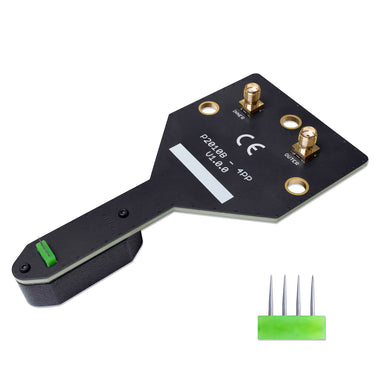
The Ossila P2010B1 is the sharp-tipped probe head for the Ossila Four-Point Probe. It is used to measure sheet resistance, resistivity and conductivity, and is intended for materials that naturally grow an oxide layer on their surface.
Its probes are made from nickel-plated tungsten carbide and end in tips 0.08 mm in diameter. At maximum travel they press with a force of 197.43 gf, enough to break through the insulating oxide and make dependable contact with the material underneath. The probes are spaced 1.6 mm (0.063") apart, have a stroke of 1.19 mm and a spring constant of 159.22 gf/mm. The head connects to the instrument through SMA connectors.
To use this head, the Ossila Four-Point Probe must run screen firmware version 1.1.0 or newer, which is available for download from Ossila.
- Measuring sheet resistance of samples with a naturally forming oxide layer.
- Determining the resistivity of materials using the Ossila Four-Point Probe.
- Measuring the conductivity of materials whose surface oxide must be pierced for reliable contact.
| Brand | Ossila |
|---|---|
| CAS number | — |
| Molecular formula | — |
| Purity | — |
| Category | — |
| Pack sizes | — |
| Physical form | — |
| Storage | — |
- Product code: P2010B1
- Probe Spacing: 1.6 mm (0.063")
- Probe Tip Diameter: 0.08 mm
- Probe Stroke: 1.19 mm
- Force at Maximum Travel: 197.43 gf
- Spring Constant: 159.22 gf/mm
- Probe Material: Nickel-plated tungsten carbide
- Connections: SMA
- Required Firmware: Screen firmware version 1.1.0 or newer
Do not exceed the maximum probe stroke of 1.19 mm, as this may damage or destroy the substrate.
—
Produk Terkait
-
Ossila Solar Cell I-V Test System without Solar Simulator T2002F2
Regular price Rp 99.381.450,00Regular price -
Ossila Four Point Probe Original Soft-tipped probe head T2001A4
Regular price Rp 88.920.300,00Regular price -
Ossila Contact Angle Goniometer
Regular price Rp 104.611.500,00Regular price -
Ossila UV Ozone Cleaner L2002A3
Regular price Rp 125.533.800,00Regular price -
Ossila Dip Coater L2006A2
Regular price Rp 104.611.500,00Regular price -
Ossila LED Solar Simulator G2009B2
Regular price Rp 104.611.500,00Regular price -
Ossila Potentiostat without Electrochemical Cell and Electrodes T2006A1
Regular price Rp 73.228.050,00Regular price -
Ossila Source Measure Unit P2005A2
Regular price Rp 73.972.500,00Regular price


