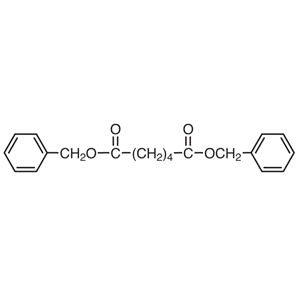
Dibenzyl Adipate is a chemical compound widely used in laboratory settings for its role in constructing complex molecular structures. As a building block in organic chemistry, it serves as a key reagent in various synthetic processes. Its versatility makes it indispensable in both academic and industrial research environments. This compound is particularly valued for its ability to participate in esterification and substitution reactions, which are fundamental to the development of polymers and other organic materials. Its presence in chemical synthesis supports the creation of a wide range of functional compounds.
The chemical properties of Dibenzyl Adipate make it a preferred choice for laboratory use. It exhibits a stable molecular structure and possesses chemical characteristics that allow for good reactivity under diverse laboratory conditions. Being non-polar, it is well-suited for applications requiring minimal solubility in polar solvents. Additionally, its high melting point ensures thermal stability, making it ideal for reactions that require elevated temperatures. These properties contribute to its reliability and consistency in chemical processes, enhancing its utility in both routine and advanced experiments.
In Indonesian laboratories, Dibenzyl Adipate is commonly used in organic chemistry research, polymer development, and the production of industrial chemicals. It plays a vital role in the synthesis of various compounds, supporting both educational and commercial applications. Its availability and performance make it a valuable component in the chemical toolkit of researchers and institutions across the country. Its use is integral to advancing chemical innovation and maintaining the quality of laboratory outputs.
Related TCI products
- Organic synthesis reactions benefit from Dibenzyl Adipate's ability to form ester bonds, enabling the creation of complex organic molecules.
- Polymer development relies on its role as a cross-linking agent, enhancing the structural integrity of synthetic polymers.
- Industrial chemical production utilizes its stability and reactivity to synthesize a wide range of functional compounds.
- Research in material science employs it to develop new materials with specific chemical and physical properties.
- Educational laboratories use it as a teaching tool to demonstrate esterification and substitution reactions in organic chemistry.
| Brand | TCI |
|---|---|
| CAS number | 2451-84-5 |
| Molecular formula | — |
| Purity | — |
| Category | Chemistry > Building Blocks > Non-Heterocyclic Building Blocks |
| Pack sizes | Available in various quantities as per standard laboratory supply options |
| Physical form | Solid |
| Storage | Store in a cool, dry place away from direct sunlight and moisture |
Dibenzyl Adipate should be stored in a cool, dry environment to maintain its chemical stability. It is recommended to keep it in airtight containers to prevent exposure to moisture and air, which could affect its reactivity. Due to its non-polar nature, it is best stored in glass or high-density polyethylene containers to avoid chemical interactions. Laboratory personnel should handle it with care, using appropriate personal protective equipment when necessary. Proper storage conditions ensure the compound remains effective for use in a wide range of chemical applications. Regular monitoring of storage conditions is essential to maintain its quality and safety in laboratory settings.
—
Produk Terkait
-
Bis(2-methoxyethyl)Adipate TCI A0165
Regular price From Rp 1.724.100,00Regular priceRp 1.205.400,00Sale price From Rp 1.724.100,00 -
Bis(2-ethylhexyl)Adipate TCI A0163
Regular price Rp 452.550,00Regular priceRp 316.050,00Sale price Rp 452.550,00 -
Bis(2-butoxyethyl)Adipate TCI B2716
Regular price From Rp 717.150,00Regular priceRp 500.850,00Sale price From Rp 717.150,00 -
MonomethylAdipate TCI A1738
Regular price From Rp 1.485.750,00Regular priceRp 1.038.450,00Sale price From Rp 1.485.750,00 -
DiisononylAdipate(mixtureofbranchedchainisomers) TCI A1387
Regular price From Rp 584.850,00Regular priceRp 408.450,00Sale price From Rp 584.850,00 -
MonoethylAdipate TCI A1223
Regular price From Rp 1.140.300,00Regular priceRp 796.950,00Sale price From Rp 1.140.300,00 -
DipropylAdipate TCI A0931
Regular price Rp 1.008.000,00Regular priceRp 704.550,00Sale price Rp 1.008.000,00 -
DiisopropylAdipate TCI A0654
Regular price From Rp 903.000,00Regular priceRp 631.050,00Sale price From Rp 903.000,00