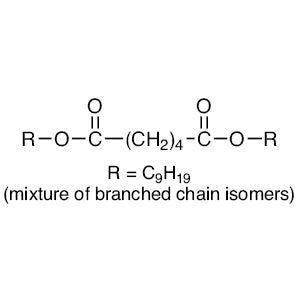
Bis(2-butoxyethyl) Adipate is a chemical compound widely used in laboratory settings as a building block for various organic synthesis reactions. It serves as a versatile intermediate in the creation of complex organic molecules, offering stability and reactivity that make it valuable for chemical research. This compound is particularly useful in polymerization reactions, where it acts as a linking agent between molecular chains, contributing to the formation of polymers with desired properties. Its role in the laboratory extends beyond synthesis, as it is also employed in the modification of existing molecules to enhance their functional characteristics.
One of the key properties that make Bis(2-butoxyethyl) Adipate a preferred choice is its solubility in organic solvents such as ethyl acetate. This solubility facilitates its use in a wide range of chemical processes, including esterification and copolymerization. Additionally, its ability to react with various functional groups makes it adaptable to different synthetic strategies. The compound also exhibits relatively high boiling and melting points, which aid in separation and purification processes within the laboratory. These characteristics collectively make it a reliable and efficient reagent for chemical synthesis.
In Indonesian laboratories, Bis(2-butoxyethyl) Adipate is commonly used in research related to organic chemistry, pharmaceuticals, and materials science. It is a key component in the development of new compounds with applications in the pharmaceutical, plastics, and chemical industries. Many research institutions and universities rely on this compound for its versatility and effectiveness in chemical synthesis, making it an essential tool for scientific innovation.
TCI brochures (PDF)
- Polymer Additives 2026-04-16 · p. 3
Related TCI products
- Organic synthesis applications benefit from Bis(2-butoxyethyl) Adipate due to its reactivity and ability to form stable intermediates in complex molecule creation.
- Polymerization processes utilize this compound as a linking agent, enabling the formation of polymers with controlled properties and structural integrity.
- Esterification reactions are enhanced by its solubility in organic solvents, allowing for efficient reaction conditions and product isolation.
- Molecular modification projects rely on its ability to react with various functional groups, enabling the design of compounds with specific properties.
- Research in pharmaceutical development uses this compound to synthesize new drug candidates with improved stability and bioavailability.
| Brand | TCI |
|---|---|
| CAS number | 141-18-4 |
| Molecular formula | — |
| Purity | — |
| Category | Chemistry > Building Blocks > Non-Heterocyclic Building Blocks |
| Pack sizes | Available in various sizes as per standard laboratory supply |
| Physical form | Liquid |
| Storage | Store in a cool, dry place away from direct sunlight and incompatible materials |
Bis(2-butoxyethyl) Adipate should be stored in a cool, dry environment to maintain its chemical stability. It is recommended to keep the compound in a tightly sealed container to prevent exposure to moisture and air, which could affect its properties. Suitable containers for storage include glass or polyethylene vessels that are resistant to chemical degradation. In laboratory settings, it is important to handle the compound with appropriate personal protective equipment, such as gloves and safety goggles, to ensure safe handling. Proper labeling of containers is also essential to prevent accidental misuse. The compound should be stored away from incompatible substances like strong oxidizers to avoid potential chemical reactions. Regular inspection of storage conditions ensures the compound remains in optimal condition for use in research applications.
—
Produk Terkait
-
PhthalicAcidBis(2-butoxyethyl)Ester TCI P0657
Regular price Rp 769.650,00Regular priceRp 537.600,00Sale price Rp 769.650,00 -
Bis(2-ethylhexyl)Adipate TCI A0163
Regular price Rp 452.550,00Regular priceRp 316.050,00Sale price Rp 452.550,00 -
DiisononylAdipate(mixtureofbranchedchainisomers) TCI A1387
Regular price From Rp 584.850,00Regular priceRp 408.450,00Sale price From Rp 584.850,00 -
DipropylAdipate TCI A0931
Regular price Rp 1.008.000,00Regular priceRp 704.550,00Sale price Rp 1.008.000,00 -
DiisopropylAdipate TCI A0654
Regular price From Rp 903.000,00Regular priceRp 631.050,00Sale price From Rp 903.000,00 -
Tris(2-butoxyethyl)Phosphate TCI P0683
Regular price From Rp 822.150,00Regular priceRp 590.100,00Sale price From Rp 822.150,00 -
DimethylAdipate TCI A0166
Regular price From Rp 505.050,00Regular priceRp 352.800,00Sale price From Rp 505.050,00 -
Bis(2-methoxyethyl)Adipate TCI A0165
Regular price From Rp 1.724.100,00Regular priceRp 1.205.400,00Sale price From Rp 1.724.100,00