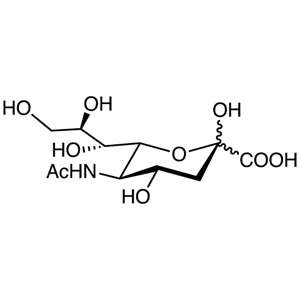
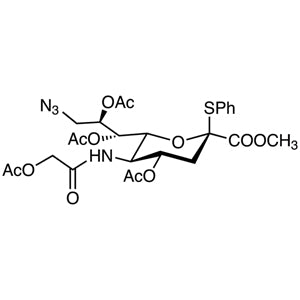
N-Acetylneuraminic Acid (Neuraminic Acid) is a chemical compound belonging to the sialic acid family. It plays a crucial role in chemical biology and glycoscience research, particularly in the study of carbohydrate structure and function. In the laboratory, this compound serves as a key reagent for the synthesis of complex molecules and is widely used in molecular composition analysis and protein surface characterization. Its unique chemical structure, featuring an N-acetyl group and a carboxylic acid group, enables it to interact with various biomolecules, making it essential for understanding molecular interactions in biological systems.
The compound's high reactivity and specificity make it a preferred choice for researchers in genetics, immunology, and molecular biology. Its stability and resistance to degradation ensure consistent results in experimental settings. Additionally, its solubility in organic solvents such as ethanol and acetone facilitates easy handling and integration into diverse chemical reactions. These properties contribute to its reliability and effectiveness in both analytical and synthetic applications.
In Indonesian laboratories, N-Acetylneuraminic Acid is commonly used in academic and industrial research settings. It supports studies on carbohydrate-based molecules and their biological roles, including their involvement in disease mechanisms and immune responses. Its application spans from basic research to applied studies, making it a valuable resource for scientists working in the field of glycoscience and related disciplines.
TCI brochures (PDF)
Related TCI products
- TCI A1105 131-48-6 N-Acetylneuraminic Acid
- TCI N1166 110935-75-6 N-Acetylneuraminic Acid Pentamer alpha(2-8)
- TCI N1165 96425-83-1 N-Acetylneuraminic Acid Tetramer alpha(2-8)
- TCI N1164 76152-09-5 N-Acetylneuraminic Acid Trimer alpha(2-8)
- TCI N1163 95983-78-1 N-Acetylneuraminic Acid Dimer alpha(2-8)
- TCI M2696 1195053-25-8 Methyl (Phenyl 5-Acetoxyacetamido-4,7,8-tri-O-acetyl-9-azido-3,5,9-trideoxy-2-thio-D-glycero-beta-D-galacto-2-nonulopyranosid)onate
- Glycoscience Research - N-Acetylneuraminic Acid is used to study carbohydrate structures and their biological functions, aiding in understanding molecular interactions.
- Protein Surface Characterization - Its ability to bind to proteins makes it useful in analyzing surface properties and molecular recognition processes.
- Molecular Composition Analysis - The compound is employed in analytical techniques to determine the composition of complex biomolecules.
- Genetic Disease Studies - It plays a role in investigating the role of sialic acids in genetic disorders and their impact on cellular processes.
- Immunological Research - N-Acetylneuraminic Acid is used to study its involvement in immune responses and pathogen recognition mechanisms.
| Brand | TCI |
|---|---|
| CAS number | 131-48-6 |
| Molecular formula | — |
| Purity | — |
| Category | Chemistry > Chemical Biology > Glycoscience |
| Pack sizes | Available in various quantities as per supplier specifications |
| Physical form | Powder |
| Storage | Store in a cool, dry place away from moisture and direct sunlight |
N-Acetylneuraminic Acid should be stored in a cool, dry environment to maintain its stability and prevent degradation. It is best kept in a sealed container to avoid exposure to moisture and air, which can affect its chemical integrity. Due to its reactivity, it should be handled with care using appropriate personal protective equipment such as gloves and safety goggles. It is recommended to store the compound in a well-ventilated area to minimize the risk of inhalation. Avoid contact with incompatible substances to ensure safe handling and long-term usability in laboratory settings.
—
Produk Terkait
-
N-AcetylneuraminicAcid TCI A1105
Regular price From Rp 1.140.300,00Regular priceRp 812.700,00Sale price From Rp 1.140.300,00 -
N-AcetylneuraminicAcidPentameralpha(2-8) TCI N1166
Regular price Rp 12.587.400,00Regular priceRp 8.817.900,00Sale price Rp 12.587.400,00 -
N-AcetylneuraminicAcidTetrameralpha(2-8) TCI N1165
Regular price Rp 9.459.450,00Regular priceRp 6.630.750,00Sale price Rp 9.459.450,00 -
N-AcetylneuraminicAcidTrimeralpha(2-8) TCI N1164
Regular price Rp 8.003.100,00Regular priceRp 5.612.250,00Sale price Rp 8.003.100,00 -
N-AcetylneuraminicAcidDimeralpha(2-8) TCI N1163
Regular price Rp 6.333.600,00Regular priceRp 4.444.650,00Sale price Rp 6.333.600,00 -
Methyl(Phenyl5-Acetoxyacetamido-4,7,8-tri-O-acetyl-9-azido-3,5,9-trideoxy-2-thio-D-glycero-beta-D-galacto-2-nonulopyranosid)onate TCI M2696
Regular price Rp 10.890.600,00Regular priceRp 7.631.400,00Sale price Rp 10.890.600,00 -
Methyl(Phenyl5-Acetamido-4,7,8-tri-O-acetyl-9-azido-3,5,9-trideoxy-2-thio-D-glycero-beta-D-galacto-2-nonulopyranosid)onate TCI M2695
Regular price Rp 24.088.050,00Regular priceRp 16.859.850,00Sale price Rp 24.088.050,00 -
Methyl5-Acetamido-7,8,9-tri-O-acetyl-5-N,4-O-carbonyl-3,5-dideoxy-2-S-phenyl-2-thio-D-glycero-beta-D-galacto-2-nonulopyranosylonate TCI M2319
Regular price From Rp 6.413.400,00Regular priceRp 4.500.300,00Sale price From Rp 6.413.400,00