


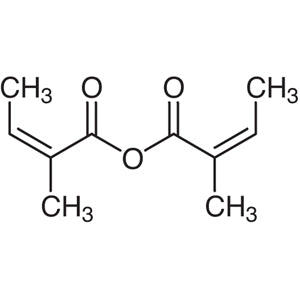
Angelica Anhydride (94487-74-8) is a chemical compound widely used in laboratory settings for its versatility in organic synthesis. It serves as a key building block in the creation of complex organic molecules, including heterocyclic compounds and long-chain structures. This reagent is commonly employed in reactions that require coupling or substitution mechanisms, making it an essential tool for chemists working on synthetic pathways. Its role as an intermediate in various chemical processes highlights its importance in both academic and industrial research environments.
The compound's chemical stability under controlled conditions makes it a preferred choice for laboratory applications. However, it is highly sensitive to moisture and oxidation, which necessitates careful handling and storage. These properties make it ideal for reactions that require precise environmental control. Its solid form and reactivity with various functional groups further enhance its utility in a wide range of chemical transformations. The ability to participate in diverse reactions without compromising its structural integrity ensures its reliability in synthetic chemistry.
In Indonesian laboratories, Angelica Anhydride is frequently used in organic chemistry research, particularly in academic institutions and research centers focused on the synthesis of new compounds. Its availability and chemical properties make it a favored reagent for students and researchers working on advanced chemical projects. Its role in supporting scientific innovation aligns with the growing demand for high-quality chemical reagents in the region.
Related TCI products
- Organic synthesis of heterocyclic compounds due to its reactivity with functional groups and ability to form stable intermediates.
- Coupling reactions in the development of complex organic molecules requiring precise chemical control.
- Substitution reactions where Angelica Anhydride acts as a versatile reagent for modifying molecular structures.
- Research in polymer chemistry for the creation of long-chain polymers through controlled chemical transformations.
- Development of pharmaceutical compounds in the synthesis of bioactive molecules with specific structural requirements.
| Brand | TCI |
|---|---|
| CAS number | 94487-74-8 |
| Molecular formula | — |
| Purity | — |
| Category | Chemistry > Building Blocks > Non-Heterocyclic Building Blocks |
| Pack sizes | Available in various quantities as per standard laboratory supply practices |
| Physical form | Solid |
| Storage | Requires dry, cool, and well-ventilated conditions to prevent degradation |
Angelica Anhydride should be stored in a dry, cool, and well-ventilated area to prevent moisture-induced degradation. It is recommended to use airtight containers made of materials resistant to chemical reactions, such as glass or high-density polyethylene. Due to its sensitivity to oxidation, it should be kept away from strong oxidizing agents and sources of heat. Laboratory personnel should wear appropriate personal protective equipment, including gloves and safety goggles, when handling this compound. Regular monitoring of storage conditions is essential to maintain its chemical integrity and ensure safe usage in experimental settings.
—
Produk Terkait
-
ValericAnhydride TCI V0006
Regular price From Rp 928.200,00Regular priceRp 664.650,00Sale price From Rp 928.200,00 -
3-BromophthalicAnhydride TCI B4061
Regular price From Rp 1.246.350,00Regular priceRp 871.500,00Sale price From Rp 1.246.350,00 -
Bicyclo[2.2.2]oct-5-ene-2,3-dicarboxylicAnhydride TCI B3038
Regular price Rp 3.605.700,00Regular priceRp 2.521.050,00Sale price Rp 3.605.700,00 -
ButylsuccinicAnhydride TCI B2742
Regular price From Rp 5.274.150,00Regular priceRp 3.687.600,00Sale price From Rp 5.274.150,00 -
4-BromophthalicAnhydride TCI B1693
Regular price From Rp 2.386.650,00Regular priceRp 1.668.450,00Sale price From Rp 2.386.650,00 -
2-Buten-1-ylsuccinicAnhydride TCI B1613
Regular price From Rp 2.491.650,00Regular priceRp 1.757.700,00Sale price From Rp 2.491.650,00 -
BehenicAnhydride TCI B1531
Regular price From Rp 1.829.100,00Regular priceRp 1.294.650,00Sale price From Rp 1.829.100,00 -
4-tert-ButylphthalicAnhydride TCI B1337
Regular price From Rp 2.704.800,00Regular priceRp 1.891.050,00Sale price From Rp 2.704.800,00


