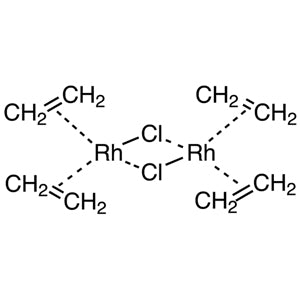
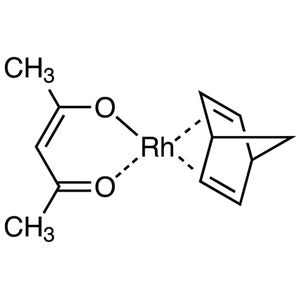
Acetylacetonatobis(ethylene)rhodium(I) is a metal complex compound widely used in catalytic reactions, particularly in C-H activation processes. This compound plays a crucial role in laboratory settings where efficient and selective catalytic reactions are required. It is a key reagent in the field of inorganic and organic chemistry, enabling the transformation of complex molecular structures under more moderate conditions. Its application helps reduce the need for extreme environments such as high temperatures or pressures, making it a valuable tool in modern chemical research.
The compound is known for its high catalytic efficiency and selectivity, making it a preferred choice in various chemical processes. Its stable complex structure allows for consistent performance in a wide range of reaction conditions. The reactivity of Acetylacetonatobis(ethylene)rhodium(I) enables it to participate in both organic and inorganic reactions, offering versatility in experimental design. Its ability to function as a homogeneous catalyst further enhances its utility in laboratory applications, where uniformity and control are essential.
In Indonesian laboratories, this compound is commonly used in research focused on C-H activation, synthesis of complex compounds, and the development of new catalytic techniques. It is particularly favored in academic and industrial research settings where precision and efficiency in chemical reactions are paramount. Its role in advancing chemical innovation makes it an essential component in the toolkit of chemists and researchers in Indonesia.
TCI brochures (PDF)
- C-H Bond Activation Reaction 2025-06-20 · p. 4
- Transition Metal Catalysts 2026-04-10 · p. 10
Related TCI products
- TCI C2461 12081-16-2 Chlorobis(ethylene)rhodium(I) Dimer
- TCI B4549 819050-89-0 Bis[rhodium(alpha,alpha,alpha',alpha'-tetramethyl-1,3-benzenedipropionic Acid)]
- TCI B3961 35138-22-8 Bis(1,5-cyclooctadiene)rhodium(I) Tetrafluoroborate
- TCI B2091 36620-11-8 Bis[eta-(2,5-norbornadiene)]rhodium(I) Tetrafluoroborate
- TCI B1692 13938-94-8 Carbonylbis(triphenylphosphine)rhodium(I) Chloride
- TCI B1045 12092-47-6 Chloro(1,5-cyclooctadiene)rhodium(I) Dimer
- C-H Activation Reactions: This compound is ideal for activating carbon-hydrogen bonds, enabling the synthesis of complex organic molecules with high selectivity and efficiency.
- Organic Synthesis: Its catalytic properties make it suitable for various organic reactions, including cross-coupling and functional group transformations.
- Inorganic Chemistry Research: It is used in studies involving metal-based complexes and their reactivity, contributing to the understanding of coordination chemistry.
- Catalytic Process Development: Researchers use it to explore and optimize new catalytic systems, particularly in green chemistry and sustainable synthesis methods.
- Complex Compound Synthesis: Its ability to facilitate selective reactions makes it valuable in the creation of novel coordination compounds and metal-organic frameworks.
| Brand | TCI |
|---|---|
| CAS number | 12082-47-2 |
| Molecular formula | — |
| Purity | — |
| Category | Chemistry > Catalysis and Inorganic Chemistry > C-H Activation [Catalysis] |
| Pack sizes | Available in various quantities as per standard laboratory supply |
| Physical form | Solid or powder, depending on the specific formulation |
| Storage | Store in a cool, dry place away from moisture and direct sunlight |
Acetylacetonatobis(ethylene)rhodium(I) should be stored in a cool, dry environment to maintain its stability and catalytic activity. It is recommended to keep it in a sealed container to prevent exposure to moisture and air, which may affect its performance. The compound is generally handled in a well-ventilated laboratory setting to ensure safety during use. Standard laboratory precautions, such as wearing protective gloves and goggles, should be followed when handling this material. It is important to avoid contact with skin and eyes, and to ensure proper disposal according to local regulations. Proper storage and handling help preserve the compound’s effectiveness and ensure safe laboratory practices.
—
Produk Terkait
-
Chlorobis(ethylene)rhodium(I)Dimer TCI C2461
Regular price Rp 5.565.000,00Regular priceRp 3.907.050,00Sale price Rp 5.565.000,00 -
Bis[rhodium(alpha,alpha,alpha',alpha'-tetramethyl-1,3-benzenedipropionicAcid)] TCI B4549
Regular price Rp 2.464.350,00Regular priceRp 1.738.800,00Sale price Rp 2.464.350,00 -
Bis(1,5-cyclooctadiene)rhodium(I)Tetrafluoroborate TCI B3961
Regular price From Rp 2.411.850,00Regular priceRp 1.702.050,00Sale price From Rp 2.411.850,00 -
Bis[eta-(2,5-norbornadiene)]rhodium(I)Tetrafluoroborate TCI B2091
Regular price Rp 2.702.700,00Regular priceRp 1.905.750,00Sale price Rp 2.702.700,00 -
Carbonylbis(triphenylphosphine)rhodium(I)Chloride TCI B1692
Regular price Rp 10.414.950,00Regular priceRp 7.298.550,00Sale price Rp 10.414.950,00 -
Chloro(1,5-cyclooctadiene)rhodium(I)Dimer TCI B1045
Regular price From Rp 2.942.100,00Regular priceRp 2.072.700,00Sale price From Rp 2.942.100,00 -
(Acetylacetonato)(norbornadiene)rhodium(I) TCI A2761
Regular price From Rp 3.472.350,00Regular priceRp 2.443.350,00Sale price From Rp 3.472.350,00 -
Tris(triphenylphosphine)rhodium(I)Chloride TCI T0931
Regular price Rp 5.485.200,00Regular priceRp 3.851.400,00Sale price Rp 5.485.200,00