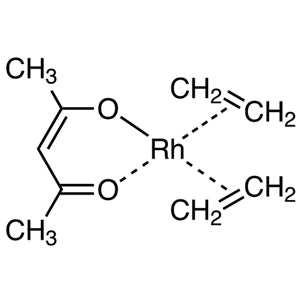
TCI A2761 32354-50-0 (Acetylacetonato)(norbornadiene)rhodium(I) is a chemical compound used in catalytic reactions, particularly in C-H activation. This material is a rhodium-based metal complex that plays a crucial role in organic catalysis. In the laboratory, it serves as an essential catalyst for reactions requiring the activation of carbon-hydrogen bonds. Its unique properties make it a valuable tool in modern synthetic chemistry, enabling previously challenging reactions to become more efficient and controlled.
The compound is preferred due to its excellent catalytic performance and stability under various reaction conditions. Its complex molecular structure allows for specific interactions with substrates, enhancing reaction efficiency and selectivity. Additionally, its resistance to degradation ensures consistent performance across multiple experimental runs. These properties make it a reliable choice for researchers aiming to achieve high yields and reproducibility in their experiments.
In Indonesian laboratories, this compound is widely used in chemical research, especially in the fields of organic catalysis and C-H activation. Researchers from educational institutions and research organizations frequently utilize it to advance their studies in synthetic chemistry. Its application supports the development of new methodologies and compounds, contributing to the growth of scientific innovation in the region.
TCI brochures (PDF)
- C-H Bond Activation Reaction 2025-06-20 · p. 4
- Transition Metal Catalysts 2026-04-10 · p. 10
Related TCI products
- TCI B2091 36620-11-8 Bis[eta-(2,5-norbornadiene)]rhodium(I) Tetrafluoroborate
- TCI N0453 12257-42-0 Norbornadiene Rhodium(I) Chloride Dimer
- TCI B4549 819050-89-0 Bis[rhodium(alpha,alpha,alpha',alpha'-tetramethyl-1,3-benzenedipropionic Acid)]
- TCI B3961 35138-22-8 Bis(1,5-cyclooctadiene)rhodium(I) Tetrafluoroborate
- TCI B1692 13938-94-8 Carbonylbis(triphenylphosphine)rhodium(I) Chloride
- TCI B1045 12092-47-6 Chloro(1,5-cyclooctadiene)rhodium(I) Dimer
- C-H Activation Reactions: This compound is ideal for C-H activation due to its ability to facilitate selective bond cleavage, enabling the synthesis of complex organic molecules with high efficiency.
- Organic Catalysis Research: It is widely used in organic catalysis studies because of its high catalytic activity and compatibility with a variety of reaction conditions.
- Synthetic Chemistry Experiments: Its stability and reactivity make it a preferred choice for synthetic chemistry experiments requiring precise control over reaction pathways.
- Green Chemistry Initiatives: The compound supports sustainable chemical processes by reducing the need for harsh reagents and minimizing byproduct formation.
- Academic Research Projects: It is commonly employed in academic settings to explore new catalytic mechanisms and improve reaction outcomes in educational and research environments.
| Brand | TCI |
|---|---|
| CAS number | 32354-50-0 |
| Molecular formula | — |
| Purity | — |
| Category | Chemistry > Catalysis and Inorganic Chemistry > C-H Activation [Catalysis] |
| Pack sizes | — |
| Physical form | — |
| Storage | Store in a cool, dry place away from moisture and light |
This compound should be stored in a cool, dry place, away from moisture and direct light, to maintain its stability and effectiveness. It is recommended to use airtight containers to prevent exposure to air and humidity, which could affect its performance. Proper labeling of storage containers is essential for safety and traceability. In a laboratory setting, it should be handled with care, using appropriate personal protective equipment such as gloves and safety goggles. Regular monitoring of storage conditions ensures the compound remains in optimal condition for use in catalytic reactions. Always follow standard laboratory safety protocols when handling and storing this material.
—
Product Categories
- Catalysis and Inorganic ChemistryC-H Activation [Catalysis]Rhodium Compounds [C-H Activation]
- Catalysis and Inorganic ChemistryTransition Elements [Catalysis and Inorganic Chemistry]Rhodium [Catalysis and Inorganic Chemistry]
- Synthetic ReagentsC-X(Non-Halogen) Bond Formation [Synthetic Reagents]C-H Bond Activation Reaction [Synthetic Reagents]
Produk Terkait
-
Bis[eta-(2,5-norbornadiene)]rhodium(I)Tetrafluoroborate TCI B2091
Regular price Rp 2.702.700,00Regular priceRp 1.905.750,00Sale price Rp 2.702.700,00 -
NorbornadieneRhodium(I)ChlorideDimer TCI N0453
Regular price Rp 6.573.000,00Regular priceRp 4.611.600,00Sale price Rp 6.573.000,00 -
Bis[rhodium(alpha,alpha,alpha',alpha'-tetramethyl-1,3-benzenedipropionicAcid)] TCI B4549
Regular price Rp 2.464.350,00Regular priceRp 1.738.800,00Sale price Rp 2.464.350,00 -
Bis(1,5-cyclooctadiene)rhodium(I)Tetrafluoroborate TCI B3961
Regular price From Rp 2.411.850,00Regular priceRp 1.702.050,00Sale price From Rp 2.411.850,00 -
Carbonylbis(triphenylphosphine)rhodium(I)Chloride TCI B1692
Regular price Rp 10.414.950,00Regular priceRp 7.298.550,00Sale price Rp 10.414.950,00 -
Chloro(1,5-cyclooctadiene)rhodium(I)Dimer TCI B1045
Regular price From Rp 2.942.100,00Regular priceRp 2.072.700,00Sale price From Rp 2.942.100,00 -
Acetylacetonatobis(ethylene)rhodium(I) TCI A2100
Regular price Rp 5.380.200,00Regular priceRp 3.777.900,00Sale price Rp 5.380.200,00 -
Tris(triphenylphosphine)rhodium(I)Chloride TCI T0931
Regular price Rp 5.485.200,00Regular priceRp 3.851.400,00Sale price Rp 5.485.200,00