


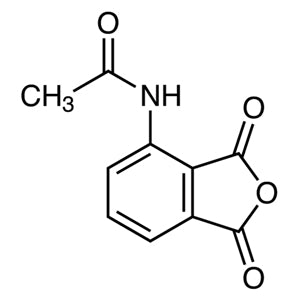
3-Acetamidophthalic Anhydride (A2804) is a chemical compound widely used in organic synthesis reactions within laboratory settings. As an anhydride of phthalic acid, it serves as a versatile reagent that participates in various coupling reactions and esterification processes. Its chemical structure makes it highly reactive, allowing it to be a key component in the development of complex organic molecules. This compound is particularly valuable in the synthesis of heterocyclic compounds and other specialized chemical structures.
The compound's reactivity and chemical stability under controlled conditions make it a preferred choice for researchers. It exhibits high melting points and dissolves readily in organic solvents such as ethyl acetate and chloroform. These properties contribute to its effectiveness in synthetic pathways. Additionally, its ability to engage in esterification and coupling reactions enhances its utility in both academic and industrial research. Its sensitivity to moisture and high temperatures necessitates careful handling and storage.
In Indonesian laboratories, 3-Acetamidophthalic Anhydride is commonly used in pure and applied chemical research. It is a staple in university research labs and research institutions, supporting the development of new compounds with applications in pharmaceuticals, materials science, and chemical industries. Its role in advancing chemical innovation is well recognized in the local scientific community.
Related TCI products
- TCI B4061 82-73-5 3-Bromophthalic Anhydride
- TCI B3038 6708-37-8 Bicyclo[2.2.2]oct-5-ene-2,3-dicarboxylic Anhydride
- TCI B2742 2035-76-9 Butylsuccinic Anhydride
- TCI B1693 86-90-8 4-Bromophthalic Anhydride
- TCI B1613 7538-42-3 2-Buten-1-ylsuccinic Anhydride
- TCI B1337 32703-79-0 4-tert-Butylphthalic Anhydride
- Organic synthesis applications benefit from its reactivity in coupling and esterification reactions, making it ideal for creating complex molecular structures.
- Pharmaceutical research utilizes it for the synthesis of heterocyclic compounds, which are essential in drug development and medicinal chemistry.
- Material science applications leverage its chemical properties to develop new polymers and functional materials with specific characteristics.
- Chemical process development incorporates it in the creation of specialized intermediates required for industrial chemical manufacturing.
- Academic research in chemistry relies on its versatility for teaching and experimental purposes in both undergraduate and graduate studies.
| Brand | TCI |
|---|---|
| CAS number | 6296-53-3 |
| Molecular formula | — |
| Purity | — |
| Category | Chemistry > Building Blocks > Non-Heterocyclic Building Blocks |
| Pack sizes | Available in various quantities as per supplier specifications |
| Physical form | Solid |
| Storage | Should be stored in a dry, cool place away from moisture and high temperatures |
This compound should be stored in a dry, cool environment to prevent moisture absorption, which can affect its chemical stability. It is recommended to use airtight containers made of glass or high-density polyethylene to ensure protection from humidity. Due to its sensitivity to high temperatures, it should be kept away from direct sunlight and heat sources. In laboratory settings, it is important to handle the compound with appropriate personal protective equipment, such as gloves and safety goggles, to ensure safe handling. Storage conditions should be monitored regularly to maintain the integrity of the material and ensure its effectiveness in chemical reactions.
—
Produk Terkait
-
3-BromophthalicAnhydride TCI B4061
Regular price From Rp 1.246.350,00Regular priceRp 871.500,00Sale price From Rp 1.246.350,00 -
Bicyclo[2.2.2]oct-5-ene-2,3-dicarboxylicAnhydride TCI B3038
Regular price Rp 3.605.700,00Regular priceRp 2.521.050,00Sale price Rp 3.605.700,00 -
ButylsuccinicAnhydride TCI B2742
Regular price From Rp 5.274.150,00Regular priceRp 3.687.600,00Sale price From Rp 5.274.150,00 -
4-BromophthalicAnhydride TCI B1693
Regular price From Rp 2.386.650,00Regular priceRp 1.668.450,00Sale price From Rp 2.386.650,00 -
2-Buten-1-ylsuccinicAnhydride TCI B1613
Regular price From Rp 2.491.650,00Regular priceRp 1.757.700,00Sale price From Rp 2.491.650,00 -
4-tert-ButylphthalicAnhydride TCI B1337
Regular price From Rp 2.704.800,00Regular priceRp 1.891.050,00Sale price From Rp 2.704.800,00


