

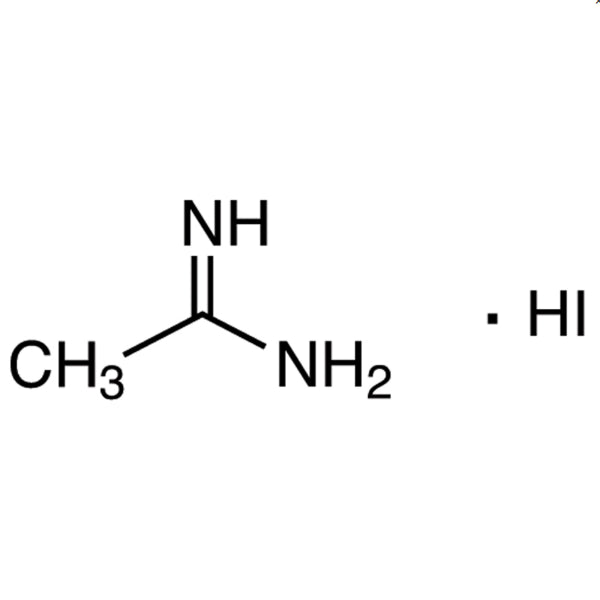
Acetamidine Hydroiodide (AHI) is a chemical compound widely utilized in scientific research, particularly in the field of electronic materials and energy. It plays a crucial role in the development of perovskite solar cells (PSCs), where it serves as a key component in the active layer structure. In laboratory settings, AHI is essential for the synthesis and characterization of materials with unique conductive and optical properties. Its application extends to various research areas where precise chemical composition control is required.
The chemical properties of AHI make it a preferred choice for researchers. It exhibits chemical stability under specific conditions, which is vital for maintaining the integrity of experimental results. However, it is highly sensitive to moisture and air exposure, necessitating careful handling and storage. The low water content in this product ensures greater accuracy in experiments, making it ideal for high-precision applications. Its reliability and consistency are critical for reproducible outcomes in scientific studies.
In Indonesian laboratories, AHI is commonly used in the development of perovskite solar cell technology. Research institutions and universities rely on this material to advance clean energy solutions. Its availability and compliance with international quality standards make it a favored choice among scientists working on sustainable energy projects. The material supports ongoing efforts to innovate in the field of renewable energy and electronic materials.
TCI brochures (PDF)
- Perovskite Precursor: Lead Acetate Anhydrous 2025-01-16 · p. 2
- Perovskite Precursor for Solar Cell Purified Lead(II) Iodide 2023-12-28 · p. 2
- High Purity Perovskite Precursor Purified Lead(II) Bromide 2024-04-04 · p. 2
- Perovskite Precursor Tin(II) Iodide Tin(II) Bromide 2024-01-09 · p. 2
- Organic-Inorganic Perovskite Precursors 2026-09-01 · p. 6
- Solar Cell Materials 2026-04-21 · p. 5
Related TCI products
- TCI M2589 6876-37-5 Methylamine Hydrobromide (Low water content)
- TCI M2556 14965-49-2 Methylamine Hydroiodide (Low water content)
- TCI I1006 101023-55-6 Imidazole Hydrobromide (Low water content)
- TCI I0970 68007-08-9 Imidazole Hydroiodide (Low water content)
- TCI F0974 879643-71-7 Formamidine Hydroiodide (Low water content)
- TCI F0973 146958-06-7 Formamidine Hydrobromide (Low water content)
- Perovskite Solar Cell Fabrication: AHI is used to create the active layer in PSCs, contributing to efficient light absorption and charge transport.
- Material Synthesis and Characterization: It is essential for synthesizing and analyzing materials with unique optical and conductive properties.
- Energy Research and Development: AHI supports the development of clean energy technologies, aiding in the exploration of sustainable alternatives.
- Chemical Precursor in Organic Electronics: It serves as a precursor in the production of organic electronic materials, enhancing device performance.
- Analytical Chemistry Studies: AHI is utilized in studies that require precise chemical composition control and stability under specific conditions.
| Brand | TCI |
|---|---|
| CAS number | 1452099-14-7 |
| Molecular formula | — |
| Purity | — |
| Category | Materials Science > Electronic Materials > Perovskite Solar Cell (PSC) Materials |
| Pack sizes | 1 g, 10 g, 100 g |
| Physical form | White crystalline powder |
| Storage | Store in a dry, sealed container away from moisture and air exposure |
Acetamidine Hydroiodide should be stored in a dry, sealed container to prevent moisture absorption and degradation. It is recommended to use airtight containers made of glass or high-density polyethylene to maintain its stability. Due to its sensitivity to humidity and air, it should be kept in a cool, dark environment with controlled temperature and low humidity levels. Regular monitoring of storage conditions is essential to ensure the material remains suitable for use. Laboratory personnel should handle AHI with care, using appropriate personal protective equipment to avoid direct contact. Proper storage and handling protocols are critical to maintaining the material’s integrity and ensuring safe laboratory practices.
—
Produk Terkait
-
MethylamineHydrobromide(Lowwatercontent) TCI M2589
Regular price From Rp 903.000,00Regular priceRp 631.050,00Sale price From Rp 903.000,00 -
MethylamineHydroiodide(Lowwatercontent) TCI M2556
Regular price From Rp 823.200,00Regular priceRp 575.400,00Sale price From Rp 823.200,00 -
ImidazoleHydrobromide(Lowwatercontent) TCI I1006
Regular price From Rp 1.351.350,00Regular priceRp 960.750,00Sale price From Rp 1.351.350,00 -
ImidazoleHydroiodide(Lowwatercontent) TCI I0970
Regular price From Rp 1.988.700,00Regular priceRp 1.405.950,00Sale price From Rp 1.988.700,00 -
FormamidineHydroiodide(Lowwatercontent) TCI F0974
Regular price From Rp 1.618.050,00Regular priceRp 1.146.600,00Sale price From Rp 1.618.050,00 -
FormamidineHydrobromide(Lowwatercontent) TCI F0973
Regular price From Rp 1.246.350,00Regular priceRp 887.250,00Sale price From Rp 1.246.350,00 -
1,3-DiaminopropaneDihydrochloride(Lowwatercontent) TCI D5253
Regular price From Rp 1.405.950,00Regular priceRp 982.800,00Sale price From Rp 1.405.950,00 -
AcetamidineHydrochloride TCI A0008
Regular price From Rp 610.050,00Regular priceRp 442.050,00Sale price From Rp 610.050,00


