

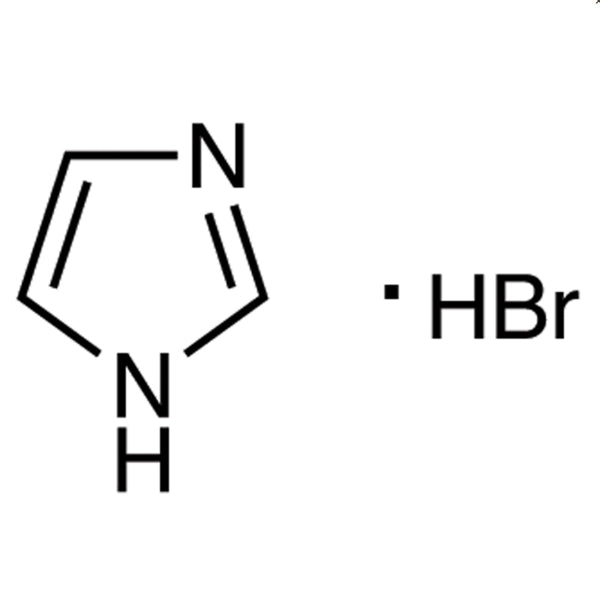
Imidazole Hydrobromide (Low water content), with the CAS number 101023-55-6, is a chemical compound widely used in materials science research, particularly in the development of perovskite solar cells (PSCs). This compound plays a crucial role in the synthesis of active layers that are essential for converting light into electrical energy. Its presence ensures the formation of stable and efficient structures, which are vital for the performance of PSCs. In laboratory settings, it is a key component in the fabrication of high-quality photovoltaic materials.
One of the main reasons Imidazole Hydrobromide is preferred is its chemical stability and resistance to unwanted reactions. Its low water content makes it ideal for applications requiring high purity and chemical integrity. Additionally, it dissolves easily in organic solvents, facilitating the synthesis and processing of materials. These properties make it a reliable choice for researchers aiming to produce consistent and high-performance materials.
In Indonesian laboratories, Imidazole Hydrobromide is commonly used in the research and development of perovskite solar cell technology. Local researchers rely on this compound to create materials with optimal performance, supporting innovation in renewable energy and advanced material technologies. Its use is integral to achieving efficient and stable photovoltaic systems, contributing to the growth of sustainable energy solutions.
TCI brochures (PDF)
- Solar Cell Materials 2026-04-21 · p. 7
Related TCI products
- TCI A2902 1452099-14-7 Acetamidine Hydroiodide (Low water content)
- TCI M2589 6876-37-5 Methylamine Hydrobromide (Low water content)
- TCI M2556 14965-49-2 Methylamine Hydroiodide (Low water content)
- TCI I0970 68007-08-9 Imidazole Hydroiodide (Low water content)
- TCI F0974 879643-71-7 Formamidine Hydroiodide (Low water content)
- TCI F0973 146958-06-7 Formamidine Hydrobromide (Low water content)
- Perovskite Solar Cell Synthesis: This material is essential for creating the active layers in PSCs, which are critical for efficient light absorption and charge transport.
- High-Purity Material Preparation: Its low water content ensures that the synthesized materials maintain high purity, which is necessary for reliable experimental results.
- Organic Solvent Compatibility: The compound's solubility in organic solvents simplifies the process of material synthesis and processing in the lab.
- Stability Testing of Photovoltaic Materials: Its chemical stability allows for consistent performance in long-term experiments and material testing.
- Research on Renewable Energy Technologies: It supports the development of sustainable energy solutions by enabling the production of high-efficiency solar cell materials.
| Brand | TCI |
|---|---|
| CAS number | 101023-55-6 |
| Molecular formula | — |
| Purity | — |
| Category | Materials Science > Electronic Materials > Perovskite Solar Cell (PSC) Materials |
| Pack sizes | Available in various quantities as per standard laboratory requirements |
| Physical form | Solid powder |
| Storage | Store in a cool, dry place away from moisture and direct sunlight |
Imidazole Hydrobromide should be stored in a cool, dry environment to prevent moisture absorption, which could affect its low water content. It is recommended to use airtight containers made of glass or polyethylene to maintain its chemical integrity. Due to its chemical stability, it does not require special handling under normal laboratory conditions. However, it is advisable to avoid exposure to strong acids or bases to prevent unwanted reactions. Always ensure proper ventilation when handling the compound to minimize any potential health risks. Regular monitoring of storage conditions will help maintain the material's quality and usability in research applications.
—
Produk Terkait
-
AcetamidineHydroiodide(Lowwatercontent) TCI A2902
Regular price From Rp 1.749.300,00Regular price -
MethylamineHydrobromide(Lowwatercontent) TCI M2589
Regular price From Rp 903.000,00Regular price -
MethylamineHydroiodide(Lowwatercontent) TCI M2556
Regular price From Rp 823.200,00Regular price -
ImidazoleHydroiodide(Lowwatercontent) TCI I0970
Regular price From Rp 1.936.200,00Regular price -
FormamidineHydroiodide(Lowwatercontent) TCI F0974
Regular price From Rp 1.565.550,00Regular price -
FormamidineHydrobromide(Lowwatercontent) TCI F0973
Regular price From Rp 1.193.850,00Regular price -
1,3-DiaminopropaneDihydrochloride(Lowwatercontent) TCI D5253
Regular price From Rp 1.405.950,00Regular price -
Lead(II)Bromide(Lowwatercontent)[forPerovskiteprecursor] TCI L0346
Regular price From Rp 1.115.100,00Regular price


![10031-22-8 Lead(II) Bromide (Low water content) [for Perovskite precursor] - AMI Scientific](http://amiscientific.com/cdn/shop/files/TCI2510L0346.jpg?v=1767121754&width=533)