

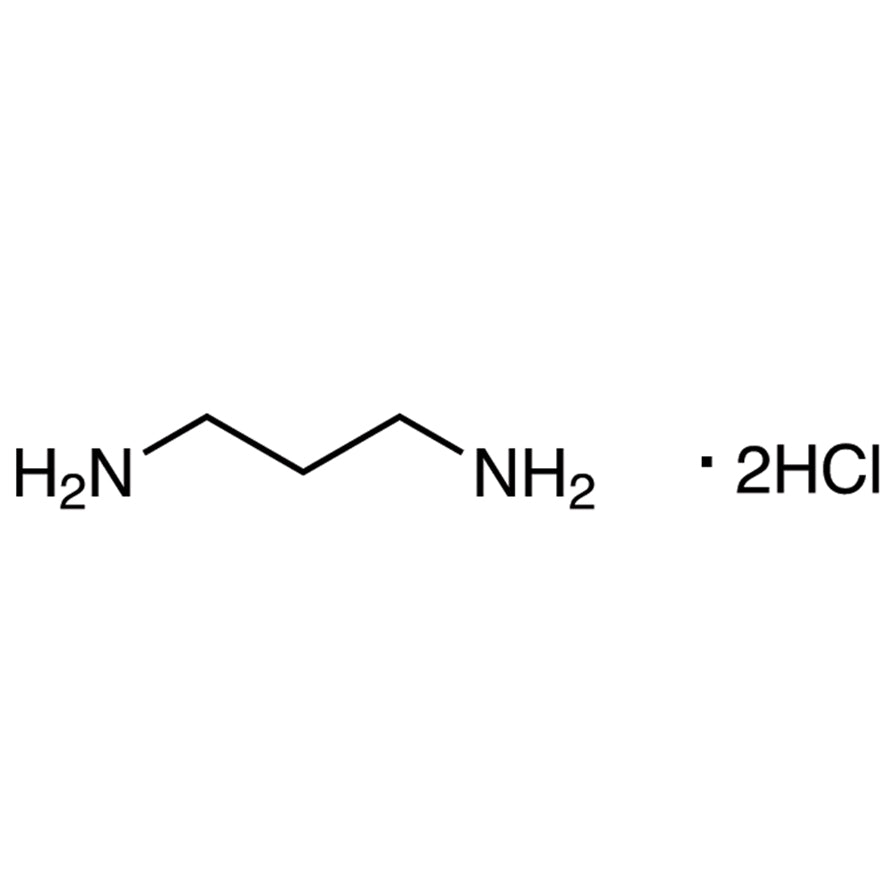
1,3-Diaminopropane Dihydrochloride is a chemical compound widely used in laboratory research, particularly in the field of electronic materials. This compound plays a crucial role in the development of perovskite solar cell (PSC) materials, where it contributes to the formation of active layers essential for efficient energy conversion. Its chemical structure enables it to act as a key component in the synthesis of materials with specific conductive and stability properties. Due to its unique characteristics, it is a preferred material for researchers working on advanced photovoltaic technologies.
The compound’s ability to bind positive ions (cations) within its molecular structure enhances its compatibility with other materials during synthesis processes. This property makes it highly suitable for applications requiring ion involvement in chemical reactions. Additionally, the presence of chloride in its molecular structure provides a level of stability that simplifies handling and processing in laboratory environments. These features make it an essential material for researchers in the field of electronic materials.
In Indonesian laboratories, 1,3-Diaminopropane Dihydrochloride is extensively used in electronic material research, especially in the development of perovskite solar cells. It is commonly found in academic and industrial research settings where the focus is on creating high-performance photovoltaic materials. Its reliability and effectiveness in laboratory applications have made it a standard choice for scientists and engineers working on next-generation solar technologies.
- Perovskite Solar Cell Fabrication: This compound is essential for creating the active layer in perovskite solar cells, enhancing light absorption and charge transport properties.
- Conductive Material Synthesis: Its ability to bind cations makes it ideal for synthesizing materials with controlled conductivity and stability.
- Ion-Exchange Processes: The presence of chloride ions allows it to participate in ion-exchange reactions, which are critical in material modification and functionalization.
- Electronic Device Prototyping: It is used in the development of prototype electronic devices where precise material properties are required.
- Material Stability Testing: Its stable molecular structure makes it suitable for testing the long-term stability of new electronic materials under various conditions.
| Brand | TCI |
|---|---|
| CAS number | 10517-44-9 |
| Molecular formula | — |
| Purity | — |
| Category | Materials Science > Electronic Materials > Perovskite Solar Cell (PSC) Materials |
| Pack sizes | Available in various quantities as per standard laboratory supply |
| Physical form | Solid powder |
| Storage | Store in a cool, dry place away from moisture and direct sunlight |
This compound should be stored in a cool, dry environment to maintain its chemical integrity and prevent degradation. It is recommended to use airtight containers to minimize exposure to moisture and air, which can affect its stability. Since it contains chloride, it should be handled with care to avoid contamination. In laboratory settings, it is important to ensure proper ventilation when working with this material to prevent inhalation of any airborne particles. Always use appropriate personal protective equipment, such as gloves and safety goggles, when handling or processing this compound. Proper storage and handling practices help ensure the material remains effective and safe for use in research applications.
—
Produk Terkait
-
AcetamidineHydroiodide(Lowwatercontent) TCI A2902
Regular price From Rp 1.749.300,00Regular price -
MethylamineHydrobromide(Lowwatercontent) TCI M2589
Regular price From Rp 903.000,00Regular price -
MethylamineHydroiodide(Lowwatercontent) TCI M2556
Regular price From Rp 823.200,00Regular price -
ImidazoleHydrobromide(Lowwatercontent) TCI I1006
Regular price From Rp 1.298.850,00Regular price -
ImidazoleHydroiodide(Lowwatercontent) TCI I0970
Regular price From Rp 1.936.200,00Regular price -
FormamidineHydroiodide(Lowwatercontent) TCI F0974
Regular price From Rp 1.565.550,00Regular price -
FormamidineHydrobromide(Lowwatercontent) TCI F0973
Regular price From Rp 1.193.850,00Regular price -
1,3-DiaminopropaneDihydroiodide TCI D5091
Regular price From Rp 1.565.550,00Regular price


