

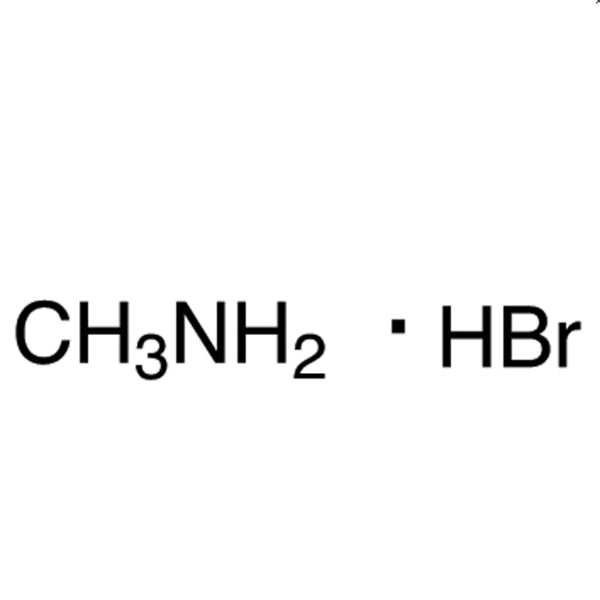
Methylamine Hydrobromide (MAB), with CAS number 6876-37-5, is a chemical compound widely used in scientific research, particularly in the field of electronic materials. It plays a crucial role in the development of perovskite solar cells (PSCs), which are among the most promising renewable energy technologies. In the laboratory, MAB serves as a key component in the synthesis of active layers for PSCs, contributing to the formation of optimal crystalline structures. Its chemical stability under specific conditions makes it a reliable material for precision-based experiments.
The chemical properties of Methylamine Hydrobromide, including its solubility in organic solvents and reactivity with both organic and inorganic compounds, make it a preferred choice for researchers. These characteristics allow for efficient processing and integration into various experimental workflows. The compound’s ability to act as a source of ammonia ions further enhances its utility in creating stable and functional perovskite materials. Its consistent performance and predictable behavior in laboratory settings ensure reliable results in material synthesis.
In Indonesian laboratories, Methylamine Hydrobromide is extensively used in electronic materials research, especially in the development of perovskite solar cells. It is a critical reagent for scientists working on renewable energy solutions, contributing to the advancement of sustainable technologies. Its availability and reliability make it an essential component in the growing field of photovoltaic research in Indonesia.
TCI brochures (PDF)
- SAM Formation Reagent with Face-on Orientation to Substrate Surface 3PATAT-C3 2025-12-16 · p. 1
- SAM Formation Reagent with Three Carboxylic Acid Moieties as Anchors 3CATAT-C3 2025-10-31 · p. 1
- Perovskite Precursor: Lead Acetate Anhydrous 2025-01-16 · p. 2
- Perovskite Precursor for Solar Cell Purified Lead(II) Iodide 2023-12-28 · p. 2
- High Purity Perovskite Precursor Purified Lead(II) Bromide 2024-04-04 · p. 2
- Perovskite Precursor Tin(II) Iodide Tin(II) Bromide 2024-01-09 · p. 2
Related TCI products
- TCI A2902 1452099-14-7 Acetamidine Hydroiodide (Low water content)
- TCI M2556 14965-49-2 Methylamine Hydroiodide (Low water content)
- TCI I1006 101023-55-6 Imidazole Hydrobromide (Low water content)
- TCI I0970 68007-08-9 Imidazole Hydroiodide (Low water content)
- TCI F0974 879643-71-7 Formamidine Hydroiodide (Low water content)
- TCI F0973 146958-06-7 Formamidine Hydrobromide (Low water content)
- Perovskite Solar Cell Fabrication: Methylamine Hydrobromide is essential in the synthesis of perovskite layers, contributing to the formation of stable and efficient photovoltaic structures.
- Electronic Material Synthesis: It serves as a key reagent in the preparation of various electronic materials, supporting the development of advanced semiconductor compounds.
- Organic-Inorganic Hybrid Material Research: Its reactivity with both organic and inorganic compounds makes it suitable for studying hybrid material systems.
- Crystallization Process Optimization: Methylamine Hydrobromide aids in the formation of high-quality crystalline structures, crucial for material performance and stability.
- Renewable Energy Technology Development: It plays a vital role in the research and development of next-generation solar cell technologies.
| Brand | TCI |
|---|---|
| CAS number | 6876-37-5 |
| Molecular formula | — |
| Purity | — |
| Category | Materials Science > Electronic Materials > Perovskite Solar Cell (PSC) Materials |
| Pack sizes | Available in various quantities as per standard laboratory requirements |
| Physical form | Solid powder |
| Storage | Store in a cool, dry place away from moisture and direct sunlight |
Methylamine Hydrobromide should be stored in a cool, dry environment to maintain its chemical stability. It is recommended to use airtight containers to prevent moisture absorption, which can affect its performance. Due to its chemical nature, it should be handled in a well-ventilated area to avoid inhalation of vapors. Laboratory personnel should wear appropriate personal protective equipment, such as gloves and safety goggles, when working with this compound. It is important to keep the material away from incompatible substances to ensure safe storage and usage. Proper labeling of containers is essential for safe handling and to prevent accidental exposure.
—
Produk Terkait
-
AcetamidineHydroiodide(Lowwatercontent) TCI A2902
Regular price From Rp 1.801.800,00Regular priceRp 1.275.750,00Sale price From Rp 1.801.800,00 -
MethylamineHydroiodide(Lowwatercontent) TCI M2556
Regular price From Rp 823.200,00Regular priceRp 575.400,00Sale price From Rp 823.200,00 -
ImidazoleHydrobromide(Lowwatercontent) TCI I1006
Regular price From Rp 1.351.350,00Regular priceRp 960.750,00Sale price From Rp 1.351.350,00 -
ImidazoleHydroiodide(Lowwatercontent) TCI I0970
Regular price From Rp 1.988.700,00Regular priceRp 1.405.950,00Sale price From Rp 1.988.700,00 -
FormamidineHydroiodide(Lowwatercontent) TCI F0974
Regular price From Rp 1.618.050,00Regular priceRp 1.146.600,00Sale price From Rp 1.618.050,00 -
FormamidineHydrobromide(Lowwatercontent) TCI F0973
Regular price From Rp 1.246.350,00Regular priceRp 887.250,00Sale price From Rp 1.246.350,00 -
1,3-DiaminopropaneDihydrochloride(Lowwatercontent) TCI D5253
Regular price From Rp 1.405.950,00Regular priceRp 982.800,00Sale price From Rp 1.405.950,00 -
MethylamineCyanate TCI M3134
Regular price From Rp 1.510.950,00Regular priceRp 1.056.300,00Sale price From Rp 1.510.950,00


