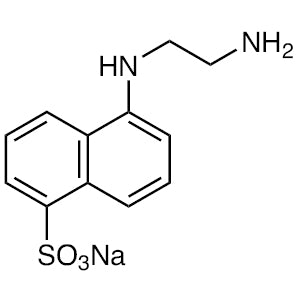
Ammonium 8-Anilino-1-naphthalenesulfonate (ANS-NH4) is a hydrophobic fluorescent probe widely used in biochemical and biomedical research. This compound serves as a fluorescent indicator for detecting conformational changes in proteins or molecular interactions within solution. Its ability to bind specifically to proteins enables visual detection or quantitative analysis using a spectrophotometer. ANS-NH4 is particularly valuable for applications requiring high sensitivity and resolution, making it a key tool in fluorescence-based experiments.
The unique properties of ANS-NH4 make it a preferred choice for researchers. It exhibits strong fluorescence when exposed to UV light, which is essential for fluorescence microscopy and spectroscopy. Its hydrophobic nature allows it to interact effectively with hydrophobic regions of proteins, enhancing its utility in studying protein structure and dynamics. Additionally, ANS-NH4 is stable under certain conditions and resists degradation, ensuring consistent performance in experimental settings. These characteristics contribute to its reliability and reproducibility in laboratory applications.
In Indonesian laboratories, ANS-NH4 is commonly used in biochemical studies, especially in research involving proteins and molecular interactions. It is a popular choice for diagnostic and analytical fluorescence applications, supporting both fundamental and applied research. Its availability in the local market ensures that researchers can easily access this essential reagent for their experiments.
- Fluorescence Microscopy: ANS-NH4 is ideal for visualizing protein conformational changes, providing clear fluorescent signals under UV excitation.
- Protein Binding Studies: Its specific binding to hydrophobic regions allows researchers to analyze protein-ligand interactions with high sensitivity.
- Spectroscopic Analysis: The compound's strong fluorescence makes it suitable for quantitative analysis using spectrophotometric techniques.
- Molecular Interaction Research: ANS-NH4 helps detect and study molecular interactions in solution, offering insights into biomolecular behavior.
- Diagnostic Applications: Its fluorescence properties support diagnostic tools requiring high sensitivity and resolution in analytical settings.
| Brand | TCI |
|---|---|
| CAS number | 28836-03-5 |
| Molecular formula | — |
| Purity | — |
| Category | Life Science > Biochemicals and Reagents > Fluorescent Probes, Fluorescent Labels, Fluorescent Stains |
| Pack sizes | — |
| Physical form | Solid (powder) |
| Storage | Store at room temperature, away from light and moisture |
ANS-NH4 should be stored at room temperature in a dry, cool place, away from direct sunlight and sources of moisture. It is recommended to use airtight containers to prevent exposure to humidity, which could affect its stability. Due to its fluorescent properties, it is advisable to handle the compound in a well-ventilated area to minimize any potential exposure. Always wear appropriate personal protective equipment, such as gloves and safety goggles, when working with this material. Proper storage ensures the compound remains effective for its intended applications in laboratory research.
—
Produk Terkait
-
Sodium5-(2-Aminoethylamino)-1-naphthalenesulfonate TCI S0891
Regular price Rp 2.041.200,00Regular priceRp 1.442.700,00Sale price Rp 2.041.200,00 -
8-Anilino-1-naphthalenesulfonicAcidMagnesium(II)Salt TCI A0484
Regular price Rp 2.889.600,00Regular priceRp 2.020.200,00Sale price Rp 2.889.600,00 -
RhodamineBHydrazide TCI R0260
Regular price From Rp 3.100.650,00Regular priceRp 2.168.250,00Sale price From Rp 3.100.650,00 -
Fluorescein TCI F0095
Regular price Rp 875.700,00Regular priceRp 612.150,00Sale price Rp 875.700,00