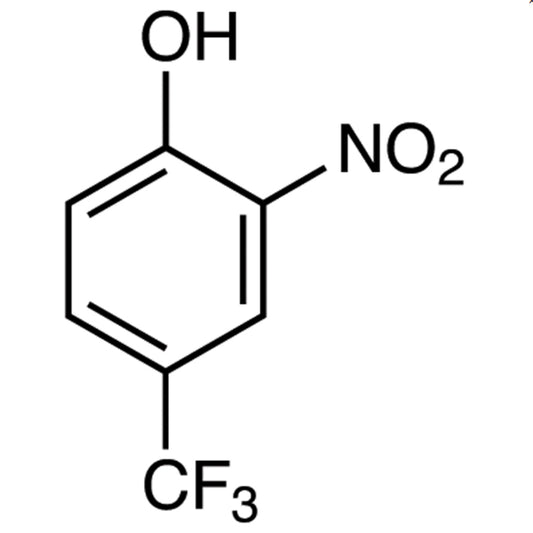
1-Nitro-3,5-bis(trifluoromethyl)benzene is a chemical compound widely used in organic synthesis as a building block for complex molecule development. This compound plays a crucial role in laboratory settings, particularly in the creation of pharmaceuticals, industrial chemicals, and bioactive compounds. Its unique molecular structure, featuring a nitro group and two trifluoromethyl groups, contributes to its reactivity and stability, making it a versatile reagent in synthetic pathways. Due to its chemical properties, it is often selected for its ability to participate in various substitution reactions, offering researchers a reliable tool for functional group modification.
The compound's trifluoromethyl groups provide exceptional chemical stability and reactivity, which are essential for controlled synthetic processes. These groups also enhance the compound's compatibility with a range of reaction conditions, allowing for greater flexibility in experimental design. The presence of the nitro group further adds to its utility, as it can be selectively reduced or modified to yield a variety of derivatives. These characteristics make it a preferred choice for chemists working on complex molecular architectures and functional group transformations.
In Indonesian laboratories, this compound is extensively used in both academic and applied research settings. It is a key component in the development of new drugs, materials, and bioactive substances. Its availability and consistent quality make it a trusted resource for researchers aiming to achieve precise and reproducible results in their experiments.
Related TCI products
- TCI T2155 713-65-5 1-Nitro-4-(trifluoromethoxy)benzene
- TCI B2546 320-88-7 1-Nitro-2,5-bis(trifluoromethyl)benzene
- TCI N0884 2995-45-1 1-Nitro-3-(trifluoromethoxy)benzene
- TCI N1068 320-47-8 4-Nitro-2-(trifluoromethyl)benzonitrile
- TCI N1037 320-37-6 4-Nitro-2-(trifluoromethyl)benzoic Acid
- TCI N0779 400-99-7 2-Nitro-4-(trifluoromethyl)phenol
- Pharmaceutical synthesis for the development of new drug compounds due to its reactivity and structural versatility.
- Organic chemistry research for the creation of complex molecules with controlled functional groups.
- Industrial chemical production as a building block for specialty chemicals and intermediates.
- Bioactive compound development for applications in pharmacology and biotechnology.
- Academic teaching and experimental studies in advanced organic chemistry courses.
| Brand | TCI |
|---|---|
| CAS number | 328-75-6 |
| Molecular formula | — |
| Purity | — |
| Category | Chemistry > Building Blocks > Fluorinated Building Blocks |
| Pack sizes | Available in various quantities as per standard laboratory supply |
| Physical form | Solid, crystalline appearance |
| Storage | Store in a cool, dry place away from light and moisture |
This compound should be stored in a cool, dry environment, away from direct sunlight and moisture. It is recommended to use airtight containers made of glass or high-density polyethylene to prevent contamination and degradation. Due to its chemical stability, it does not require refrigeration under normal conditions. In laboratory settings, it is important to handle the compound with appropriate personal protective equipment, such as gloves and safety goggles, to ensure safe handling. Avoid exposure to heat or open flames, as it may react under extreme conditions. Proper ventilation should be maintained when working with this material to minimize inhalation risks.
—
Produk Terkait
-
1-Nitro-4-(trifluoromethoxy)benzene TCI T2155
Regular price From Rp 769.650,00Regular priceRp 537.600,00Sale price From Rp 769.650,00 -
1-Nitro-2,5-bis(trifluoromethyl)benzene TCI B2546
Regular price From Rp 584.850,00Regular priceRp 408.450,00Sale price From Rp 584.850,00 -
1-Nitro-3-(trifluoromethoxy)benzene TCI N0884
Regular price From Rp 1.326.150,00Regular priceRp 927.150,00Sale price From Rp 1.326.150,00 -
4-Nitro-2-(trifluoromethyl)benzonitrile TCI N1068
Regular price Rp 1.113.000,00Regular priceRp 793.800,00Sale price Rp 1.113.000,00 -
4-Nitro-2-(trifluoromethyl)benzoicAcid TCI N1037
Regular price Rp 875.700,00Regular priceRp 627.900,00Sale price Rp 875.700,00 -
2-Nitro-4-(trifluoromethyl)phenol TCI N0779
Regular price From Rp 743.400,00Regular priceRp 519.750,00Sale price From Rp 743.400,00 -
2-Nitro-4-(trifluoromethyl)benzoicAcid TCI N0720
Regular price From Rp 1.087.800,00Regular priceRp 775.950,00Sale price From Rp 1.087.800,00 -
4'-Nitro-3'-(trifluoromethyl)acetanilide TCI N0548
Regular price From Rp 1.643.250,00Regular priceRp 1.164.450,00Sale price From Rp 1.643.250,00