

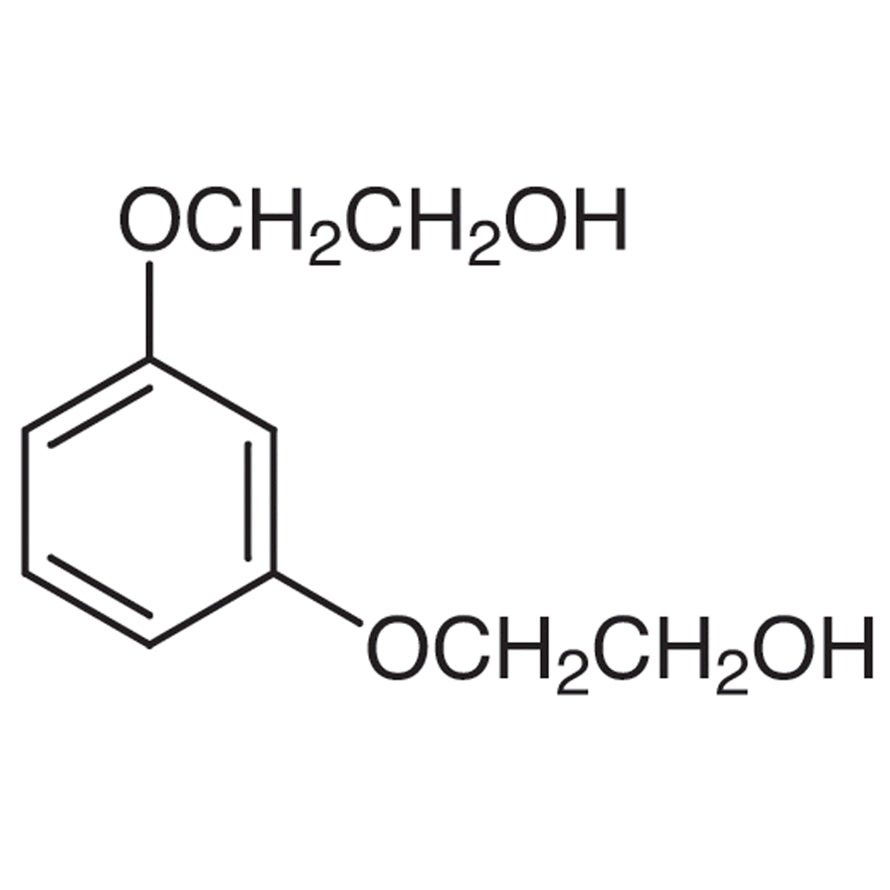
1,3-Bis(2-hydroxyethoxy)benzene is a chemical compound widely used in laboratory settings for its versatility in chemical reactions and molecular synthesis. As a building block in organic chemistry, it serves as a foundational material for creating more complex compounds. This compound is particularly valuable in research environments where the development of new materials and pharmaceuticals is essential. Its unique structure, featuring two hydroxyethoxy groups attached to a benzene ring, makes it a key player in various synthetic pathways.
The compound’s high polarity and controlled reactivity make it a preferred choice for chemists. It exhibits good solubility in organic solvents such as ethyl acetate and dimethyl sulfoxide, which simplifies its use in synthesis processes. Its stability and neutral chemical properties allow it to be used under a wide range of experimental conditions. Additionally, its non-toxic and non-hazardous nature enhances safety in laboratory operations, making it a reliable material for both academic and industrial research.
In Indonesian laboratories, this compound is commonly used in chemical research, especially in higher education institutions and research organizations. It is integral to the development of new chemical products and is frequently employed in pharmaceutical and industrial chemistry applications. Its availability and ease of handling make it a standard component in many experimental setups across the country.
Related TCI products
- TCI D1065 104-38-1 1,4-Bis(2-hydroxyethoxy)benzene
- TCI B0979 1606-85-5 1,4-Bis(2-hydroxyethoxy)-2-butyne
- TCI H0859 22042-73-5 4-(2-Hydroxyethoxy)benzaldehyde
- TCI H0858 60345-97-3 3-(2-Hydroxyethoxy)benzaldehyde
- TCI H0857 22042-72-4 2-(2-Hydroxyethoxy)benzaldehyde
- TCI H0820 3204-73-7 Methyl 4-(2-Hydroxyethoxy)benzoate
- Organic synthesis: This compound is ideal for organic synthesis due to its reactivity and solubility in various solvents, enabling the creation of complex molecular structures.
- Pharmaceutical research: It is used in the development of new drugs and pharmaceutical compounds, as it can serve as a precursor in the synthesis of bioactive molecules.
- Industrial chemistry: Its application in industrial chemistry includes the production of polymers and specialty chemicals, where its stability and reactivity are advantageous.
- Material science: It is employed in material science for the development of new materials with specific functional properties.
- Educational laboratories: It is commonly used in academic settings for teaching and research, providing students with hands-on experience in chemical synthesis and analysis.
| Brand | TCI |
|---|---|
| CAS number | 102-40-9 |
| Molecular formula | — |
| Purity | — |
| Category | Chemistry > Building Blocks > Non-Heterocyclic Building Blocks |
| Pack sizes | Available in various pack sizes as per supplier specifications |
| Physical form | Liquid |
| Storage | Store in a cool, dry place away from direct sunlight |
This compound should be stored in a cool, dry location, away from direct sunlight and sources of heat. It is recommended to use suitable containers that are resistant to chemical reactions and capable of withstanding the compound’s properties. General laboratory precautions include ensuring proper ventilation when handling the material and wearing appropriate personal protective equipment. Due to its non-toxic and non-hazardous nature, it does not require special handling beyond standard laboratory safety practices. The compound is stable under normal storage conditions, making it easy to manage in a laboratory setting.
—
Produk Terkait
-
1,4-Bis(2-hydroxyethoxy)benzene TCI D1065
Regular price From Rp 582.750,00Regular priceRp 423.150,00Sale price From Rp 582.750,00 -
1,4-Bis(2-hydroxyethoxy)-2-butyne TCI B0979
Regular price Rp 2.173.500,00Regular priceRp 1.535.100,00Sale price Rp 2.173.500,00 -
4-(2-Hydroxyethoxy)benzaldehyde TCI H0859
Regular price From Rp 1.060.500,00Regular priceRp 741.300,00Sale price From Rp 1.060.500,00 -
3-(2-Hydroxyethoxy)benzaldehyde TCI H0858
Regular price From Rp 1.298.850,00Regular priceRp 908.250,00Sale price From Rp 1.298.850,00 -
2-(2-Hydroxyethoxy)benzaldehyde TCI H0857
Regular price From Rp 1.405.950,00Regular priceRp 982.800,00Sale price From Rp 1.405.950,00 -
Methyl4-(2-Hydroxyethoxy)benzoate TCI H0820
Regular price From Rp 3.340.050,00Regular priceRp 2.350.950,00Sale price From Rp 3.340.050,00 -
4-(2-Hydroxyethoxy)salicylicAcid TCI H0730
Regular price Rp 6.306.300,00Regular priceRp 4.425.750,00Sale price Rp 6.306.300,00 -
9,9-Bis[4-(2-hydroxyethoxy)phenyl]fluorene TCI F0447
Regular price From Rp 848.400,00Regular priceRp 609.000,00Sale price From Rp 848.400,00


