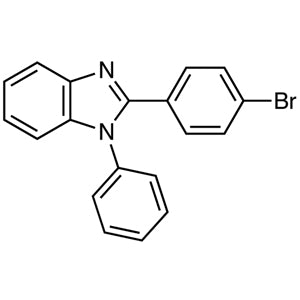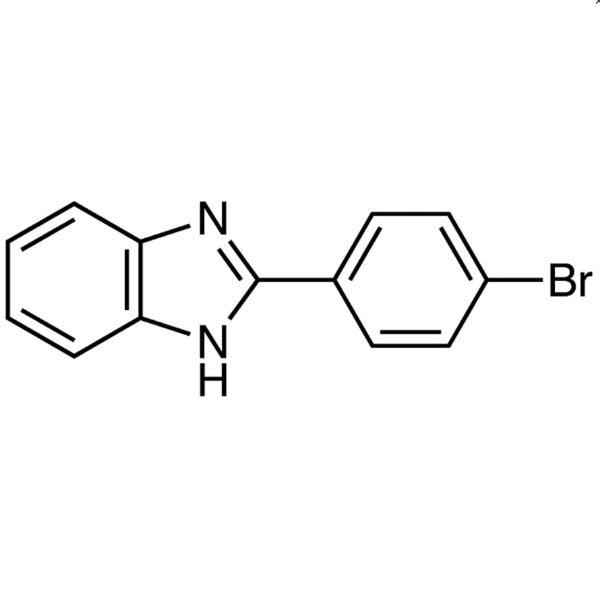
2-(4-Bromophenyl)benzimidazole is a chemical compound widely used in scientific research, particularly in the fields of organic chemistry and materials science. It serves as a crucial building block in the synthesis of metal complexes, acting as a ligand that facilitates the formation of functional metal complexes. This compound plays a vital role in the development of new materials with unique properties such as conductivity, optical response, and photochemical behavior. Its importance in the laboratory is underscored by its versatility and stability, making it a valuable tool for researchers seeking to explore advanced chemical interactions and material innovations.
The compound is preferred for its chemical stability and ability to form stable complexes with various metal ions. Its molecular structure allows for a wide range of reactivity and chemical interactions, enabling researchers to tailor its behavior for specific applications. Additionally, its solubility in organic solvents simplifies synthesis and manipulation processes in the laboratory. These properties make it an essential component in both academic and industrial research settings, where precise control over chemical reactions is required.
In Indonesian laboratories, 2-(4-Bromophenyl)benzimidazole is commonly used by researchers in chemistry and materials science. It is frequently employed in studies related to molecular structure, chemical properties, and the development of new technologies. Its availability in the local market supports ongoing research efforts and contributes to the advancement of scientific knowledge in the region.
TCI brochures (PDF)
- Ligands 2025-12-01 · p. 11
- Building Blocks for Organic Semiconductor 2026-03-24 · p. 17
Related TCI products
- TCI B6092 13275-42-8 2-(2-Bromophenyl)-1H-benzimidazole
- TCI A2759 7621-86-5 5-Amino-2-(4-aminophenyl)benzimidazole
- TCI P2263 952514-86-2 1-Phenyl-2-[3-(4,4,5,5-tetramethyl-1,3,2-dioxaborolan-2-yl)phenyl]-1H-benzimidazole
- TCI H1736 2963-66-8 2-(2-Hydroxyphenyl)-1H-benzimidazole
- TCI C2027 1019-85-8 2-(4-Chlorophenyl)benzimidazole
- TCI B5308 50907-23-8 5-(4-Bromophenyl)-1H-tetrazole
- Metal complex synthesis: This compound is ideal for creating functional metal complexes due to its ability to act as a ligand and form stable bonds with various metal ions.
- Organic synthesis: Its reactivity and solubility make it suitable for use in organic reactions where precise control over chemical interactions is necessary.
- Material development: Researchers use it to develop new materials with unique optical and conductive properties, enhancing the performance of advanced materials.
- Photochemical studies: The compound's response to light makes it valuable in experiments involving photochemical reactions and light-sensitive materials.
- Structural analysis: It is often used in studies that require detailed molecular structure analysis, supporting research in both academic and industrial settings.
| Brand | TCI |
|---|---|
| CAS number | 2622-74-4 |
| Molecular formula | — |
| Purity | — |
| Category | Materials Science > Material Building Blocks > Ligands for Functional Metal Complexes |
| Pack sizes | Available in various quantities as per standard laboratory requirements |
| Physical form | Solid |
| Storage | Store in a cool, dry place away from light |
This compound should be stored in a cool, dry place, away from direct light and sources of heat. It is recommended to use airtight containers made of glass or polyethylene to prevent contamination and maintain its chemical integrity. Due to its chemical nature, it should be handled with appropriate personal protective equipment, such as gloves and safety goggles, to ensure laboratory safety. Avoid exposure to moisture and incompatible substances to maintain its stability and effectiveness. Regular monitoring of storage conditions is advised to ensure optimal preservation and usability in research applications.
—
Produk Terkait
-
2-(2-Bromophenyl)-1H-benzimidazole TCI B6092
Regular price From Rp 1.008.000,00Regular priceRp 720.300,00Sale price From Rp 1.008.000,00 -
5-Amino-2-(4-aminophenyl)benzimidazole TCI A2759
Regular price From Rp 2.147.250,00Regular priceRp 1.517.250,00Sale price From Rp 2.147.250,00 -
1-Phenyl-2-[3-(4,4,5,5-tetramethyl-1,3,2-dioxaborolan-2-yl)phenyl]-1H-benzimidazole TCI P2263
Regular price From Rp 2.650.200,00Regular priceRp 1.869.000,00Sale price From Rp 2.650.200,00 -
2-(2-Hydroxyphenyl)-1H-benzimidazole TCI H1736
Regular price From Rp 2.623.950,00Regular priceRp 1.850.100,00Sale price From Rp 2.623.950,00 -
2-(4-Chlorophenyl)benzimidazole TCI C2027
Regular price From Rp 3.153.150,00Regular priceRp 2.220.750,00Sale price From Rp 3.153.150,00 -
5-(4-Bromophenyl)-1H-tetrazole TCI B5308
Regular price From Rp 2.464.350,00Regular priceRp 1.738.800,00Sale price From Rp 2.464.350,00 -
2-(4-Bromophenyl)-1-phenylbenzimidazole TCI B4479
Regular price Rp 1.351.350,00Regular priceRp 960.750,00Sale price Rp 1.351.350,00 -
1-(4-Bromophenyl)imidazole TCI B4101
Regular price From Rp 2.464.350,00Regular priceRp 1.738.800,00Sale price From Rp 2.464.350,00