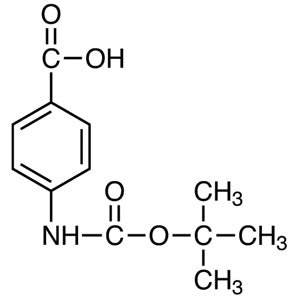
4-[(tert-Butoxycarbonylamino)methyl]benzoic Acid is a chemical compound widely used in laboratory settings for its versatility in organic and biochemical applications. This compound plays a crucial role in the synthesis of complex molecules, particularly in peptide chemistry and molecular biology. Its unique structure enables it to participate in a variety of chemical reactions, making it an essential reagent for researchers working on advanced chemical processes. Due to its functional groups, it is often employed as a building block in the development of bioactive compounds and diagnostic agents.
The compound’s key properties include its high reactivity and the presence of the tert-butoxycarbonyl (Boc) group, which provides stability during synthesis and facilitates deprotection in later stages. These characteristics make it a preferred choice for researchers requiring precise control over chemical reactions. The Boc group also enhances the compound’s utility in protecting amino groups during multi-step syntheses, ensuring the integrity of the final product. This stability and reactivity are critical in maintaining the efficiency and accuracy of laboratory procedures.
In Indonesian laboratories, this compound is commonly used in pharmacology, biochemical research, and material science. Its relevance extends to the development of new compounds and the modification of existing ones to enhance their biological activity. Researchers in these fields rely on its predictable behavior and compatibility with various synthetic methods, making it a valuable tool in both academic and industrial research environments.
Related TCI products
- TCI B3898 66493-39-8 4-(tert-Butoxycarbonylamino)benzoic Acid
- TCI B3831 35264-09-6 1-(tert-Butoxycarbonylamino)cyclopentanecarboxylic Acid
- TCI B3539 222530-34-9 (1S,3R)-3-(tert-Butoxycarbonylamino)cyclohexanecarboxylic Acid
- TCI B3538 222530-39-4 (1R,3S)-3-(tert-Butoxycarbonylamino)cyclohexanecarboxylic Acid
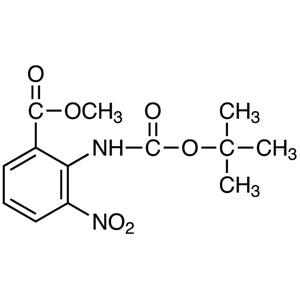
- TCI M2797 57113-90-3 Methyl 2-(tert-Butoxycarbonylamino)-3-nitrobenzoate
- TCI F0888 94744-50-0 2-[(9H-Fluoren-9-ylmethoxy)carbonylamino]isobutyric Acid
- Peptide Synthesis: This compound is ideal for peptide synthesis due to its Boc group, which protects amino functionalities during complex multi-step reactions.
- Bioactive Compound Development: Its reactivity and structural versatility make it suitable for creating compounds with enhanced biological activity.
- Molecular Biology Research: It is frequently used in molecular biology for the synthesis of biomolecules and the study of protein structures.
- Diagnostic Reagent Preparation: The compound’s chemical stability and reactivity support the development of diagnostic agents for medical testing.
- Organic Chemistry Studies: Its role in organic reactions makes it a key component in the exploration of new synthetic pathways and chemical transformations.
| Brand | TCI |
|---|---|
| CAS number | 33233-67-9 |
| Molecular formula | — |
| Purity | — |
| Category | Chemistry > Chemical Biology > Peptide Chemistry |
| Pack sizes | Available in various quantities as per supplier specifications |
| Physical form | Solid powder |
| Storage | Store in a cool, dry place away from moisture and direct sunlight |
This compound should be stored in a cool, dry environment to maintain its chemical stability. It is recommended to keep it in a tightly sealed container to prevent exposure to moisture and air. Due to its reactivity, it should be handled with care in a well-ventilated laboratory setting. Avoid contact with incompatible substances to ensure safety during use. Proper personal protective equipment, such as gloves and safety goggles, should be worn when handling the compound. Regular monitoring of storage conditions is essential to maintain the integrity of the material and ensure safe laboratory practices.
—
Product Categories
Produk Terkait
-
4-(tert-Butoxycarbonylamino)benzoicAcid TCI B3898
Regular price From Rp 1.167.600,00Regular priceRp 831.600,00Sale price From Rp 1.167.600,00 -
1-(tert-Butoxycarbonylamino)cyclopentanecarboxylicAcid TCI B3831
Regular price Rp 2.518.950,00Regular priceRp 1.776.600,00Sale price Rp 2.518.950,00 -
(1S,3R)-3-(tert-Butoxycarbonylamino)cyclohexanecarboxylicAcid TCI B3539
Regular price Rp 7.976.850,00Regular priceRp 5.593.350,00Sale price Rp 7.976.850,00 -
(1R,3S)-3-(tert-Butoxycarbonylamino)cyclohexanecarboxylicAcid TCI B3538
Regular price Rp 4.081.350,00Regular priceRp 2.869.650,00Sale price Rp 4.081.350,00 -
Methyl2-(tert-Butoxycarbonylamino)-3-nitrobenzoate TCI M2797
Regular price From Rp 2.544.150,00Regular priceRp 1.794.450,00Sale price From Rp 2.544.150,00 -
2-[(9H-Fluoren-9-ylmethoxy)carbonylamino]isobutyricAcid TCI F0888
Regular price Rp 1.749.300,00Regular priceRp 1.239.000,00Sale price Rp 1.749.300,00 -
4-[(2,4-Dimethoxyphenyl)[(9H-fluoren-9-ylmethoxy)carbonylamino]methyl]phenoxyaceticAcid TCI D2672
Regular price Rp 2.173.500,00Regular priceRp 1.535.100,00Sale price Rp 2.173.500,00