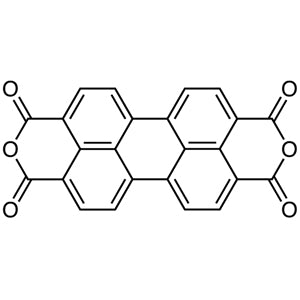
N,N'-Bis[2-(dimethylamino)ethyl]-1,8:4,5-naphthalenetetracarboxdiimide is an organic compound widely used in electronic material research, particularly in the development of organic field-effect transistor (OFET) devices. This material plays a crucial role in laboratory settings where researchers are working on flexible and lightweight electronic components. Its unique molecular structure enables efficient electron transport, making it a key component in the fabrication of active layers and semiconductor layers within OFETs. Due to its chemical stability and high conductivity, it is highly sought after in the field of electronic materials.
The compound's high electrical conductivity and chemical stability make it a preferred choice for various electronic applications. Its molecular structure, featuring two dimethylamino groups at both ends, provides excellent polarity, allowing for effective interactions with substrates and other layers. This property enhances its performance in electrochemical applications. Additionally, its ability to maintain consistent performance under different conditions makes it reliable for use in laboratory experiments and industrial-scale applications.
In Indonesian laboratories, this compound is commonly used in research related to organic electronic materials, especially in the development of OFETs for various applications. It is a fundamental material in the study of flexible electronics, optoelectronics, and other advanced electronic systems. Its versatility and performance make it a valuable resource for researchers aiming to innovate in the field of electronic materials.
TCI brochures (PDF)
- Organic Transistor (OFET) Materials 2026-05-07 · p. 11
Related TCI products
- TCI B5954 117901-97-0 N,N'-Bis[3-(dimethylamino)propyl]perylene-3,4,9,10-tetracarboxylic Diimide
- TCI P3289 1020180-01-1 2,9-Bis[3-[[3-(dimethylamino)propyl]amino]propyl]anthra[2,1,9-def:6,5,10-d'e'f']diisoquinoline-1,3,8,10(2H,9H)-tetraone
- TCI D4429 5521-31-3 N,N'-Dimethyl-3,4,9,10-perylenetetracarboxylic Diimide
- TCI D4175 78151-58-3 N,N'-Di-n-octyl-3,4,9,10-perylenetetracarboxylic Diimide
- TCI D3947 95689-92-2 N,N'-Ditridecyl-3,4,9,10-perylenetetracarboxylic Diimide
- TCI P2102 128-69-8 3,4,9,10-Perylenetetracarboxylic Dianhydride (purified by sublimation)
- Organic Field-Effect Transistor (OFET) Development: This compound is ideal for creating active layers in OFETs due to its high electrical conductivity and stable molecular structure.
- Flexible Electronic Component Fabrication: Its lightweight and flexible properties make it suitable for manufacturing components used in flexible electronics and wearable devices.
- Semiconductor Layer Research: The compound is used as a semiconductor layer in OFETs, contributing to efficient electron transport and device performance.
- Electrochemical Device Testing: Its chemical stability and conductivity make it a good candidate for testing electrochemical interactions in various experimental setups.
- Material Characterization Studies: It is frequently used in studies to analyze the properties of organic materials, including conductivity, stability, and molecular interactions.
| Brand | TCI |
|---|---|
| CAS number | 22291-04-9 |
| Molecular formula | — |
| Purity | — |
| Category | Materials Science > Electronic Materials > Organic Transistor (OFET) Materials |
| Pack sizes | Available in various quantities as per standard laboratory supply |
| Physical form | Solid powder |
| Storage | Store in a cool, dry place away from moisture and direct light |
This compound should be stored in a cool, dry environment, away from moisture and direct sunlight to maintain its chemical stability and conductivity. It is recommended to use airtight containers made of glass or high-density polyethylene to prevent contamination and degradation. Due to its organic nature, it is important to handle it with care, using appropriate personal protective equipment such as gloves and safety goggles. Avoid exposure to high temperatures and ensure proper ventilation in the laboratory to minimize any potential risks. Regular monitoring of storage conditions will help ensure the material remains effective for research applications.
—
Produk Terkait
-
N,N'-Bis[3-(dimethylamino)propyl]perylene-3,4,9,10-tetracarboxylicDiimide TCI B5954
Regular price From Rp 3.498.600,00Regular priceRp 2.462.250,00Sale price From Rp 3.498.600,00 -
2,9-Bis[3-[[3-(dimethylamino)propyl]amino]propyl]anthra[2,1,9-def:6,5,10-d'e'f']diisoquinoline-1,3,8,10(2H,9H)-tetraone TCI P3289
Regular price Rp 3.683.400,00Regular priceRp 2.591.400,00Sale price Rp 3.683.400,00 -
N,N'-Dimethyl-3,4,9,10-perylenetetracarboxylicDiimide TCI D4429
Regular price From Rp 2.544.150,00Regular priceRp 1.794.450,00Sale price From Rp 2.544.150,00 -
N,N'-Di-n-octyl-3,4,9,10-perylenetetracarboxylicDiimide TCI D4175
Regular price Rp 3.895.500,00Regular priceRp 2.739.450,00Sale price Rp 3.895.500,00 -
N,N'-Ditridecyl-3,4,9,10-perylenetetracarboxylicDiimide TCI D3947
Regular price From Rp 1.934.100,00Regular priceRp 1.368.150,00Sale price From Rp 1.934.100,00 -
3,4,9,10-PerylenetetracarboxylicDianhydride(purifiedbysublimation) TCI P2102
Regular price Rp 3.021.900,00Regular priceRp 2.112.600,00Sale price Rp 3.021.900,00 -
3,4,9,10-PerylenetetracarboxylicDianhydride TCI P0972
Regular price From Rp 1.485.750,00Regular priceRp 1.038.450,00Sale price From Rp 1.485.750,00 -
1,8:4,5-Naphthalenetetracarboxdiimide TCI N0536
Regular price From Rp 4.796.400,00Regular priceRp 3.369.450,00Sale price From Rp 4.796.400,00