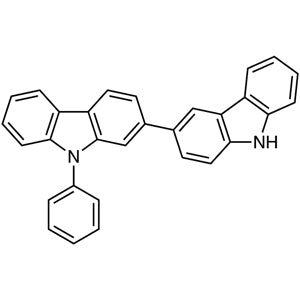
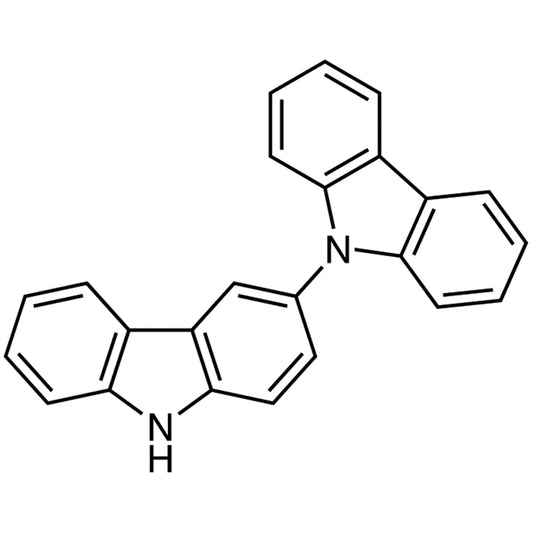
3,3'-Bicarbazole is a heterocyclic compound with a complex structure featuring two carbazole rings connected at the 3-position. This compound plays a crucial role in organic chemistry laboratories, particularly in the synthesis of advanced organic materials and functional molecules. Its unique structure allows it to serve as a fundamental building block for creating compounds with specific electronic or optical properties. As a versatile chemical intermediate, it is widely used in research and development projects that require precise molecular design and chemical functionality.
The chemical properties of 3,3'-Bicarbazole make it a preferred choice for synthetic chemists. It exhibits stability under normal conditions but remains highly reactive in specific chemical environments. This reactivity enables it to participate in various chemical reactions, including substitution, coupling, and modification processes. The presence of nitrogen atoms in its ring structure enhances its ability to form stable bonds with functional groups, making it ideal for the synthesis of complex organic molecules. Its chemical versatility supports a wide range of applications in both academic and industrial research settings.
In Indonesian laboratories, 3,3'-Bicarbazole is commonly used in organic chemistry research, particularly in the development of new materials and functional compounds. It is a key component in projects related to organic electronics, sensors, and electrolytic components. Its availability and chemical properties make it a valuable resource for scientists working on molecular design and advanced material synthesis. Its role in these fields highlights its importance in modern chemical research in Indonesia.
TCI brochures (PDF)
- Carbazoles 2025-06-27 · p. 3
- Building Blocks for Organic Semiconductor 2026-03-24 · p. 18
Related TCI products
- TCI P2640 1382955-10-3 9-Phenyl-9H,9'H-2,3'-bicarbazole
- TCI B4811 18628-07-4 3,9'-Bicarbazole
- TCI D5387 20466-00-6 9,9'-Diethyl-9H,9'H-3,3'-bicarbazole
- TCI D5303 57102-51-9 9,9'-Di([1,1'-biphenyl]-4-yl)-9H,9'H-3,3'-bicarbazole
- TCI D4980 354135-75-4 6,6'-Dibromo-9,9'-diphenyl-3,3'-bicarbazole
- TCI B6951 1454567-05-5 9-([1,1'-Biphenyl]-4-yl)-9'-phenyl-9H,9'H-3,3'-bicarbazole
- Organic synthesis applications benefit from 3,3'-Bicarbazole due to its ability to form stable bonds with functional groups and participate in complex molecular structures.
- Material science research utilizes this compound for developing organic materials with specific electronic and optical properties.
- Sensor development leverages its chemical reactivity and structural versatility to create sensitive and selective detection systems.
- Electrochemical studies incorporate 3,3'-Bicarbazole for designing electrolytic components with enhanced conductivity and stability.
- Molecular design projects rely on this compound for constructing complex organic molecules with tailored chemical functionalities.
| Brand | TCI |
|---|---|
| CAS number | 1984-49-2 |
| Molecular formula | — |
| Purity | — |
| Category | Chemistry > Building Blocks > Heterocyclic Building Blocks |
| Pack sizes | Available in standard laboratory quantities |
| Physical form | Solid |
| Storage | Store in a cool, dry place away from light and moisture |
3,3'-Bicarbazole should be stored in a cool, dry environment, away from direct light and moisture to maintain its chemical integrity. It is recommended to use airtight containers made of materials that are chemically inert, such as glass or high-density polyethylene, to prevent contamination and degradation. In laboratory settings, it is important to handle the compound with appropriate personal protective equipment, including gloves and safety goggles, to ensure safety during handling and experimentation. Proper ventilation should be maintained when working with this compound to minimize exposure to airborne particles. Regular monitoring of storage conditions is essential to ensure the compound remains stable and suitable for use in chemical synthesis and research applications.
—
Produk Terkait
-
9-Phenyl-9H,9'H-2,3'-bicarbazole TCI P2640
Regular price Rp 3.843.000,00Regular priceRp 2.702.700,00Sale price Rp 3.843.000,00 -
3,9'-Bicarbazole TCI B4811
Regular price From Rp 3.578.400,00Regular priceRp 2.517.900,00Sale price From Rp 3.578.400,00 -
9,9'-Diethyl-9H,9'H-3,3'-bicarbazole TCI D5387
Regular price Rp 2.969.400,00Regular priceRp 2.091.600,00Sale price Rp 2.969.400,00 -
9,9'-Di([1,1'-biphenyl]-4-yl)-9H,9'H-3,3'-bicarbazole TCI D5303
Regular price Rp 2.306.850,00Regular priceRp 1.628.550,00Sale price Rp 2.306.850,00 -
6,6'-Dibromo-9,9'-diphenyl-3,3'-bicarbazole TCI D4980
Regular price From Rp 2.093.700,00Regular priceRp 1.479.450,00Sale price From Rp 2.093.700,00 -
9-([1,1'-Biphenyl]-4-yl)-9'-phenyl-9H,9'H-3,3'-bicarbazole TCI B6951
Regular price Rp 2.173.500,00Regular priceRp 1.535.100,00Sale price Rp 2.173.500,00 -
9-([1,1'-Biphenyl]-3-yl)-9'-([1,1'-biphenyl]-4-yl)-9H,9'H-3,3'-bicarbazole TCI B6625
Regular price Rp 3.870.300,00Regular priceRp 2.721.600,00Sale price Rp 3.870.300,00 -
1,3,6,8-Tetramethyl-9H-carbazole TCI T3882
Regular price From Rp 4.108.650,00Regular priceRp 2.888.550,00Sale price From Rp 4.108.650,00