


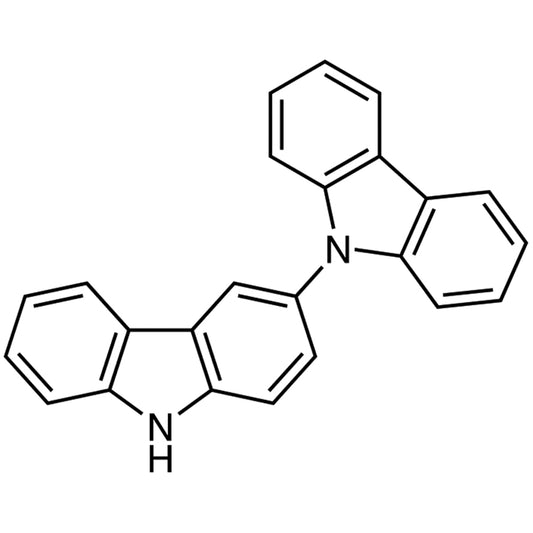
9-Phenyl-9H,9'H-2,3'-bicarbazole is a chemical compound classified under the heterocyclic category, commonly used in organic chemistry research as a building block for the synthesis of complex molecules. This compound plays a crucial role in laboratories where the development of new chemical structures is essential. Its unique molecular structure, consisting of two connected carbazole rings, makes it a versatile tool for creating compounds with specific functional properties. Due to its stability and controlled reactivity, it is widely utilized in various scientific applications.
The compound is preferred for its chemical stability and predictable reactivity, which allow for consistent results in synthetic processes. Its molecular structure provides the necessary framework for the creation of compounds with pharmaceutical or electronic applications. Researchers appreciate its ability to participate in a range of chemical reactions, making it a reliable choice for both academic and industrial research. Its chemical properties ensure that it can be manipulated and stored under standard laboratory conditions without significant degradation.
In Indonesian laboratories, this compound is frequently used in organic chemistry and material science research. Local researchers rely on it for the development of new compounds with potential applications in medicine, electronics, and environmental science. Its availability and reliability make it an essential component in the toolkit of many scientists working in these fields.
TCI brochures (PDF)
- Building Blocks for Organic Semiconductor 2026-03-24 · p. 22
Related TCI products
- TCI B4646 1984-49-2 3,3'-Bicarbazole
- TCI B4811 18628-07-4 3,9'-Bicarbazole
- TCI D5387 20466-00-6 9,9'-Diethyl-9H,9'H-3,3'-bicarbazole
- TCI D5303 57102-51-9 9,9'-Di([1,1'-biphenyl]-4-yl)-9H,9'H-3,3'-bicarbazole
- TCI D4980 354135-75-4 6,6'-Dibromo-9,9'-diphenyl-3,3'-bicarbazole
- TCI B6951 1454567-05-5 9-([1,1'-Biphenyl]-4-yl)-9'-phenyl-9H,9'H-3,3'-bicarbazole
- Organic synthesis applications benefit from this compound's stable structure, allowing for the creation of complex molecules with specific functional groups.
- Material science research utilizes its unique molecular framework to develop new electronic or optoelectronic materials with tailored properties.
- Pharmaceutical research leverages its chemical versatility to synthesize compounds with potential therapeutic applications in drug development.
- Analytical chemistry uses it as a reference standard for the identification and quantification of similar heterocyclic compounds.
- Environmental studies incorporate it in the development of compounds for pollution monitoring or remediation processes.
| Brand | TCI |
|---|---|
| CAS number | 1382955-10-3 |
| Molecular formula | — |
| Purity | — |
| Category | Chemistry > Building Blocks > Heterocyclic Building Blocks |
| Pack sizes | Available in various quantities as per supplier specifications |
| Physical form | Solid, crystalline |
| Storage | Store in a cool, dry place away from light and moisture |
This compound should be stored in a cool, dry environment, away from direct light and moisture to maintain its chemical stability. It is recommended to use airtight containers made of glass or high-density polyethylene to prevent contamination and degradation. Due to its chemical nature, it should be handled with appropriate personal protective equipment, including gloves and safety goggles, to ensure laboratory safety. The compound is non-hazardous under normal conditions but should be kept out of reach of children and not exposed to incompatible substances. Regular monitoring of storage conditions is advised to ensure the integrity of the material over time.
—
Produk Terkait
-
3,3'-Bicarbazole TCI B4646
Regular price From Rp 2.094.750,00Regular price -
3,9'-Bicarbazole TCI B4811
Regular price From Rp 3.525.900,00Regular price -
9,9'-Diethyl-9H,9'H-3,3'-bicarbazole TCI D5387
Regular price Rp 2.916.900,00Regular price -
9,9'-Di([1,1'-biphenyl]-4-yl)-9H,9'H-3,3'-bicarbazole TCI D5303
Regular price Rp 2.254.350,00Regular price -
6,6'-Dibromo-9,9'-diphenyl-3,3'-bicarbazole TCI D4980
Regular price From Rp 2.041.200,00Regular price -
9-([1,1'-Biphenyl]-4-yl)-9'-phenyl-9H,9'H-3,3'-bicarbazole TCI B6951
Regular price Rp 2.121.000,00Regular price -
9-([1,1'-Biphenyl]-3-yl)-9'-([1,1'-biphenyl]-4-yl)-9H,9'H-3,3'-bicarbazole TCI B6625
Regular price Rp 3.817.800,00Regular price -
1,3,6,8-Tetramethyl-9H-carbazole TCI T3882
Regular price From Rp 4.056.150,00Regular price



![9,9'-Di([1,1'-biphenyl]-4-yl)-9H,9'H-3,3'-bicarbazole (CAS 57102-51-9) - TCI D5303 - AMI Scientific](http://amiscientific.com/cdn/shop/files/TCI2510D5303.jpg?v=1768818376&width=533)

![9-([1,1'-Biphenyl]-4-yl)-9'-phenyl-9H,9'H-3,3'-bicarbazole (CAS 1454567-05-5) - TCI B6951 - AMI Scientific](http://amiscientific.com/cdn/shop/files/TCI2510B6951.jpg?v=1769144603&width=533)
![9-([1,1'-Biphenyl]-3-yl)-9'-([1,1'-biphenyl]-4-yl)-9H,9'H-3,3'-bicarbazole (CAS 1643479-47-3) - TCI B6625 - AMI Scientific](http://amiscientific.com/cdn/shop/files/TCI2510B6625.jpg?v=1768816083&width=533)
