


TCI D5387 9,9'-Diethyl-9H,9'H-3,3'-bicarbazole is an aromatic compound built from two carbazole cores joined directly through a single bond at the 3 and 3' positions, with an ethyl group already installed on each nitrogen atom. In the laboratory it belongs to the class of electronic materials used for organic light-emitting diode devices. Its role goes beyond that of a synthetic starting material: it is also a functional material whose electronic properties are directly relevant to the assembly of device layers, so it is frequently evaluated as supplied after further purification steps such as sublimation.
The characteristics that lead researchers to select this compound are its electron-rich, conjugated bicarbazole system and its comparatively shallow highest occupied molecular orbital energy level. The 3,3' linkage extends conjugation between the two carbazole cores, so the electron-donating ability increases relative to a single carbazole unit — a property that is useful for positive charge transport. The ethyl groups on both nitrogen atoms deliver two benefits at once: they cap the reactive N–H positions so the compound is more stable, and they improve solubility in organic solvents without excessively disturbing the density of the conjugated system.
In Indonesian laboratories this material is typically handled in university and institutional research groups working on organic electronics, thin-film optoelectronics, and synthetic organic chemistry. It is commonly received as a research-scale quantity, logged into the chemical inventory, and drawn upon for small-batch film preparation or as a building block in multi-step syntheses. Because the work often involves device fabrication and optical measurement, the compound is usually reserved for use under controlled conditions with careful attention to residual impurities.
TCI brochures (PDF)
- Organic Light-Emitting Diode (OLED) Materials 2026-08-18 · p. 7
- Building Blocks for Organic Semiconductor 2026-03-24 · p. 21
Related TCI products
- TCI D5303 57102-51-9 9,9'-Di([1,1'-biphenyl]-4-yl)-9H,9'H-3,3'-bicarbazole
- TCI B6951 1454567-05-5 9-([1,1'-Biphenyl]-4-yl)-9'-phenyl-9H,9'H-3,3'-bicarbazole
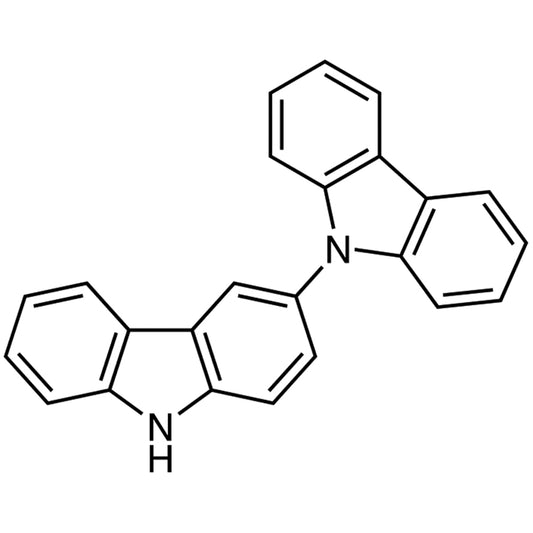
- TCI B4811 18628-07-4 3,9'-Bicarbazole
- TCI B4646 1984-49-2 3,3'-Bicarbazole
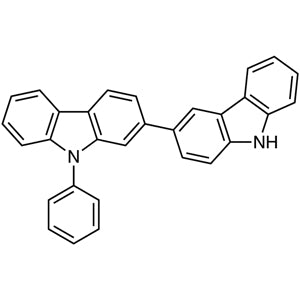
- TCI P2640 1382955-10-3 9-Phenyl-9H,9'H-2,3'-bicarbazole
- TCI D4980 354135-75-4 6,6'-Dibromo-9,9'-diphenyl-3,3'-bicarbazole
- Hole-transport layer development — the electron-rich bicarbazole system and relatively shallow highest occupied molecular orbital level support the movement of positive charge through an organic device stack.
- Host material studies for OLED emissive layers — the extended 3,3'-linked conjugation gives the electronic behaviour sought when evaluating carbazole-based frameworks as a matrix for emitters.
- Building block in multi-step organic synthesis — the preformed bicarbazole skeleton with both nitrogen atoms already ethylated saves synthetic steps when constructing larger functional molecules.
- Solution-processed thin-film preparation — the ethyl substituents raise solubility in organic solvents, making the compound more tractable for spin-coating and other solution-based deposition methods.
- Structure–property investigations of carbazole derivatives — comparing this 3,3'-linked dimer against single carbazole units illustrates how extended conjugation changes electron-donating ability.
| Brand | TCI |
|---|---|
| CAS number | 20466-00-6 |
| Molecular formula | — |
| Purity | — |
| Category | Materials Science > Electronic Materials > Organic Light-Emitting Diode (OLED) Materials |
| Pack sizes | research-scale packaging as listed by the manufacturer; please confirm the available pack size when ordering |
| Physical form | — |
| Storage | keep in the closed original container, protected from light and moisture |
- Chemical name: 9,9'-Diethyl-9H,9'H-3,3'-bicarbazole
Store the compound in its tightly closed original container in a cool, dry place, shielded from direct light and away from sources of ignition and strong oxidising agents. Amber glass or the manufacturer's supplied container is appropriate; where material is transferred for device work, use clean, dry glassware and re-seal promptly to limit moisture uptake. Handle the solid in a fume hood or a well-ventilated area, wearing safety glasses, gloves, and a laboratory coat, and avoid generating dust during weighing. Consult the manufacturer's safety data sheet before use, and dispose of residues and contaminated consumables through the laboratory's chemical waste stream.
—
Product Categories
Produk Terkait
-
9,9'-Di([1,1'-biphenyl]-4-yl)-9H,9'H-3,3'-bicarbazole TCI D5303
Regular price Rp 2.254.350,00Regular price -
9-([1,1'-Biphenyl]-4-yl)-9'-phenyl-9H,9'H-3,3'-bicarbazole TCI B6951
Regular price Rp 2.121.000,00Regular price -
3,9'-Bicarbazole TCI B4811
Regular price From Rp 3.525.900,00Regular price -
3,3'-Bicarbazole TCI B4646
Regular price From Rp 2.094.750,00Regular price -
9-Phenyl-9H,9'H-2,3'-bicarbazole TCI P2640
Regular price Rp 3.790.500,00Regular price -
6,6'-Dibromo-9,9'-diphenyl-3,3'-bicarbazole TCI D4980
Regular price From Rp 2.041.200,00Regular price -
9-([1,1'-Biphenyl]-3-yl)-9'-([1,1'-biphenyl]-4-yl)-9H,9'H-3,3'-bicarbazole TCI B6625
Regular price Rp 3.817.800,00Regular price -
9,9'-Diphenyl-9H,9'H-3,3'-bicarbazole TCI D4903
Regular price From Rp 5.009.550,00Regular price
![9,9'-Di([1,1'-biphenyl]-4-yl)-9H,9'H-3,3'-bicarbazole (CAS 57102-51-9) - TCI D5303 - AMI Scientific](http://amiscientific.com/cdn/shop/files/TCI2510D5303.jpg?v=1768818376&width=533)
![9-([1,1'-Biphenyl]-4-yl)-9'-phenyl-9H,9'H-3,3'-bicarbazole (CAS 1454567-05-5) - TCI B6951 - AMI Scientific](http://amiscientific.com/cdn/shop/files/TCI2510B6951.jpg?v=1769144603&width=533)



![9-([1,1'-Biphenyl]-3-yl)-9'-([1,1'-biphenyl]-4-yl)-9H,9'H-3,3'-bicarbazole (CAS 1643479-47-3) - TCI B6625 - AMI Scientific](http://amiscientific.com/cdn/shop/files/TCI2510B6625.jpg?v=1768816083&width=533)
