
![9-([1,1'-Biphenyl]-3-yl)-9'-([1,1'-biphenyl]-4-yl)-9H,9'H-3,3'-bicarbazole (CAS 1643479-47-3) - TCI B6625 - AMI Scientific](http://amiscientific.com/cdn/shop/files/TCI2510B6625.jpg?v=1768816083&width=1946)
![9-([1,1'-Biphenyl]-3-yl)-9'-([1,1'-biphenyl]-4-yl)-9H,9'H-3,3'-bicarbazole (CAS 1643479-47-3) - TCI B6625 - AMI Scientific](http://amiscientific.com/cdn/shop/files/TCI2510B6625.jpg?v=1768816083&width=1445)
9-([1,1'-Biphenyl]-3-yl)-9'-([1,1'-biphenyl]-4-yl)-9H,9'H-3,3'-bicarbazole is a small molecule semiconductor material built from two carbazole units linked at their 3 and 3' positions, each carrying a biphenyl substituent on its nitrogen atom. In materials science and organic optoelectronics laboratories, this compound serves as both a host material and a hole transport material in organic light emitting diodes. The bicarbazole framework is one of the most well established motifs in OLED material design because it combines strong electron donor character with good morphological stability in thin film form.
The characteristics that make this material a preferred choice are its combination of high triplet energy, thermal stability, and a tendency to form uniform amorphous layers. The difference in substitution pattern between the two biphenyl groups, one at the meta position and one at the para position, is deliberately designed to partially break conjugation and inhibit crystallization, so that the deposited film remains homogeneous throughout device operation. The carbazole core contributes good hole transport capability, while the bulky and asymmetric structure raises the glass transition temperature and helps the layer resist morphological change.
In Indonesian laboratories, this material is typically used within university and institutional research groups working on organic electronics, thin film device fabrication, and photophysical characterization. It is handled in small quantities during device prototyping work, where researchers deposit it as a host or transport layer and then evaluate the resulting film and device behaviour. Because such work is exploratory in nature, the compound is usually ordered in research scale quantities rather than production volumes.
TCI brochures (PDF)
- Carbazoles 2025-06-27 · p. 6
- Building Blocks for Organic Semiconductor 2026-03-24 · p. 22
Related TCI products
- TCI D5303 57102-51-9 9,9'-Di([1,1'-biphenyl]-4-yl)-9H,9'H-3,3'-bicarbazole
- TCI B6951 1454567-05-5 9-([1,1'-Biphenyl]-4-yl)-9'-phenyl-9H,9'H-3,3'-bicarbazole
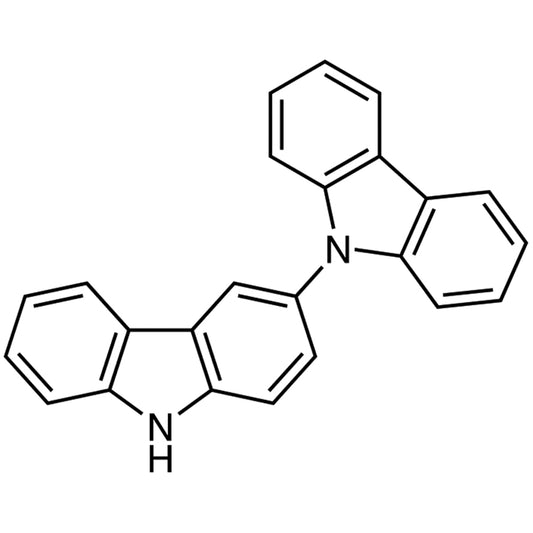
- TCI B4811 18628-07-4 3,9'-Bicarbazole
- TCI B4646 1984-49-2 3,3'-Bicarbazole
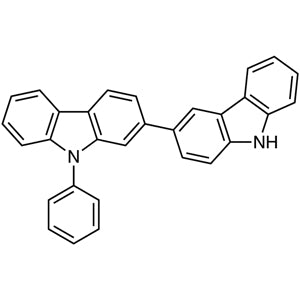
- TCI P2640 1382955-10-3 9-Phenyl-9H,9'H-2,3'-bicarbazole
- TCI D5387 20466-00-6 9,9'-Diethyl-9H,9'H-3,3'-bicarbazole
- Host material for OLED emissive layers, where the high triplet energy of the bicarbazole framework allows it to support guest emitters without quenching their excited states.
- Hole transport layer fabrication, taking advantage of the electron donating carbazole core that provides good hole mobility and favourable energy level alignment within the device stack.
- Thin film deposition studies, where the asymmetric meta and para biphenyl substitution suppresses crystallization and helps researchers obtain uniform amorphous films for reproducible measurement.
- Organic optoelectronic device prototyping, where its thermal stability and elevated glass transition temperature allow the layer to survive processing steps and sustained device operation.
- Structure property relationship research in materials science, where the defined substitution pattern makes the compound a useful reference point for studying how conjugation break affects film morphology.
| Brand | TCI |
|---|---|
| CAS number | 1643479-47-3 |
| Molecular formula | — |
| Purity | — |
| Category | Materials Science > Material Building Blocks > Small Molecule Semiconductor Building Blocks |
| Pack sizes | available in research scale pack sizes; please confirm the current options when ordering |
| Physical form | — |
| Storage | keep in a tightly closed container, protected from light and moisture |
- Product code: B6625
Store the material in its original tightly closed container, kept in a cool, dry place and protected from light and moisture, since organic semiconductor materials can degrade in performance when exposed to air and humidity over time. Amber glass vials or the supplier packaging are suitable containers, and the material should be kept away from heat sources and ignition sources. Handle in a well ventilated area or fume hood, wearing gloves, safety glasses, and a laboratory coat, and avoid generating dust when weighing. Keep the container closed when not in use, and consult the manufacturer safety data sheet before handling and for disposal guidance.
—
Produk Terkait
-
9,9'-Di([1,1'-biphenyl]-4-yl)-9H,9'H-3,3'-bicarbazole TCI D5303
Regular price Rp 2.254.350,00Regular price -
9-([1,1'-Biphenyl]-4-yl)-9'-phenyl-9H,9'H-3,3'-bicarbazole TCI B6951
Regular price Rp 2.121.000,00Regular price -
3,9'-Bicarbazole TCI B4811
Regular price From Rp 3.525.900,00Regular price -
3,3'-Bicarbazole TCI B4646
Regular price From Rp 2.094.750,00Regular price -
9-Phenyl-9H,9'H-2,3'-bicarbazole TCI P2640
Regular price Rp 3.790.500,00Regular price -
9,9'-Diethyl-9H,9'H-3,3'-bicarbazole TCI D5387
Regular price Rp 2.916.900,00Regular price -
6,6'-Dibromo-9,9'-diphenyl-3,3'-bicarbazole TCI D4980
Regular price From Rp 2.041.200,00Regular price -
9-([1,1'-Biphenyl]-4-yl)-3-(4,4,5,5-tetramethyl-1,3,2-dioxaborolan-2-yl)-9H-carbazole TCI B5091
Regular price From Rp 2.359.350,00Regular price
![9,9'-Di([1,1'-biphenyl]-4-yl)-9H,9'H-3,3'-bicarbazole (CAS 57102-51-9) - TCI D5303 - AMI Scientific](http://amiscientific.com/cdn/shop/files/TCI2510D5303.jpg?v=1768818376&width=533)
![9-([1,1'-Biphenyl]-4-yl)-9'-phenyl-9H,9'H-3,3'-bicarbazole (CAS 1454567-05-5) - TCI B6951 - AMI Scientific](http://amiscientific.com/cdn/shop/files/TCI2510B6951.jpg?v=1769144603&width=533)




![1391729-66-0 9-([1,1'-Biphenyl]-4-yl)-3-(4,4,5,5-tetramethyl-1,3,2-dioxaborolan-2-yl)-9H-carbazole - AMI Scientific](http://amiscientific.com/cdn/shop/files/TCI2510B5091.jpg?v=1769180123&width=533)