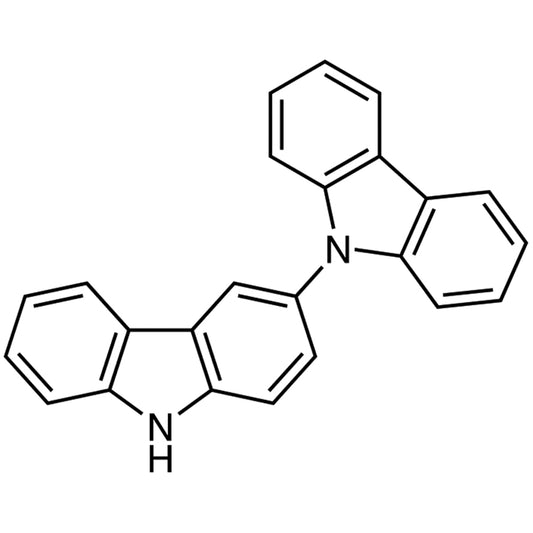
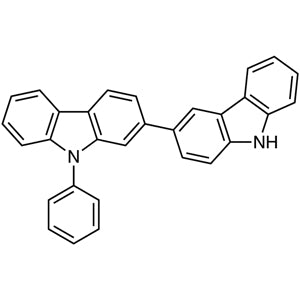
![9,9'-Di([1,1'-biphenyl]-4-yl)-9H,9'H-3,3'-bicarbazole (CAS 57102-51-9) - TCI D5303 - AMI Scientific](http://amiscientific.com/cdn/shop/files/TCI2510D5303.jpg?v=1768818376&width=1946)
![9,9'-Di([1,1'-biphenyl]-4-yl)-9H,9'H-3,3'-bicarbazole (CAS 57102-51-9) - TCI D5303 - AMI Scientific](http://amiscientific.com/cdn/shop/files/TCI2510D5303.jpg?v=1768818376&width=1445)
9,9'-Di([1,1'-biphenyl]-4-yl)-9H,9'H-3,3'-bicarbazole is an organic compound widely used in electronic material research, particularly in the development of OLED (Organic Light-Emitting Diode) devices. This compound plays a crucial role in laboratory settings where advanced display technologies and optoelectronic applications are being explored. Its molecular structure enables precise control over optical and electronic properties, making it a key component in the fabrication of high-performance OLEDs. Due to its stability and efficiency, it is frequently utilized in both academic and industrial research environments.
This material is preferred for its exceptional chemical stability, strong molecular bonding, and high light-emission efficiency. These properties allow it to function effectively as either an emissive layer or an electron transport layer, depending on the device configuration. Its ability to maintain performance under various environmental conditions makes it a reliable choice for researchers working on next-generation display technologies. Additionally, its compatibility with a wide range of synthetic and processing techniques enhances its versatility in laboratory applications.
In Indonesian laboratories, this compound is highly relevant for research in electronic materials and display technologies. Institutions and research centers focused on material innovation often require such compounds for the development of OLED-based devices. Its application supports both fundamental research and applied projects, contributing to the advancement of optoelectronic technologies in the region.
TCI brochures (PDF)
- Organic Light-Emitting Diode (OLED) Materials 2026-08-18 · p. 4
- Carbazoles 2025-06-27 · p. 6
- Building Blocks for Organic Semiconductor 2026-03-24 · p. 20
Related TCI products
- TCI B6951 1454567-05-5 9-([1,1'-Biphenyl]-4-yl)-9'-phenyl-9H,9'H-3,3'-bicarbazole
- TCI B6625 1643479-47-3 9-([1,1'-Biphenyl]-3-yl)-9'-([1,1'-biphenyl]-4-yl)-9H,9'H-3,3'-bicarbazole
- TCI D5387 20466-00-6 9,9'-Diethyl-9H,9'H-3,3'-bicarbazole
- TCI B4811 18628-07-4 3,9'-Bicarbazole
- TCI B4646 1984-49-2 3,3'-Bicarbazole
- TCI P2640 1382955-10-3 9-Phenyl-9H,9'H-2,3'-bicarbazole
- OLED Device Fabrication: This compound is essential for creating high-efficiency OLEDs, where it serves as an emissive or transport layer, enhancing device performance and longevity.
- Organic Light-Emitting Diode Research: It is widely used in studies focused on optimizing light emission properties and improving the efficiency of organic materials in display technologies.
- Electronic Material Development: Researchers use it to explore new material configurations and improve the stability and performance of organic electronic components.
- Display Technology Innovation: Its role in advanced display applications makes it a key material for developing next-generation flexible and high-resolution screens.
- Optoelectronic Device Testing: It is employed in testing the optical and electronic characteristics of materials under various conditions, supporting the design of new optoelectronic systems.
| Brand | TCI |
|---|---|
| CAS number | 57102-51-9 |
| Molecular formula | — |
| Purity | — |
| Category | Materials Science > Electronic Materials > Organic Light-Emitting Diode (OLED) Materials |
| Pack sizes | Available in various quantities as per standard laboratory supply practices |
| Physical form | Solid (as per typical organic compound properties) |
| Storage | Store in a cool, dry place away from direct light and moisture |
This compound should be stored in a cool, dry environment, away from direct sunlight and sources of moisture. It is recommended to use airtight containers to prevent exposure to air and humidity, which could affect its stability. Due to its organic nature, it should be handled with care, using appropriate personal protective equipment such as gloves and safety goggles. It is important to ensure that the storage area is well-ventilated to minimize any potential risks associated with handling. Proper labeling of containers is essential to ensure safe handling and prevent accidental exposure. Laboratories should follow standard chemical safety protocols to maintain a safe working environment.
—
Produk Terkait
-
9-([1,1'-Biphenyl]-4-yl)-9'-phenyl-9H,9'H-3,3'-bicarbazole TCI B6951
Regular price Rp 2.121.000,00Regular price -
9-([1,1'-Biphenyl]-3-yl)-9'-([1,1'-biphenyl]-4-yl)-9H,9'H-3,3'-bicarbazole TCI B6625
Regular price Rp 3.817.800,00Regular price -
9,9'-Diethyl-9H,9'H-3,3'-bicarbazole TCI D5387
Regular price Rp 2.916.900,00Regular price -
3,9'-Bicarbazole TCI B4811
Regular price From Rp 3.525.900,00Regular price -
3,3'-Bicarbazole TCI B4646
Regular price From Rp 2.094.750,00Regular price -
9-Phenyl-9H,9'H-2,3'-bicarbazole TCI P2640
Regular price Rp 3.790.500,00Regular price -
6,6'-Dibromo-9,9'-diphenyl-3,3'-bicarbazole TCI D4980
Regular price From Rp 2.041.200,00Regular price -
9,9'-Diphenyl-9H,9'H-3,3'-bicarbazole TCI D4903
Regular price From Rp 5.009.550,00Regular price
![9-([1,1'-Biphenyl]-4-yl)-9'-phenyl-9H,9'H-3,3'-bicarbazole (CAS 1454567-05-5) - TCI B6951 - AMI Scientific](http://amiscientific.com/cdn/shop/files/TCI2510B6951.jpg?v=1769144603&width=533)
![9-([1,1'-Biphenyl]-3-yl)-9'-([1,1'-biphenyl]-4-yl)-9H,9'H-3,3'-bicarbazole (CAS 1643479-47-3) - TCI B6625 - AMI Scientific](http://amiscientific.com/cdn/shop/files/TCI2510B6625.jpg?v=1768816083&width=533)