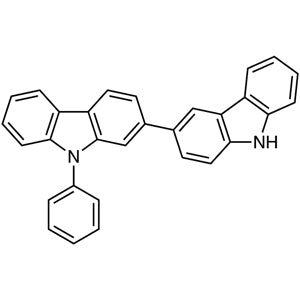
3,9'-Bicarbazole is an organic compound widely used in material science research within laboratory settings. It serves as a fundamental building block for the development of organic semiconductors and conductive materials. Its unique chemical structure enables it to be a key component in the synthesis of complex molecules with specialized electronic properties. This compound is essential for researchers aiming to explore new materials with enhanced conductivity and stability. Due to its versatility, it is frequently utilized in various experimental processes that require precise chemical control and reproducibility.
The compound is known for its chemical stability and controlled reactivity, making it a preferred choice for laboratory applications. Its molecular structure, consisting of two carbazole units connected in a specific manner, provides excellent electronic properties. These characteristics allow it to be used in the development of advanced electronic materials. Additionally, its high melting point facilitates ease of processing under different experimental conditions. The combination of stability and reactivity ensures that it remains a reliable material for scientific research.
In Indonesian laboratories, 3,9'-Bicarbazole is commonly used in material science and technology research. It supports studies focused on organic semiconductors, conductive polymers, and other advanced materials. Many research institutions and universities in Indonesia rely on this compound for their experimental work. Its role in developing new materials with unique electronic properties makes it a valuable resource for scientific innovation in the region.
TCI brochures (PDF)
- Carbazoles 2025-06-27 · p. 3
- Building Blocks for Organic Semiconductor 2026-03-24 · p. 18
Related TCI products
- TCI B4646 1984-49-2 3,3'-Bicarbazole
- TCI P2640 1382955-10-3 9-Phenyl-9H,9'H-2,3'-bicarbazole
- TCI D5387 20466-00-6 9,9'-Diethyl-9H,9'H-3,3'-bicarbazole
- TCI D5303 57102-51-9 9,9'-Di([1,1'-biphenyl]-4-yl)-9H,9'H-3,3'-bicarbazole
- TCI D4980 354135-75-4 6,6'-Dibromo-9,9'-diphenyl-3,3'-bicarbazole
- TCI B6951 1454567-05-5 9-([1,1'-Biphenyl]-4-yl)-9'-phenyl-9H,9'H-3,3'-bicarbazole
- Organic Semiconductor Development: This compound is ideal for creating organic semiconductors due to its stable electronic properties and unique molecular structure.
- Conductive Material Synthesis: Its chemical stability and controlled reactivity make it suitable for synthesizing conductive polymers and materials.
- Electronic Device Research: The compound is used in the development of electronic devices that require high-performance conductive materials.
- Material Characterization Studies: Its well-defined structure allows for accurate analysis in material characterization experiments.
- Advanced Material Innovation: It supports the creation of new materials with enhanced electronic and chemical properties for future applications.
| Brand | TCI |
|---|---|
| CAS number | 18628-07-4 |
| Molecular formula | — |
| Purity | — |
| Category | Materials Science > Material Building Blocks > Small Molecule Semiconductor Building Blocks |
| Pack sizes | As available |
| Physical form | Solid |
| Storage | Store in a cool, dry place away from light |
3,9'-Bicarbazole should be stored in a cool, dry environment away from direct light to maintain its chemical stability. It is recommended to use airtight containers to prevent exposure to moisture and air. Due to its chemical nature, it should be handled with care in a well-ventilated laboratory setting. Avoid contact with incompatible substances to ensure safety. The compound is non-hazardous under normal conditions but should be stored in a secure location to prevent accidental exposure. Proper labeling and storage practices are essential for maintaining the integrity of the material during experimental use.
—
Produk Terkait
-
3,3'-Bicarbazole TCI B4646
Regular price From Rp 2.147.250,00Regular priceRp 1.517.250,00Sale price From Rp 2.147.250,00 -
9-Phenyl-9H,9'H-2,3'-bicarbazole TCI P2640
Regular price Rp 3.843.000,00Regular priceRp 2.702.700,00Sale price Rp 3.843.000,00 -
9,9'-Diethyl-9H,9'H-3,3'-bicarbazole TCI D5387
Regular price Rp 2.969.400,00Regular priceRp 2.091.600,00Sale price Rp 2.969.400,00 -
9,9'-Di([1,1'-biphenyl]-4-yl)-9H,9'H-3,3'-bicarbazole TCI D5303
Regular price Rp 2.306.850,00Regular priceRp 1.628.550,00Sale price Rp 2.306.850,00 -
6,6'-Dibromo-9,9'-diphenyl-3,3'-bicarbazole TCI D4980
Regular price From Rp 2.093.700,00Regular priceRp 1.479.450,00Sale price From Rp 2.093.700,00 -
9-([1,1'-Biphenyl]-4-yl)-9'-phenyl-9H,9'H-3,3'-bicarbazole TCI B6951
Regular price Rp 2.173.500,00Regular priceRp 1.535.100,00Sale price Rp 2.173.500,00 -
9-([1,1'-Biphenyl]-3-yl)-9'-([1,1'-biphenyl]-4-yl)-9H,9'H-3,3'-bicarbazole TCI B6625
Regular price Rp 3.870.300,00Regular priceRp 2.721.600,00Sale price Rp 3.870.300,00 -
9,9'-Diphenyl-9H,9'H-3,3'-bicarbazole TCI D4903
Regular price From Rp 5.062.050,00Regular priceRp 3.555.300,00Sale price From Rp 5.062.050,00