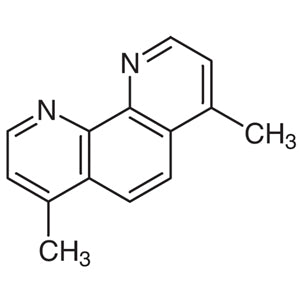
4,7-Dimethyl-1,10-phenanthroline is a chemical compound widely used in laboratory settings for its versatility in organic and inorganic chemistry applications. As a heterocyclic building block, it plays a crucial role in the synthesis of complex molecular structures. Its unique chemical properties make it an essential component in various synthetic pathways, particularly in the development of metal complexes and organic compounds. This compound is commonly found in research laboratories where its reactivity and stability are leveraged to achieve precise chemical transformations.
One of the key attributes of 4,7-Dimethyl-1,10-phenanthroline is its ability to act as a ligand for heavy metals, making it a preferred choice in coordination chemistry. Its stability under various reaction conditions and solubility in organic solvents further enhance its utility in both analytical and synthetic processes. These properties allow researchers to design and execute reactions with greater control and efficiency. Additionally, its compatibility with a wide range of reagents and solvents makes it a reliable reagent for multiple experimental setups.
In Indonesian laboratories, 4,7-Dimethyl-1,10-phenanthroline is extensively used in organic and analytical chemistry research. It is a common reagent in academic and industrial settings, supporting studies related to metal complexation, catalysis, and molecular structure development. Its consistent performance and predictable behavior make it a trusted material for researchers working on complex chemical systems. The compound's role in advancing chemical research in Indonesia underscores its importance in the scientific community.
TCI brochures (PDF)
- Ligands 2025-12-01 · p. 14
Related TCI products
- Metal complex synthesis: This compound is ideal for forming stable metal complexes due to its ability to coordinate with heavy metals, making it a preferred ligand in coordination chemistry studies.
- Organic synthesis: Its reactivity and structural versatility make it a valuable building block for the synthesis of various organic compounds, particularly in substitution and condensation reactions.
- Analytical chemistry: It is used in analytical techniques to detect and quantify metal ions, thanks to its strong chelating properties and high selectivity.
- Catalytic reactions: Its ability to act as a ligand enhances catalytic efficiency in various chemical transformations, supporting the development of more effective catalysts.
- Structural studies: It is employed in the study of molecular structures, aiding in the characterization of complex compounds through spectroscopic and chromatographic methods.
| Brand | TCI |
|---|---|
| CAS number | 3248-05-3 |
| Molecular formula | — |
| Purity | — |
| Category | Chemistry > Building Blocks > Heterocyclic Building Blocks |
| Pack sizes | Available in various quantities to suit different laboratory needs |
| Physical form | Solid, typically in crystalline or powder form |
| Storage | Store in a cool, dry place away from light and moisture |
This compound should be stored in a cool, dry environment, away from direct sunlight and moisture. It is recommended to use airtight containers to prevent exposure to air and humidity, which may affect its stability. Due to its chemical nature, it should be handled with appropriate personal protective equipment, including gloves and safety goggles. It is important to ensure proper ventilation in the workspace to minimize inhalation risks. Avoid contact with incompatible substances such as strong oxidizing agents. Regular inspection of storage conditions is advised to maintain the integrity of the material.
—
Product Categories
Produk Terkait
-
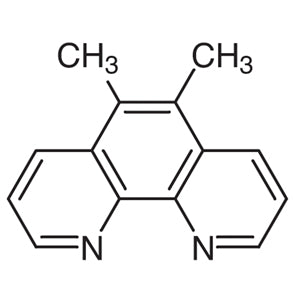
5,6-Dimethyl-1,10-phenanthroline TCI D1559
Regular price Rp 1.272.600,00Regular priceRp 905.100,00Sale price Rp 1.272.600,00 -
5-Amino-1,10-phenanthroline TCI A2977
Regular price Rp 3.790.500,00Regular priceRp 2.665.950,00Sale price Rp 3.790.500,00 -
3,4,7,8-Tetramethyl-1,10-phenanthroline TCI T0847
Regular price Rp 2.147.250,00Regular priceRp 1.517.250,00Sale price Rp 2.147.250,00 -
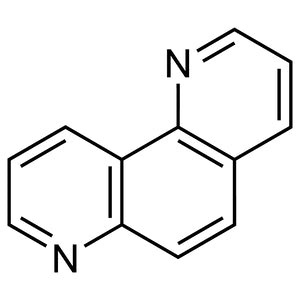
1,7-Phenanthroline TCI P3288
Regular price Rp 1.618.050,00Regular priceRp 1.146.600,00Sale price Rp 1.618.050,00 -
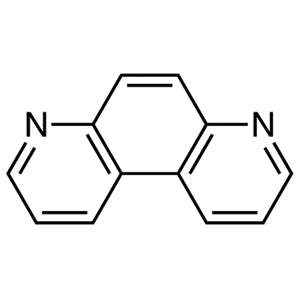
4,7-Phenanthroline TCI P2684
Regular price Rp 2.518.950,00Regular priceRp 1.776.600,00Sale price Rp 2.518.950,00 -
1,10-Phenanthroline-5,6-dione TCI P1973
Regular price Rp 3.472.350,00Regular priceRp 2.443.350,00Sale price Rp 3.472.350,00 -
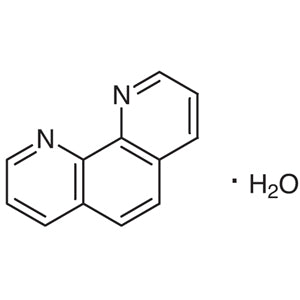
1,10-PhenanthrolineMonohydrate TCI P0879
Regular price Rp 1.510.950,00Regular priceRp 1.072.050,00Sale price Rp 1.510.950,00 -
1,10-PhenanthrolineMonohydrate TCI P0221
Regular price Rp 557.550,00Regular priceRp 405.300,00Sale price Rp 557.550,00