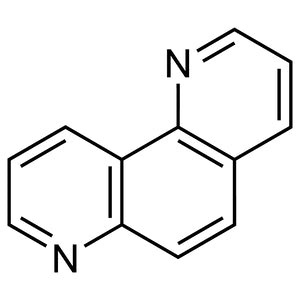
4,7-Phenanthroline is a chemical compound classified under the heterocyclic category, widely utilized in laboratory settings for its versatile applications. It serves as a building block in the synthesis of complex organic compounds, particularly in the field of heterocyclic chemistry. This compound plays a crucial role in metal complex formation, making it an essential reagent in both qualitative and quantitative analytical procedures. Its presence in laboratory workflows supports the development of new chemical structures and the study of metal-ligand interactions.
The stability and controlled reactivity of 4,7-Phenanthroline make it a preferred choice for various chemical experiments. Its molecular structure, featuring two nitrogen atoms at positions 4 and 7, enables strong coordination with heavy metals such as iron, copper, and lead. This characteristic is vital for complexation reactions and metal ion detection. Additionally, its solubility in organic solvents facilitates easy handling and integration into diverse synthetic and analytical processes. These properties ensure its reliability and effectiveness in both research and educational environments.
In Indonesian laboratories, 4,7-Phenanthroline is commonly used in chemical research, especially in qualitative analysis and organic synthesis. It is a valuable tool for academic institutions and research centers, supporting both teaching and experimental work. Its application in metal ion analysis and complexation studies aligns with the needs of modern chemical laboratories in Indonesia, making it a staple in various scientific investigations.
TCI brochures (PDF)
- Ligands 2025-12-01 · p. 15
Related TCI products
- Metal ion analysis where 4,7-Phenanthroline forms stable complexes with heavy metals, enabling accurate detection and quantification in environmental and industrial samples.
- Organic synthesis involving heterocyclic compounds, as its structure facilitates the creation of complex molecular frameworks with high specificity.
- Qualitative analysis in chemical laboratories, where it acts as a reagent for identifying metal ions through colorimetric reactions and visual indicators.
- Teaching demonstrations in chemistry courses, providing students with hands-on experience in complexation reactions and analytical techniques.
- Research in coordination chemistry, where its ability to coordinate with multiple metal ions supports the study of metal-ligand interactions and reaction mechanisms.
| Brand | TCI |
|---|---|
| CAS number | 230-07-9 |
| Molecular formula | — |
| Purity | — |
| Category | Chemistry > Building Blocks > Heterocyclic Building Blocks |
| Pack sizes | Available in various quantities as per standard laboratory supply formats |
| Physical form | Solid, typically in crystalline or powder form |
| Storage | Store in a cool, dry place away from light and moisture |
4,7-Phenanthroline should be stored in a cool, dry environment, away from direct light and moisture to maintain its chemical integrity. It is recommended to use airtight containers to prevent exposure to air and humidity, which may affect its stability. In laboratory settings, it should be handled with care, using appropriate personal protective equipment such as gloves and safety goggles. Due to its potential reactivity with certain substances, it should be stored separately from strong oxidizing agents and incompatible materials. Proper labeling and safe storage practices are essential to ensure the safety of laboratory personnel and the integrity of the compound.
—
Product Categories
Produk Terkait
-
5-Amino-1,10-phenanthroline TCI A2977
Regular price Rp 3.738.000,00Regular price -
3,4,7,8-Tetramethyl-1,10-phenanthroline TCI T0847
Regular price From Rp 2.094.750,00Regular price -
1,7-Phenanthroline TCI P3288
Regular price From Rp 1.565.550,00Regular price -
1,10-Phenanthroline-5,6-dione TCI P1973
Regular price From Rp 3.419.850,00Regular price -
1,10-PhenanthrolineMonohydrate TCI P0879
Regular price Rp 1.458.450,00Regular price -
1,10-PhenanthrolineMonohydrate TCI P0221
Regular price From Rp 505.050,00Regular price -
1,10-PhenanthrolineHydrochlorideMonohydrate TCI P0081
Regular price Rp 1.644.300,00Regular price -
2-Methyl-1,10-phenanthroline TCI M2512
Regular price Rp 6.070.050,00Regular price