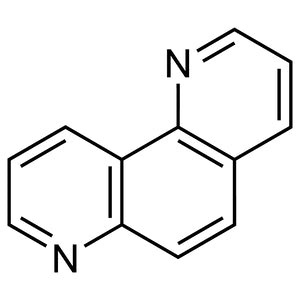
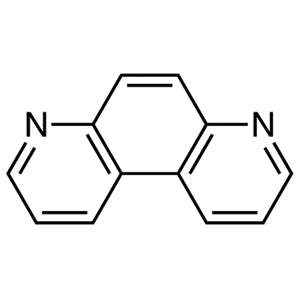
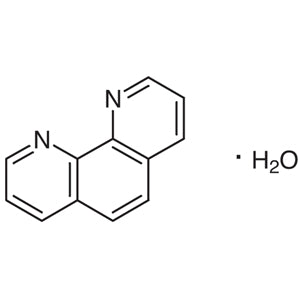
1,10-Phenanthroline Monohydrate is a chemical compound widely used in laboratory settings for its versatile applications in chemical reactions and analytical processes. As a heterocyclic compound, it possesses a stable aromatic structure and functions effectively as a ligand in metal complex formation. This compound is essential in various analytical and synthetic procedures due to its ability to interact with heavy metals, making it a valuable tool for qualitative and quantitative analysis. Its role in laboratory work extends beyond mere reactivity, as it is also employed as an indicator in specific chemical reactions, particularly in the analysis of chloride and sulfide ions.
The key properties that make 1,10-Phenanthroline Monohydrate a preferred choice include its solubility in both organic solvents and water, as well as its chemical stability under certain conditions. These characteristics allow it to be used in a wide range of applications where reactivity and selectivity are crucial. Additionally, its ability to form complexes with heavy metals such as copper, silver, and lead enhances its utility in metal detection and analysis. The compound’s reliability and consistent performance make it a trusted reagent in both academic and industrial laboratories.
In Indonesian laboratories, 1,10-Phenanthroline Monohydrate is commonly used in chemical research, environmental analysis, and the development of chemical products. It plays a significant role in educational institutions and research centers, supporting both teaching and experimental work. Its relevance in various scientific fields underscores its importance as a fundamental reagent in the Indonesian scientific community.
TCI brochures (PDF)
- Ligands 2025-12-01 · p. 14
Related TCI products
- Metal ion analysis due to its ability to form stable complexes with heavy metals such as copper, silver, and lead, making it ideal for qualitative and quantitative analysis.
- Environmental testing as it is used to detect and quantify metal contaminants in water and soil samples, supporting environmental monitoring efforts.
- Chemical synthesis where its reactivity and selectivity are essential for creating complex organic molecules and functional compounds.
- Analytical chemistry applications, particularly in the detection of chloride and sulfide ions, where it serves as a reliable indicator in titration processes.
- Educational research in academic institutions, where it is used to demonstrate coordination chemistry and metal complex formation in laboratory courses.
| Brand | TCI |
|---|---|
| CAS number | 5144-89-8 |
| Molecular formula | — |
| Purity | — |
| Category | Chemistry > Building Blocks > Heterocyclic Building Blocks |
| Pack sizes | Available in various quantities as per standard laboratory supply |
| Physical form | Solid, crystalline monohydrate |
| Storage | Store in a cool, dry place away from direct sunlight and moisture |
1,10-Phenanthroline Monohydrate should be stored in a cool, dry environment to maintain its chemical stability and prevent degradation. It is recommended to keep the compound in a tightly sealed container to minimize exposure to moisture and air, which could affect its performance. Since it is soluble in water, it should be stored away from sources of water contamination. In laboratory settings, it is important to handle the compound with appropriate personal protective equipment, such as gloves and safety goggles, to ensure safe handling. Proper labeling of storage containers is also essential for safe and efficient laboratory operations. Regular inspection of storage conditions ensures that the compound remains in optimal condition for use in analytical and synthetic processes.
—
Product Categories
Produk Terkait
-
5-Amino-1,10-phenanthroline TCI A2977
Regular price Rp 3.738.000,00Regular price -
3,4,7,8-Tetramethyl-1,10-phenanthroline TCI T0847
Regular price From Rp 2.094.750,00Regular price -
1,7-Phenanthroline TCI P3288
Regular price From Rp 1.565.550,00Regular price -
4,7-Phenanthroline TCI P2684
Regular price From Rp 2.466.450,00Regular price -
1,10-Phenanthroline-5,6-dione TCI P1973
Regular price From Rp 3.419.850,00Regular price -
1,10-PhenanthrolineMonohydrate TCI P0221
Regular price From Rp 505.050,00Regular price -
1,10-PhenanthrolineHydrochlorideMonohydrate TCI P0081
Regular price Rp 1.644.300,00Regular price -
2-Methyl-1,10-phenanthroline TCI M2512
Regular price Rp 6.070.050,00Regular price