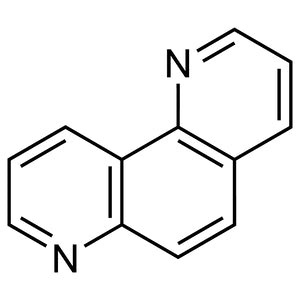
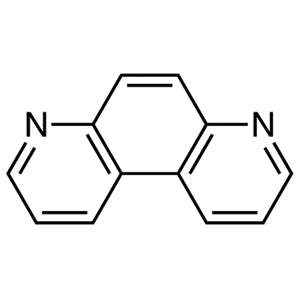
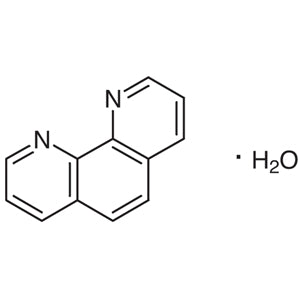
1,10-Phenanthroline Hydrochloride Monohydrate is the hydrochloride salt of 1,10-phenanthroline in monohydrate form. 1,10-Phenanthroline is an aromatic heterocyclic compound with two nitrogen atoms placed so that they can chelate metal ions. This TCI product belongs to the heterocyclic building block group. In the laboratory it is widely known as a bidentate ligand, a reagent for colorimetric iron analysis, and a starting material for synthesizing metal complexes and phenanthroline derivatives. It is useful to both analytical and synthetic chemists.
Chemists choose this material because it chelates strongly and selectively. The two nitrogen atoms sit on a rigid framework, so they form stable chelate rings with many transition metal ions. With iron(II) it forms an intense red-orange complex known as ferroin, which is the basis of spectrophotometric methods for determining iron. The hydrochloride salt is generally more soluble in water than the free base. This makes it practical for preparing aqueous analytical reagent solutions without extra solubilization steps, which helps keep routine procedures simple and reproducible.
In Indonesia, this material is especially relevant to laboratories that test drinking water, wastewater, and environmental samples, where iron levels are checked routinely. It also suits teaching laboratories that run analytical chemistry practicals, where the ferroin color reaction shows complex formation and spectrophotometric quantification clearly. Research groups working on coordination chemistry, catalysis, and the synthesis of new heterocyclic compounds also use it as a dependable ligand and building block.
TCI brochures (PDF)
- Ligands 2025-12-01 · p. 14
- Suzuki-Miyaura Cross Coupling Reaction 2025-12-01 · p. 27
Related TCI products
- TCI P0221 5144-89-8 1,10-Phenanthroline Monohydrate
- TCI M0300 3002-78-6 5-Methyl-1,10-phenanthroline [for Colorimetric Determination of Iron]
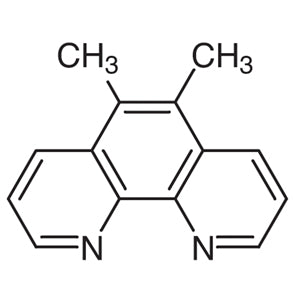
- TCI D1559 3002-81-1 5,6-Dimethyl-1,10-phenanthroline
- TCI B0989 53744-42-6 Bathophenanthrolinedisulfonic Acid Disodium Salt Hydrate [for Determination of Ferrous Ion]
- TCI A2977 54258-41-2 5-Amino-1,10-phenanthroline
- TCI T0847 1660-93-1 3,4,7,8-Tetramethyl-1,10-phenanthroline
- Spectrophotometric determination of iron: the compound forms the intensely colored red-orange ferroin complex with iron(II), so iron can be measured reliably at low concentrations.
- Water and environmental testing: its good water solubility as a hydrochloride salt makes it easy to prepare reagent solutions for routine iron checks on drinking water, wastewater, and environmental samples.
- Coordination chemistry research: as a rigid bidentate ligand with two well-positioned nitrogen atoms, it forms stable chelate complexes with many transition metal ions for structural and reactivity studies.
- Synthesis of phenanthroline derivatives: as a heterocyclic building block, it is a convenient starting material for preparing functionalized phenanthroline compounds and new metal complexes.
- Analytical chemistry education: the clear ferroin color reaction shows students metal chelation and colorimetric quantification in practical, visually intuitive laboratory sessions.
| Brand | TCI (product code P0081) |
|---|---|
| CAS number | 18851-33-7 |
| Molecular formula | — |
| Purity | — |
| Category | Chemistry > Building Blocks > Heterocyclic Building Blocks |
| Pack sizes | please check the product page for the pack sizes currently offered |
| Physical form | solid (hydrochloride salt, monohydrate) |
| Storage | keep tightly closed in a cool, dry place, following the manufacturer's label and SDS |
Store 1,10-Phenanthroline Hydrochloride Monohydrate in its original, tightly closed container in a cool, dry, well-ventilated area, away from direct sunlight, moisture, and incompatible materials such as strong oxidizing agents. Keep the container clearly labeled and reseal it promptly after use so the hydrate form stays stable. Handle the material wearing appropriate personal protective equipment, including gloves, safety glasses, and a lab coat. Avoid creating and breathing dust, and work in a fume hood or well-ventilated area where possible. Wash hands thoroughly after handling. Before use, always read the manufacturer's Safety Data Sheet for full hazard, first-aid, and disposal information, and dispose of waste according to local regulations.
—
Product Categories
Produk Terkait
-
1,10-PhenanthrolineMonohydrate TCI P0221
Regular price From Rp 505.050,00Regular price -
5-Methyl-1,10-phenanthroline[forColorimetricDeterminationofIron] TCI M0300
Regular price From Rp 1.060.500,00Regular price -
5,6-Dimethyl-1,10-phenanthroline TCI D1559
Regular price From Rp 1.220.100,00Regular price -
BathophenanthrolinedisulfonicAcidDisodiumSaltHydrate[forDeterminationofFerrousIon] TCI B0989
Regular price Rp 5.672.100,00Regular price -
5-Amino-1,10-phenanthroline TCI A2977
Regular price Rp 3.738.000,00Regular price -
3,4,7,8-Tetramethyl-1,10-phenanthroline TCI T0847
Regular price From Rp 2.094.750,00Regular price -
1,7-Phenanthroline TCI P3288
Regular price From Rp 1.565.550,00Regular price -
4,7-Phenanthroline TCI P2684
Regular price From Rp 2.466.450,00Regular price
![3002-78-6 5-Methyl-1,10-phenanthroline [for Colorimetric Determination of Iron] - AMI Scientific](http://amiscientific.com/cdn/shop/files/TCI2510M0300.jpg?v=1767122633&width=533)
![53744-42-6 Bathophenanthrolinedisulfonic Acid Disodium Salt Hydrate [for Determination of Ferrous Ion] - AMI Scientific](http://amiscientific.com/cdn/shop/files/TCI2510B0989.jpg?v=1768193262&width=533)