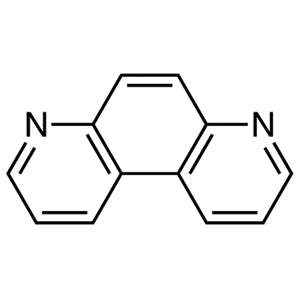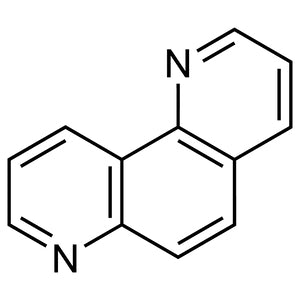
1,7-Phenanthroline is a tricyclic heteroaromatic compound with two nitrogen atoms at positions 1 and 7 of the phenanthrene framework. It is a positional isomer of 1,10-phenanthroline, which is well known as a chelating ligand. Laboratories use 1,7-phenanthroline as a heterocyclic building block, as a monodentate or bridging ligand in coordination chemistry, and as a reference compound in studies that need to separate chelation effects from the effects of a flat aromatic structure. Its azaarene framework is also of interest in materials research and supramolecular chemistry.
What sets 1,7-phenanthroline apart is where its two nitrogen atoms sit. In 1,10-phenanthroline, the nitrogens are next to each other, so they can grip a single metal ion in a bidentate fashion. In the 1,7 isomer, the nitrogens are positioned so that this kind of chelation is not possible. Instead, each nitrogen tends to bind on its own, and the molecule can bridge two metal centres. This makes it very useful as a negative control in biochemical or catalytic experiments that use 1,10-phenanthroline. It also serves as a building unit for coordination polymers and metal-organic frameworks.
In Indonesian laboratories, this TCI product is relevant to university inorganic and coordination chemistry groups, synthetic organic chemistry laboratories, and materials science research teams. Researchers studying metal complexes, enzyme inhibition by metal chelators, or porous coordination materials can use it alongside its better-known 1,10 isomer to design properly controlled experiments. Supplied under the TCI brand, it is suitable for academic research, postgraduate thesis work, and industrial research and development that need a dependable, well-identified heterocyclic reagent.
TCI brochures (PDF)
- Agrochemical Ingredients for Research and Experimental Use 2026-01-08 · p. 9
- Plant Research Reagents 2026-02-24 · p. 14
- Ligands 2025-12-01 · p. 15
Related TCI products
- Heterocyclic building block synthesis: its nitrogen-containing tricyclic framework gives organic chemists a rigid aromatic scaffold for building more complex heterocyclic molecules and functional derivatives.
- Coordination chemistry as a monodentate or bridging ligand: because its nitrogens cannot chelate a single metal, it can bind metal centres separately or link two metal centres together.
- Negative control for 1,10-phenanthroline experiments: it shares the flat aromatic structure but cannot chelate in the same way, which helps researchers tell chelation effects apart from structural effects in biochemical and catalytic studies.
- Coordination polymers and metal-organic frameworks: its ability to bridge metal centres makes it a useful building unit for extended coordination networks and porous framework materials.
- Supramolecular and materials chemistry research: its planar azaarene framework is attractive for studying aromatic stacking, host-guest interactions, and the design of new functional organic materials.
| Brand | TCI (product code P3288) |
|---|---|
| CAS number | 230-46-6 |
| Molecular formula | — |
| Purity | — |
| Category | Chemistry > Building Blocks > Heterocyclic Building Blocks |
| Pack sizes | available in the pack sizes listed by TCI for this product code; please check the product listing for current options |
| Physical form | refer to the TCI product label and Safety Data Sheet for the physical form and grade |
| Storage | keep in the original tightly closed container as directed on the TCI label and Safety Data Sheet |
Store 1,7-Phenanthroline in its original, tightly sealed container in a cool, dry, well-ventilated area, away from direct sunlight, heat sources, and incompatible materials such as strong oxidising agents. Follow any specific storage temperature given on the TCI label or Safety Data Sheet. Label containers clearly and reseal them promptly after each use to avoid contamination and moisture uptake. When handling, wear suitable personal protective equipment, including a laboratory coat, chemical-resistant gloves, and safety glasses. Work in a fume hood or well-ventilated area to avoid breathing in dust, and avoid contact with skin and eyes. Always read the Safety Data Sheet before use, and dispose of waste according to local regulations and your institution's chemical waste procedures.
—
Product Categories
Produk Terkait
-
5-Amino-1,10-phenanthroline TCI A2977
Regular price Rp 3.738.000,00Regular price -
3,4,7,8-Tetramethyl-1,10-phenanthroline TCI T0847
Regular price From Rp 2.094.750,00Regular price -
4,7-Phenanthroline TCI P2684
Regular price From Rp 2.466.450,00Regular price -
1,10-Phenanthroline-5,6-dione TCI P1973
Regular price From Rp 3.419.850,00Regular price -
1,10-PhenanthrolineMonohydrate TCI P0879
Regular price Rp 1.458.450,00Regular price -
1,10-PhenanthrolineMonohydrate TCI P0221
Regular price From Rp 505.050,00Regular price -
1,10-PhenanthrolineHydrochlorideMonohydrate TCI P0081
Regular price Rp 1.644.300,00Regular price -
2-Methyl-1,10-phenanthroline TCI M2512
Regular price Rp 6.070.050,00Regular price