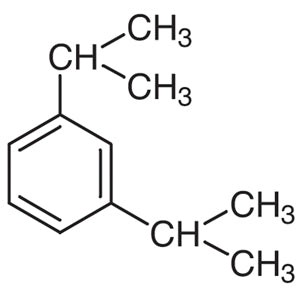
1,3-Diisopropylbenzene is an organic compound widely utilized in various chemical reactions, particularly in the synthesis of complex molecules. This compound features an aromatic benzene ring with two isopropyl groups attached at positions 1 and 3. Its structural simplicity and chemical versatility make it a valuable resource in laboratory settings. It is commonly used as a building block in the development of heterocyclic compounds, pharmaceuticals, and industrial chemicals. Its stability and controlled reactivity contribute to its popularity among chemists working on diverse synthetic pathways.
The compound exhibits non-polar characteristics and volatility, which make it suitable for reactions requiring vacuum or high-temperature conditions. Its non-heterocyclic nature ensures minimal side reactions, making it ideal for applications demanding high purity and precision. Additionally, its resistance to oxidation and controlled reactivity enhance its safety profile in laboratory environments. These properties collectively position 1,3-Diisopropylbenzene as a reliable and versatile material for chemical synthesis.
In Indonesian laboratories, 1,3-Diisopropylbenzene is frequently employed in chemical research, especially in the synthesis of complex compounds and the development of new chemical materials. It is a staple in research institutions and universities, supporting both academic and industrial chemical innovation. Its consistent performance and reliability make it a preferred choice for scientists engaged in advanced chemical studies.
- Synthetic chemistry applications benefit from its stable structure and controlled reactivity, enabling precise molecular construction.
- Pharmaceutical research utilizes it as a building block for the synthesis of complex heterocyclic compounds and drug molecules.
- Industrial chemical development relies on its non-polar nature and volatility for reactions under vacuum or high-temperature conditions.
- High-purity chemical synthesis favors its minimal side reaction potential, ensuring accurate and reproducible results.
- Organic reaction studies use it as a model compound to explore reaction mechanisms and functional group behavior.
| Brand | TCI |
|---|---|
| CAS number | 99-62-7 |
| Molecular formula | — |
| Purity | — |
| Category | Chemistry > Building Blocks > Non-Heterocyclic Building Blocks |
| Pack sizes | Available in standard laboratory quantities |
| Physical form | Liquid |
| Storage | Store in a cool, dry place away from direct sunlight |
1,3-Diisopropylbenzene should be stored in a cool, dry environment, away from direct sunlight and sources of heat. It is recommended to use sealed containers made of materials compatible with organic solvents, such as glass or high-density polyethylene. Due to its volatility, proper ventilation is essential when handling the compound. It is important to avoid contact with skin and eyes, and appropriate personal protective equipment should be worn. The compound should not be stored near incompatible substances, such as strong oxidizing agents. Regular monitoring of storage conditions is advised to maintain its stability and ensure safe laboratory practices.
—
Produk Terkait
-
1,3-Diisopropylbenzene TCI D2490
Regular price From Rp 610.050,00Regular price -
Diisopropylbenzene(mixtureofisomers) TCI D0929
Regular price Rp 505.050,00Regular price -
1,4-Diisopropylbenzene TCI D0928
Regular price From Rp 1.087.800,00Regular price -
1,3,5-Triisopropylbenzene TCI T0458
Regular price From Rp 823.200,00Regular price -
Cyclopropylbenzene TCI P2963
Regular price From Rp 3.630.900,00Regular price -
Propylbenzene TCI P0523
Regular price From Rp 823.200,00Regular price -
1-Ethyl-4-isopropylbenzene TCI E1406
Regular price From Rp 2.491.650,00Regular price -
1-Ethynyl-4-propylbenzene TCI E0750
Regular price From Rp 1.035.300,00Regular price