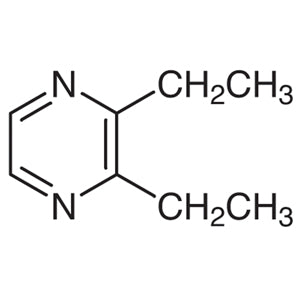
2,3-Diethylpyrazine is a chemical compound classified under the heterocyclic category, commonly used in laboratory settings for the synthesis of complex molecules. As a building block in organic chemistry, it serves as a fundamental component for creating compounds with intricate structures, which are essential in pharmaceutical and chemical research. Its versatility makes it a valuable tool for researchers aiming to develop new drugs or functional materials. This compound plays a crucial role in various experimental processes, contributing to the advancement of scientific knowledge in multiple fields.
The compound exhibits stable molecular structure and moderate reactivity, which facilitates efficient chemical synthesis. Its volatility allows for effective evaporation and separation during experimental procedures, making it suitable for reactions requiring controlled conditions. Additionally, its availability in liquid form simplifies handling and storage, ensuring convenience for laboratory use. These properties collectively make 2,3-Diethylpyrazine a preferred choice for chemists working in both academic and industrial environments.
In Indonesian laboratories, 2,3-Diethylpyrazine is widely utilized in organic chemistry research, particularly in universities and research institutions. Its availability and consistent quality support the execution of complex chemical experiments, contributing to the development of new compounds with biological activity. The compound is frequently used in the study of pharmaceuticals, aroma compounds, and other specialized applications, making it an essential reagent in the Indonesian scientific community.
Related TCI products
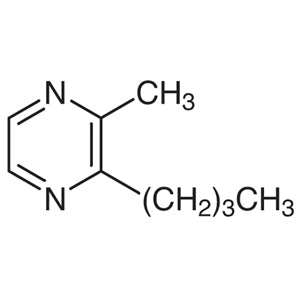
- TCI B1173 15987-00-5 2-Butyl-3-methylpyrazine
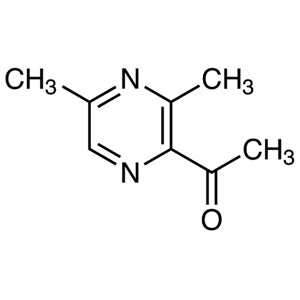
- TCI A3326 54300-08-2 2-Acetyl-3,5-dimethylpyrazine (contains 2-Acetyl-3,6-dimethylpyrazine)
- TCI A2992 5521-56-2 2-Amino-6-methylpyrazine
- TCI A2003 32974-92-8 2-Acetyl-3-ethylpyrazine
- TCI A1978 23787-80-6 2-Acetyl-3-methylpyrazine
- TCI T0942 14667-55-1 2,3,5-Trimethylpyrazine
- Organic synthesis of complex molecules where 2,3-Diethylpyrazine serves as a key structural component for building biologically active compounds.
- Development of pharmaceuticals requiring heterocyclic scaffolds for drug design and molecular modification.
- Investigation of aroma compounds and flavor chemistry in food science and fragrance research.
- Preparation of intermediate compounds for further chemical transformations in industrial and academic settings.
- Study of reaction mechanisms and chemical behavior under controlled laboratory conditions.
| Brand | TCI |
|---|---|
| CAS number | 15707-24-1 |
| Molecular formula | — |
| Purity | — |
| Category | Chemistry > Building Blocks > Heterocyclic Building Blocks |
| Pack sizes | Available in liquid form, with standard sizes for laboratory use |
| Physical form | Liquid |
| Storage | Store in a cool, dry place away from direct sunlight and incompatible materials |
2,3-Diethylpyrazine should be stored in a cool, dry environment to maintain its stability and prevent degradation. It is recommended to use sealed containers to minimize exposure to air and moisture. Due to its volatility, it is important to ensure proper ventilation in the laboratory to avoid inhalation of vapors. The compound should be kept away from incompatible substances such as strong oxidizers or acids. Regular inspection of storage containers is advised to ensure integrity. Proper personal protective equipment, including gloves and goggles, should be worn during handling to ensure safety in the laboratory setting.
—
Produk Terkait
-
2-Butyl-3-methylpyrazine TCI B1173
Regular price Rp 3.232.950,00Regular price -
2-Acetyl-3,5-dimethylpyrazine(contains2-Acetyl-3,6-dimethylpyrazine) TCI A3326
Regular price From Rp 1.326.150,00Regular price -
2-Amino-6-methylpyrazine TCI A2992
Regular price From Rp 903.000,00Regular price -
2-Acetyl-3-ethylpyrazine TCI A2003
Regular price From Rp 1.035.300,00Regular price -
2-Acetyl-3-methylpyrazine TCI A1978
Regular price Rp 1.035.300,00Regular price -
2,3,5-Trimethylpyrazine TCI T0942
Regular price From Rp 875.700,00Regular price -
5-Methylpyrazin-2-amine TCI M3006
Regular price From Rp 4.293.450,00Regular price -
5-Methylpyrazine-2-carboxylicAcid TCI M1003
Regular price From Rp 505.050,00Regular price