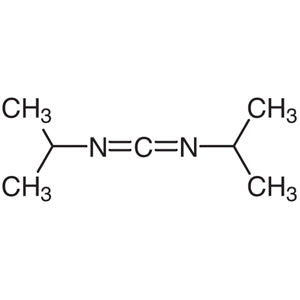
1-(3-Dimethylaminopropyl)-3-ethylcarbodiimide Hydrochloride, better known as EDC·HCl or WSC·HCl, is a carbodiimide reagent from TCI. It works as a coupling agent in peptide synthesis and amide bond formation. The reagent activates carboxyl groups so they can react with amines to form amide bonds. In organic chemistry, biochemistry and biotechnology laboratories, EDC is one of the most versatile coupling reagents available. Its uses range from peptide synthesis to protein conjugation and the surface modification of materials.
The main advantage of EDC over classic carbodiimides such as DCC is that it dissolves in water. The urea by-product it forms is also water-soluble, so it can be removed by extraction or aqueous washing without filtering off a precipitate. Because of this, EDC can be used in aqueous media, which matters greatly when working with biomolecules such as proteins, antibodies and nucleic acids. EDC is also often combined with NHS or sulfo-NHS to form a more stable active ester. This raises coupling efficiency and reduces side reactions.
In Indonesia, EDC is widely used in university organic chemistry laboratories and biotechnology research centres. Researchers rely on it for synthesising peptides and amide compounds in student and graduate research projects. They also use it for bioconjugation work, such as attaching proteins or antibodies to carriers and surfaces. Its compatibility with aqueous systems makes it a practical everyday reagent for academic and institutional laboratories working at the boundary between synthetic chemistry and the life sciences.
Advantages (TCI brochure)
- Byproducts are easily removed by partition
TCI brochures (PDF)
- Condensing Agents 2025-11-18 · p. 2
- Bioconjugation Reagents 2026-07-07 · p. 12
- Reagents for Glyco Chemistry & Biology 5th Edition · p. 137
- Amino Acids and Peptide Synthesis Reagents 2025-08-14 · p. 40
Related TCI products
- TCI D4029 1892-57-5 1-(3-Dimethylaminopropyl)-3-ethylcarbodiimide
- TCI C0119 530-62-1 1,1'-Carbonyldiimidazole [Coupling Agent for Peptides Synthesis]
- TCI D0436 538-75-0 N,N'-Dicyclohexylcarbodiimide
- TCI D0254 693-13-0 N,N'-Diisopropylcarbodiimide
- TCI C0793 2491-17-0 1-Cyclohexyl-3-(2-morpholinoethyl)carbodiimide Metho-p-toluenesulfonate [for Peptide Synthesis]
- TCI H0623 6066-82-6 N-Hydroxysuccinimide
- Peptide synthesis: EDC activates the carboxyl group of an amino acid so it couples with the amine of the next residue, and its water-soluble urea by-product simplifies purification.
- Amide bond formation: As a general coupling agent, EDC links carboxylic acids and amines under mild conditions, so it is useful in many organic synthesis routes where a clean workup is required.
- Protein and antibody conjugation: Because EDC works in aqueous media, it can crosslink or label proteins and antibodies without the organic solvents that could denature these biomolecules.
- EDC/NHS active ester coupling: Combined with NHS or sulfo-NHS, EDC forms a more stable active ester, which improves coupling efficiency and reduces side reactions in multistep conjugation protocols.
- Surface modification of materials: EDC is used to graft amine-containing molecules onto carboxyl-functionalised surfaces, which supports biosensor, nanomaterial and immobilisation research in materials and bioengineering laboratories.
From the TCI brochure
- Condensation reactions, used together with HOBt
- Y. 85% (Et3N-DMF)
| Brand | TCI (product code D1601) |
|---|---|
| CAS number | 25952-53-8 |
| Molecular formula | — |
| Purity | — |
| Category | Chemistry > Chemical Biology > Peptide Chemistry |
| Pack sizes | Available in the pack sizes listed on the product page |
| Physical form | Solid reagent (see the TCI specification sheet for details) |
| Storage | Keep tightly closed and protected from moisture, following the conditions on the TCI label |
Store EDC·HCl in its original, tightly sealed container in a cool, dry place, protected from moisture and away from incompatible materials. Carbodiimide reagents are sensitive to moisture, so open the container only as long as needed and reseal it promptly after use. If the bottle has been kept cold, let it reach room temperature before opening so condensation does not form inside. Always follow the storage conditions on the TCI label and safety data sheet. Handle the reagent in a well-ventilated area or fume hood while wearing gloves, safety glasses and a lab coat. Avoid creating or breathing in dust, and prevent contact with skin and eyes. Dispose of waste according to institutional and local chemical waste regulations.
—
Product Categories
- Chemical BiologyPeptide ChemistryPeptide Coupling Agents
- Chemical BiologyGlycoscienceReagents for Oligosaccharide Synthesis [Glycoscience]
- Chemical BiologyBioconjugationZero-length Crosslinkers
- Synthetic ReagentsCoupling [Synthetic Reagents]Carbodiimides [Coupling Reagents]
- Pharmaceutical Development and Drug Discovery Research ReagentsPeptide ChemistryPeptide Coupling Agents
- GlycoscienceReagents for Oligosaccharide Synthesis [Glycoscience]
- Biochemicals and ReagentsBioconjugationZero-length Crosslinkers
- Pharmaceutical Development and Drug Discovery ResearchBioconjugationZero-length Crosslinkers
- Pharmaceutical Development and Drug Discovery ResearchPeptide ChemistryPeptide Coupling Agents
Produk Terkait
-
1-(3-Dimethylaminopropyl)-3-ethylcarbodiimide TCI D4029
Regular price From Rp 1.431.150,00Regular priceRp 1.016.400,00Sale price From Rp 1.431.150,00 -
1,1'-Carbonyldiimidazole[CouplingAgentforPeptidesSynthesis] TCI C0119
Regular price From Rp 582.750,00Regular priceRp 423.150,00Sale price From Rp 582.750,00 -
N,N'-Dicyclohexylcarbodiimide TCI D0436
Regular price From Rp 557.550,00Regular priceRp 405.300,00Sale price From Rp 557.550,00 -
N,N'-Diisopropylcarbodiimide TCI D0254
Regular price From Rp 1.431.150,00Regular priceRp 1.016.400,00Sale price From Rp 1.431.150,00 -
1-Cyclohexyl-3-(2-morpholinoethyl)carbodiimideMetho-p-toluenesulfonate[forPeptideSynthesis] TCI C0793
Regular price From Rp 6.281.100,00Regular priceRp 4.407.900,00Sale price From Rp 6.281.100,00 -
N-Hydroxysuccinimide TCI H0623
Regular price From Rp 1.220.100,00Regular priceRp 868.350,00Sale price From Rp 1.220.100,00 -
N-Hydroxysuccinimide[CouplingReagentforPeptide] TCI B0249
Regular price From Rp 1.988.700,00Regular priceRp 1.405.950,00Sale price From Rp 1.988.700,00 -
N,N'-Dicyclohexylcarbodiimide(25%inPyridine,ca.1.2mol/L) TCI D0437
Regular price Rp 3.021.900,00Regular priceRp 2.128.350,00Sale price Rp 3.021.900,00