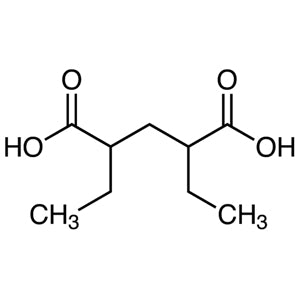
2,4-Diethylglutaric Acid (DL- and meso- mixture), with CAS number 27899-21-4, is a versatile chemical compound widely used in laboratory settings for organic synthesis. This compound serves as a building block in various chemical reactions, playing a crucial role in the development of complex molecules. Its molecular structure enables it to participate in esterification, reduction, and oxidation processes, making it a fundamental component in synthetic chemistry. Due to its chemical stability and reactivity, it is highly valued in both academic and industrial research environments.
The compound's chemical properties, including its solubility and melting point, make it ideal for use in a range of laboratory procedures. Its ability to undergo various chemical transformations without significant degradation ensures reliability in synthetic pathways. Additionally, its availability in solid form and flexible packaging options allows for easy handling and storage, supporting both small-scale experiments and larger research projects. The compound’s predictable behavior and consistent performance contribute to its popularity among chemists.
In Indonesian laboratories, 2,4-Diethylglutaric Acid is commonly used in organic chemistry research, particularly in educational institutions and research centers. Its widespread availability and competitive pricing make it a preferred choice for researchers. The compound supports a variety of applications, from basic chemical synthesis to more advanced material development. Its role in supporting scientific innovation is well-recognized in the local scientific community.
- Organic synthesis is a primary application where this compound is used to create complex molecules through esterification and oxidation reactions.
- Pharmaceutical research benefits from its ability to participate in chemical transformations, aiding in the development of new drug compounds.
- Material science applications leverage its structural properties to synthesize polymers and other advanced materials.
- Educational institutions use it for teaching and research, providing students with hands-on experience in synthetic chemistry.
- Industrial chemical processes incorporate it as a key component in the production of specialty chemicals and intermediates.
| Brand | TCI |
|---|---|
| CAS number | 27899-21-4 |
| Molecular formula | — |
| Purity | — |
| Category | Chemistry > Building Blocks > Non-Heterocyclic Building Blocks |
| Pack sizes | Available in various sizes to suit different laboratory needs |
| Physical form | Solid |
| Storage | Store in a cool, dry place away from direct sunlight |
This compound should be stored in a cool, dry environment to maintain its chemical stability and prevent degradation. It is recommended to keep it in airtight containers to avoid moisture exposure, which could affect its purity and reactivity. Due to its solid form, it is best stored in sealed containers made of materials that are chemically inert, such as glass or high-density polyethylene. Laboratory personnel should handle it with care, using appropriate personal protective equipment when necessary. The compound is generally non-hazardous under normal conditions, but it is important to follow standard laboratory safety protocols to ensure safe handling and storage.
—
Produk Terkait
-
2-MethylglutaricAcid TCI M1300
Regular price From Rp 1.167.600,00Regular price -
3-MethylglutaricAnhydride TCI M1010
Regular price Rp 2.439.150,00Regular price -
3-MethylglutaricAcid TCI M0330
Regular price From Rp 1.140.300,00Regular price -
3-Hydroxy-3-methylglutaricAcid TCI H0436
Regular price Rp 5.803.350,00Regular price -
3-Ethyl-3-methylglutaricAcid TCI E0285
Regular price Rp 3.525.900,00Regular price -
2,2-DimethylglutaricAcid TCI D1786
Regular price Rp 5.644.800,00Regular price -
2,2-DimethylglutaricAnhydride TCI D1325
Regular price From Rp 3.155.250,00Regular price -
3,3-DimethylglutaricAnhydride TCI D1323
Regular price From Rp 1.060.500,00Regular price