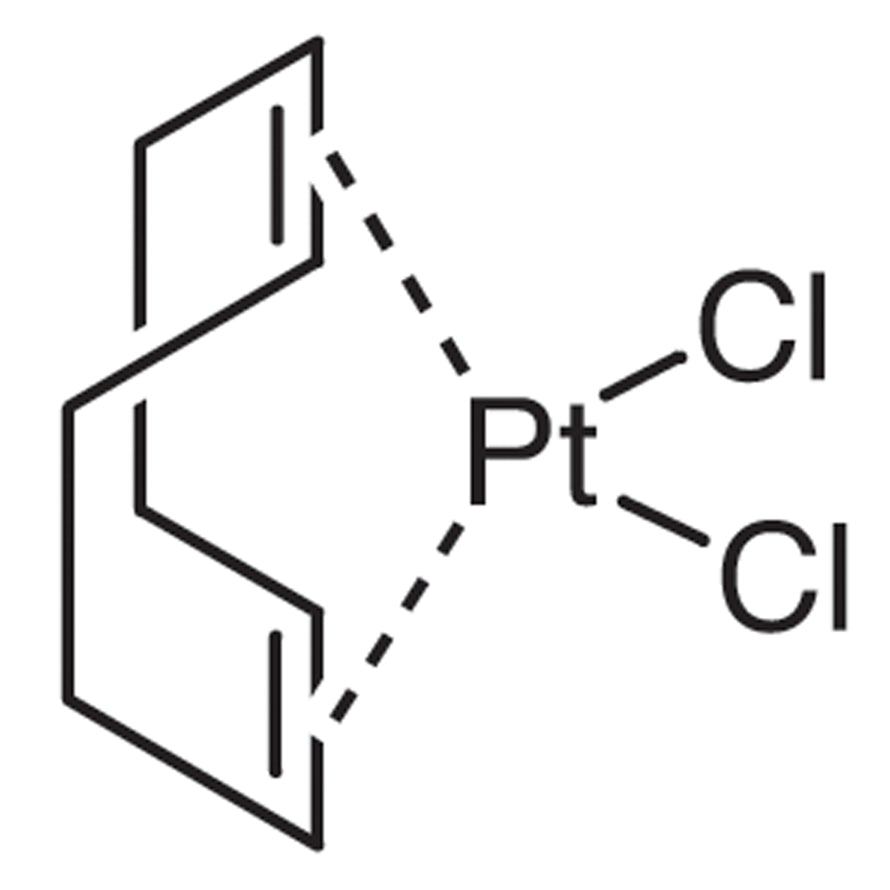
Dichloro(1,5-cyclooctadiene)platinum(II), written in much of the literature simply as Pt(COD)Cl₂, is an organoplatinum(II) complex in which a single 1,5-cyclooctadiene diene ligand and two chloride ligands surround the platinum metal centre. In the laboratory, this compound serves as a source of platinum in molecular form that is far easier to handle than platinum metal or simple inorganic platinum salts. Researchers use it as a starting point for preparing new platinum catalysts, as a subject for studying organometallic reaction mechanisms, and as a precursor to platinum-based materials at research scale.
The main characteristic that makes this complex such a frequent choice is the relatively labile nature of the cyclooctadiene ligand. That diene ligand can be displaced in a controlled manner by phosphines, N-heterocyclic carbenes, amines, or other donor ligands, allowing chemists to design the coordination environment around platinum according to their needs without beginning a synthesis from scratch. Its solid form also makes weighing precise, something that matters a great deal when working with a precious metal on a milligram scale. Because it is supplied in 200 mg and 1 g packs, consumption can be matched to the scale of the work at hand.
In Indonesian laboratories, a reagent of this kind typically belongs to university research groups, institutional research centres, and industrial R&D units working on catalysis and inorganic chemistry. It is normally ordered in the smaller pack for exploratory ligand-exchange trials and in the larger pack once a synthetic route has been established and needs to be repeated. Because platinum reagents are used sparingly, most groups keep a single pack for a project and draw from it across a series of experiments.
TCI brochures (PDF)
- Transition Metal Catalysts 2026-04-10 · p. 15
Related TCI products
- TCI T2485 14221-02-4 Tetrakis(triphenylphosphine)platinum(0)
- TCI B3115 15170-57-7 Bis(2,4-pentanedionato)platinum(II)
- TCI P3306 7440-06-4 Platinum 5% on Carbon (wetted with ca 55% Water)
- TCI P3305 7440-06-4 Platinum 3% on Carbon (wetted with ca 55% Water) (Modified by Sulfur)
- TCI P3304 7440-06-4 Platinum 2% on Carbon (wetted with ca 55% Water)
- TCI P3140 13454-96-1 Platinum(IV) Chloride
- Platinum catalyst synthesis — the labile cyclooctadiene ligand is readily displaced, so the complex acts as a convenient entry point to new platinum catalyst systems.
- Ligand exchange studies — phosphines, N-heterocyclic carbenes, and amines can be introduced in a controlled way, making it ideal for building tailored coordination environments.
- Organometallic mechanism research — as a well-defined molecular platinum(II) complex, it provides a clean, reproducible substrate for investigating reaction pathways and intermediates.
- Platinum-based materials preparation — it functions as a research-scale molecular precursor to platinum-containing materials, avoiding the difficulties of working from platinum metal.
- Teaching and method development in inorganic chemistry — its solid form allows precise milligram weighing, which suits training exercises and small-scale procedure development on precious metals.
| Brand | TCI |
|---|---|
| CAS number | 12080-32-9 |
| Molecular formula | — |
| Purity | — |
| Category | Chemistry > Catalysis and Inorganic Chemistry > Transition Elements [Catalysis and Inorganic Chemistry] |
| Pack sizes | 200 mg and 1 g |
| Physical form | solid |
| Storage | keep in the closed original container under the conditions stated on the manufacturer's label and safety data sheet |
- Catalogue reference: D3592
Store the material in its original closed container, kept tightly sealed and clearly labelled, and follow the storage conditions given on the manufacturer's label and safety data sheet. Because the compound is a solid, transfer it with clean, dry spatulas and weigh it in a container that limits exposure to air and moisture during handling. Work in a fume hood with gloves, safety glasses, and a laboratory coat, and avoid generating or inhaling dust. Given the value of platinum reagents, weigh out only what a procedure requires and return the container to storage promptly. Collect platinum-containing residues separately rather than disposing of them with general laboratory waste, and consult the safety data sheet before first use.
—
Produk Terkait
-
Tetrakis(triphenylphosphine)platinum(0) TCI T2485
Regular price Rp 3.127.950,00Regular price -
Bis(2,4-pentanedionato)platinum(II) TCI B3115
Regular price From Rp 5.300.400,00Regular price -
Platinum5%onCarbon(wettedwithca55%Water) TCI P3306
Regular price From Rp 2.650.200,00Regular price -
Platinum3%onCarbon(wettedwithca55%Water)(ModifiedbySulfur) TCI P3305
Regular price From Rp 3.100.650,00Regular price -
Platinum2%onCarbon(wettedwithca55%Water) TCI P3304
Regular price From Rp 2.174.550,00Regular price -
Platinum(IV)Chloride TCI P3140
Regular price From Rp 2.279.550,00Regular price -
Platinum(0)-1,3-DivinyltetramethyldisiloxaneComplex(19.0-21.5%asPt)(contains1,3-Divinyltetramethyldisiloxane) TCI P2075
Regular price From Rp 3.419.850,00Regular price -
Platinum(II)Chloride TCI P1920
Regular price Rp 4.479.300,00Regular price