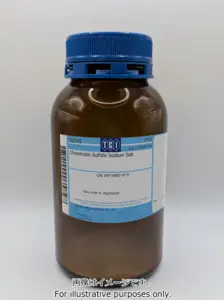
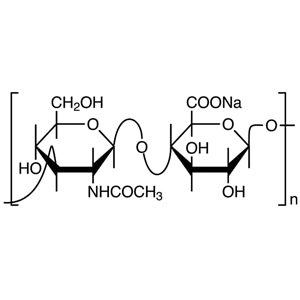
TCI D3672 Dermatan Sulfate Sodium Salt is a sulfated glycosaminoglycan supplied in sodium salt form for glycoscience research. Dermatan sulfate is a long-chain polysaccharide that occurs naturally as a component of the extracellular matrix in skin, blood vessels, tendons, and a wide range of connective tissues. In the laboratory, this material serves as a substrate, a ligand, and a reference compound for studying the structure and function of glycosaminoglycans, their interactions with proteins, and their roles in biological processes such as blood coagulation, tissue remodeling, and cell recognition.
The properties that make this material a preferred choice centre on its charge chemistry. The sulfate and carboxylate groups distributed along the polysaccharide backbone give the chain a high negative charge density, and this charge density is the basis of dermatan sulfate's strong interaction with positively charged proteins. That same behaviour underpins many analytical methods, from electrophoresis and anion-exchange chromatography through to affinity-based binding assays. The sodium salt form dissolves readily in aqueous media, so the material can be taken directly into biochemical and cell biology experiments without additional preparation steps.
In Indonesian laboratories, materials of this type are typically used in university research groups, biochemistry and molecular biology teaching laboratories, and institutional research centres working on connective tissue, matrix biology, and carbohydrate chemistry. Because it is a naturally derived polymer supplied in a water-soluble salt form, it fits well into workflows that rely on buffered aqueous systems and standard benchtop instrumentation, and it is generally handled alongside other biochemical reagents under routine laboratory conditions.
TCI brochures (PDF)
- Anti-Glycosaminoglycan Antibodies 2023-07-28 · p. 2
- Polysaccharides 2025-02-13 · p. 1
- Drug Delivery System (DDS) Research Reagents 2025-01-29 · p. 1
- Reagents for Glyco Chemistry & Biology 5th Edition · p. 115
- Biomaterials Research Reagents 2025-02-19 · p. 4
- Reagents for Biological Research 2025-03-11 · p. 54
Related TCI products
- TCI C0335 9082-07-9 Chondroitin Sulfate Sodium Salt
- TCI H0652 31799-91-4 Potassium Hyaluronate from Cockscomb
- TCI H0603 9067-32-7 Sodium Hyaluronate from Cockscomb
- TCI C2395 9012-76-4 Chitosan (5-20mPa.s, 0.5% in 0.5% Acetic Acid at 20deg C)
- TCI C1805 9062-07-1 iota-Carrageenan
- TCI C1804 11114-20-8 kappa-Carrageenan
- Glycosaminoglycan structure and function studies — the material provides a defined dermatan sulfate preparation that researchers can use as a reference chain when characterising sulfation patterns and polysaccharide backbone architecture.
- Protein–glycosaminoglycan interaction assays — the high negative charge density along the chain drives strong binding to positively charged proteins, making it a suitable ligand for interaction and competition experiments.
- Anion-exchange chromatography — the sulfate and carboxylate groups give the polymer predictable retention behaviour on anion-exchange media, so it works well as a test analyte or method development standard.
- Electrophoretic analysis of sulfated polysaccharides — the strongly anionic character of the chain allows clear migration in electrophoretic separations used to compare and identify glycosaminoglycan species.
- Extracellular matrix and cell biology experiments — as a natural connective tissue component, it is used to investigate tissue remodeling, cell recognition, and coagulation-related processes in biochemical and cell culture systems.
| Brand | TCI |
|---|---|
| CAS number | 54328-33-5 |
| Molecular formula | — |
| Purity | — |
| Category | Chemistry > Chemical Biology > Glycoscience |
| Pack sizes | available in standard TCI research packaging; please confirm the required size when ordering |
| Physical form | — |
| Storage | store according to the manufacturer's instructions on the product label |
- Chemical form: sodium salt of dermatan sulfate, a sulfated glycosaminoglycan
- Solubility: readily soluble in aqueous media, suitable for direct use in buffered systems
Store the container tightly closed in a cool, dry place, protected from moisture and away from direct sunlight, and follow the storage conditions stated on the manufacturer's label. As a hygroscopic-prone polysaccharide salt, the material should be allowed to reach room temperature before opening to reduce moisture condensation inside the container. Use clean, dry spatulas and keep the original container or an equivalent tightly sealed vessel for storage. Handle in a well-ventilated area, wear a laboratory coat, gloves, and safety glasses, avoid generating dust, and prepare aqueous solutions in clean glassware with laboratory-grade water. Consult the manufacturer's safety data sheet before use and dispose of residues in accordance with local laboratory waste regulations.
—
Product Categories
- GlycoscienceApplications Using Glyco-materialsGlyco-engeneering [Applications Using Glyco-materials]
- GlycoscienceApplications Using Glyco-materialsGlyco-utilization [Applications Using Glyco-materials]
- GlycoscienceFunctional OligosaccharidesGlycosaminoglycan [Functional Oligosaccharides]
- GlycoscienceFunctional OligosaccharidesPolysaccharides [Functional Oligosaccharides]
- GlycoscienceFunctional OligosaccharidesSulfated Sugars [Functional Oligosaccharides]
- GlycosciencePolysaccharides [Glycoscience]
- Biochemicals and ReagentsCarbohydrates
- Pharmaceutical Development and Drug Discovery ResearchDrug Delivery Systems (DDS)Natural Polymers (for DDS)
Produk Terkait
-
ChondroitinSulfateSodiumSalt TCI C0335
Regular price From Rp 2.121.000,00Regular priceRp 1.498.350,00Sale price From Rp 2.121.000,00 -
PotassiumHyaluronatefromCockscomb TCI H0652
Regular price Rp 9.459.450,00Regular priceRp 6.630.750,00Sale price Rp 9.459.450,00 -
SodiumHyaluronatefromCockscomb TCI H0603
Regular price From Rp 2.411.850,00Regular priceRp 1.702.050,00Sale price From Rp 2.411.850,00 -
Chitosan(5-20mPa.s,0.5%in0.5%AceticAcidat20degC) TCI C2395
Regular price Rp 717.150,00Regular priceRp 516.600,00Sale price Rp 717.150,00 -
iota-Carrageenan TCI C1805
Regular price From Rp 848.400,00Regular priceRp 609.000,00Sale price From Rp 848.400,00 -
kappa-Carrageenan TCI C1804
Regular price From Rp 1.008.000,00Regular priceRp 720.300,00Sale price From Rp 1.008.000,00 -
Chitosan(200-600mPas,05%in05%AceticAcidat20degC) TCI C0831
Regular price From Rp 717.150,00Regular priceRp 516.600,00Sale price From Rp 717.150,00 -
PotassiumHyaluronatefromBacteria TCI H1808
Regular price Rp 7.287.000,00Regular priceRp 5.111.400,00Sale price Rp 7.287.000,00