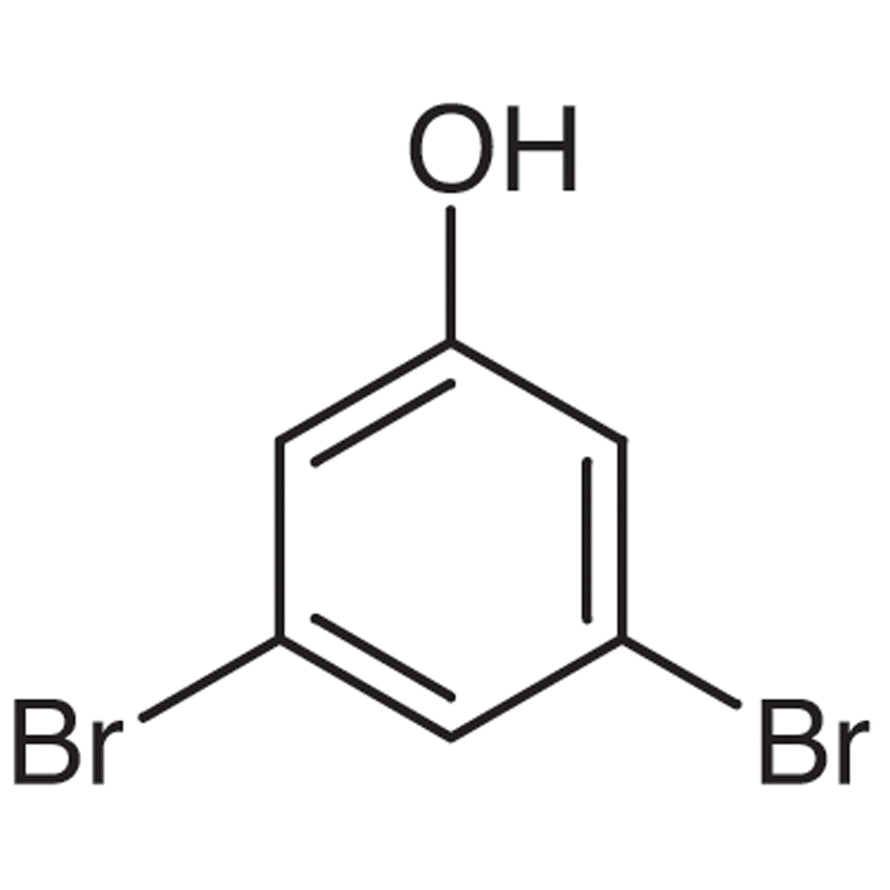
TCI D3820 with CAS number 626-41-5 is 3,5-Dibromophenol, an aromatic phenol compound carrying two bromine atoms at positions meta to the hydroxy group. This compound serves as a useful non-heterocyclic building block because it provides three distinct reactive points within a single molecule: the phenolic hydroxy group and two carbon–bromine bonds. In organic synthesis laboratories, molecules with such a clearly defined substitution pattern are highly valued, since they allow branched or symmetrical structures to be constructed in a controlled manner without the need for troublesome isomer separation steps.
The property that makes this compound a frequent choice is the reactivity of its carbon–bromine bonds, which are readily activated by palladium or copper catalysts, so the material can be used directly in a wide range of cross-coupling reactions. The symmetrical placement of the two bromine atoms relative to the hydroxy group permits double substitution to give symmetrical products, or stepwise substitution when the reaction conditions are controlled carefully. Meanwhile, the hydroxy group can be protected beforehand through etherification or esterification and then deprotected once the coupling stage is complete. This flexibility in the order of reactions is what makes the compound a dependable starting material for multi-step synthetic routes.
In Indonesian laboratories, 3,5-Dibromophenol is typically handled in university research groups, government research institutes, and industrial R&D units engaged in organic synthesis and materials development. It is generally used at bench scale, weighed out for a defined reaction sequence rather than consumed in bulk, and stored with other halogenated aromatic reagents in a controlled chemical store. Laboratories usually plan their orders around a specific synthetic project so that the material is used while it remains in good condition.
- Suzuki–Miyaura cross-coupling: the two aryl–bromine bonds are readily activated by palladium catalysts, letting chemists install one or two aryl groups onto the phenol ring in a single controlled reaction sequence.
- Symmetrical scaffold construction: because both bromine atoms sit symmetrically relative to the hydroxy group, double substitution under identical conditions yields symmetrical products without laborious separation of positional isomers afterwards.
- Stepwise mono-functionalisation: with carefully controlled reaction conditions, only one carbon–bromine bond can be engaged first, giving access to unsymmetrical intermediates that carry a second bromine for later elaboration.
- Copper-mediated coupling chemistry: the carbon–bromine bonds also respond to copper catalysis, which supports classical Ullmann-type bond formation when palladium systems are unsuitable for the substrate or route.
- Protected-phenol synthetic routes: the hydroxy group can be masked by etherification or esterification before coupling and restored afterwards, giving flexible control over the order of steps in multi-stage syntheses.
| Brand | TCI (Tokyo Chemical Industry) |
|---|---|
| CAS number | 626-41-5 |
| Molecular formula | — |
| Purity | — |
| Category | Chemistry > Building Blocks > Non-Heterocyclic Building Blocks |
| Pack sizes | supplied in standard TCI catalogue research pack sizes; please confirm the currently available packaging when ordering |
| Physical form | — |
| Storage | keep in the tightly closed original container, protected from light and moisture, in accordance with the manufacturer's product documentation |
- Chemical name: 3,5-Dibromophenol
Store 3,5-Dibromophenol in its original, tightly closed container in a cool, dry, well-ventilated chemical store, kept away from light, moisture, and incompatible materials such as strong oxidising agents and strong bases. Amber glass or the supplier's original packaging is preferred, since exposure to air and humidity can degrade the appearance and handling quality of the solid. As with other halogenated phenolic compounds, weigh and transfer the material inside a fume hood while wearing safety goggles, chemically resistant gloves, and a laboratory coat, and avoid generating dust. Close the container immediately after use, label any secondary containers clearly, and collect halogenated organic waste separately. Always consult the manufacturer's Safety Data Sheet before first use.
—
Produk Terkait
-
2,6-Dibromophenol TCI D3384
Regular price From Rp 1.696.800,00Regular price -
2,4-Dibromophenol TCI D0265
Regular price From Rp 1.115.100,00Regular price -
4-Bromophenol[forBiochemicalResearch] TCI B3910
Regular price From Rp 717.150,00Regular price -
4-Bromophenol TCI B0787
Regular price From Rp 664.650,00Regular price -
2-Bromophenol TCI B0630
Regular price From Rp 2.016.000,00Regular price -
3-Bromophenol TCI B0629
Regular price Rp 2.094.750,00Regular price -
2,4,6-Tribromophenol TCI T0349
Regular price From Rp 769.650,00Regular price -
BromophenolRed TCI B0632
Regular price From Rp 1.087.800,00Regular price


![106-41-2 4-Bromophenol [for Biochemical Research] - AMI Scientific](http://amiscientific.com/cdn/shop/files/TCI2510B3910_a28465ae-6b1a-4bff-913f-1a43d04c54cf.jpg?v=1767434602&width=533)