

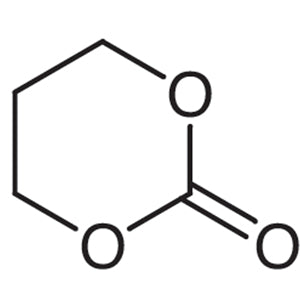
TCI D3821 with CAS number 2453-03-4 is 1,3-Dioxan-2-one, a six-membered cyclic carbonate compound also widely known as trimethylene carbonate. The molecule consists of a carbonate group enclosed within a ring, and it is precisely this ring that is the source of its usefulness. In the laboratory, this compound serves as a monomer for ring-opening polymerization, a process that converts small ring-bearing molecules into long polymer chains. The resulting poly(trimethylene carbonate) is a biodegradable polymer that has been extensively studied for biomedical applications.
The key characteristic that makes it a preferred choice is the carbonate linkage along the polymer chain, which can be slowly hydrolyzed into degradation products that are neutral in character, unlike polyesters such as polylactide, which yield acidic degradation products. This property matters in biomedical applications because an environment that is too acidic can trigger inflammatory reactions in tissue. In addition, poly(trimethylene carbonate) is flexible and elastic at room temperature, so it is frequently copolymerized with other monomers to tune flexibility, degradation rate, and the mechanical properties of the material.
In Indonesian laboratories, this monomer is typically used in academic and industrial research groups working on drug delivery systems (DDS) and biodegradable polymers for biomedical use. It is handled in polymer synthesis laboratories where ring-opening polymerization is carried out, and in formulation development work where degradation behaviour and material flexibility must be adjusted by copolymerization with other monomers. It supports pharmaceutical development and drug discovery research programmes that require well-defined, reproducible starting materials.
- Ring-opening polymerization studies: the six-membered cyclic carbonate ring opens readily to build long polymer chains, making it a direct monomer feedstock for this reaction.
- Biodegradable polymer synthesis: it yields poly(trimethylene carbonate), a biodegradable polymer whose carbonate linkages hydrolyze slowly, allowing controlled degradation to be studied in detail.
- Drug delivery system (DDS) research: the slow, neutral hydrolysis of the polymer backbone suits carrier materials where acidic degradation products would be undesirable in tissue.
- Biomedical materials development: poly(trimethylene carbonate) is flexible and elastic at room temperature, making it useful for soft, compliant biomedical constructs rather than rigid ones.
- Copolymerization work: it is frequently combined with other monomers so researchers can deliberately tune flexibility, degradation rate, and the mechanical properties of the final material.
| Brand | TCI |
|---|---|
| CAS number | 2453-03-4 |
| Molecular formula | — |
| Purity | — |
| Category | Chemistry > Pharmaceutical Development and Drug Discovery Research Reagents > Drug Delivery Systems (DDS) |
| Pack sizes | available in standard TCI research-scale packaging; please confirm the pack size options when ordering |
| Physical form | — |
| Storage | store according to the manufacturer's instructions stated on the product label and safety data sheet |
- Chemical name: 1,3-Dioxan-2-one (trimethylene carbonate)
Store the container in a cool, dry, well-ventilated area, tightly closed and protected from moisture, since cyclic carbonates are susceptible to hydrolysis. Keep the material in its original manufacturer-supplied container, or in a clean, dry, tightly sealed glass container that is clearly labelled. For polymerization work, transfer and weigh the monomer under dry conditions to preserve reaction reproducibility. Handle in a well-ventilated laboratory area or fume hood, wear a laboratory coat, safety glasses, and suitable gloves, and avoid contact with skin and eyes as well as inhalation of dust. Always consult the manufacturer's safety data sheet before use, and follow institutional procedures for chemical waste disposal.
—
Produk Terkait
-
4-Bromotetrahydro-2H-pyran TCI B5600
Regular price From Rp 1.060.500,00Regular price -
3,3-Bis(bromomethyl)oxetane TCI B5641
Regular price From Rp 1.035.300,00Regular price -
1,3:2,4-Bis-O-(3,4-dimethylbenzylidene)-D-sorbitol TCI B5693
Regular price From Rp 689.850,00Regular price -
1-Bromodibenzofuran TCI B5766
Regular price Rp 1.378.650,00Regular price -
2-Bromo-9,9-dimethyl-9H-xanthene TCI B5794
Regular price Rp 2.411.850,00Regular price -
2-Bromobenzo[b]naphtho[2,3-d]furan TCI B5805
Regular price From Rp 2.254.350,00Regular price -
2,8-Bis(diphenylphosphoryl)dibenzo[b,d]furan TCI B5822
Regular price From Rp 2.306.850,00Regular price -
2-Bromospiro[9H-fluorene-9,9'-[9H]xanthene] TCI B5842
Regular price Rp 1.246.350,00Regular price


![2-Bromobenzo[b]naphtho[2,3-d]furan (CAS 1627917-16-1) - TCI B5805 - AMI Scientific](http://amiscientific.com/cdn/shop/files/TCI2510B5805.jpg?v=1768815902&width=533)
![2,8-Bis(diphenylphosphoryl)dibenzo[b,d]furan (CAS 911397-27-8) - TCI B5822 - AMI Scientific](http://amiscientific.com/cdn/shop/files/TCI2510B5822.jpg?v=1768815910&width=533)
![2-Bromospiro[9H-fluorene-9,9'-[9H]xanthene] (CAS 899422-06-1) - TCI B5842 - AMI Scientific](http://amiscientific.com/cdn/shop/files/TCI2510B5842_e2ad23d0-bb0e-4716-9985-8039749f6ec4.jpg?v=1767863565&width=533)