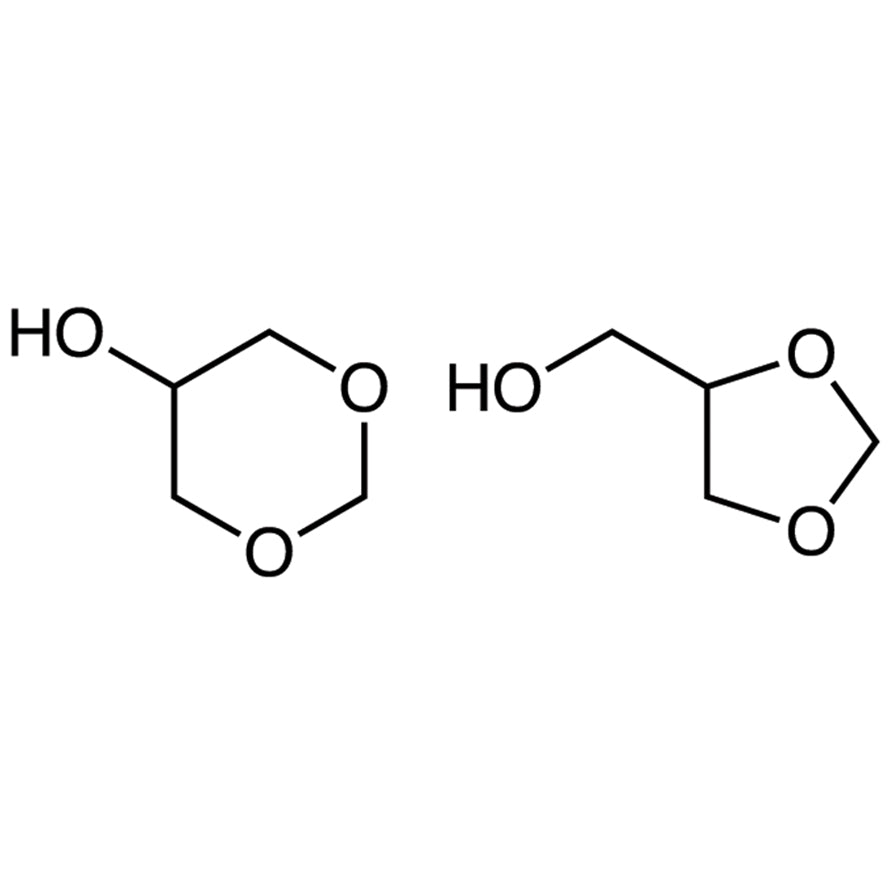
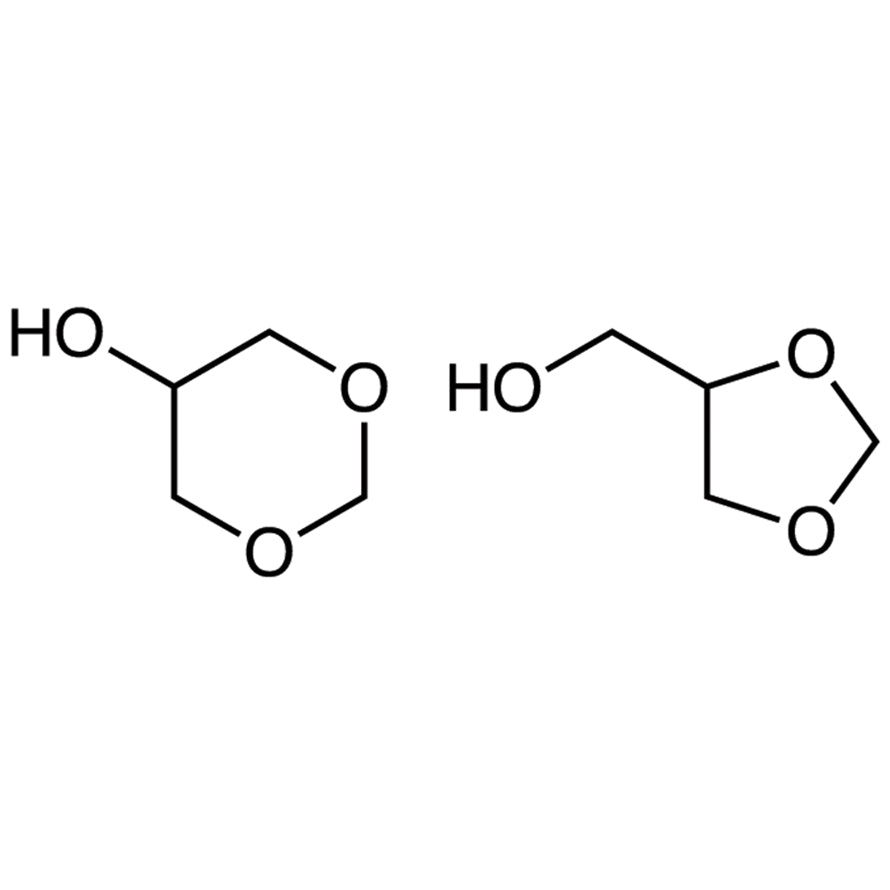
Glycerol Formal is a chemical compound composed of a mixture of 1,3-Dioxan-5-ol and 4-Hydroxymethyldioxolane. It is widely used in laboratory settings as a building block for the synthesis of complex organic compounds. This versatile reagent plays a crucial role in various chemical reactions, particularly those involving carbon-carbon bond formation and substitution reactions. Due to its reactivity and functional group versatility, it is a valuable tool for chemists working on synthetic pathways and molecular design.
One of the key properties that make Glycerol Formal a preferred choice is its solubility in organic solvents, which facilitates its use in a wide range of chemical processes. Its ability to participate in multiple reaction types, such as oxidation, reduction, and condensation, makes it highly adaptable to different synthetic strategies. Additionally, its chemical stability under controlled conditions ensures reliable performance in laboratory experiments. These characteristics make it a go-to reagent for researchers seeking to manipulate molecular structures with precision.
In Indonesian laboratories, Glycerol Formal is commonly used in both academic and industrial research settings. It is frequently found in organic synthesis labs, where it contributes to the development of new compounds and materials. Its application spans across various fields, including pharmaceuticals, polymer science, and analytical chemistry. The compound’s reactivity and solubility properties make it a popular choice for both small-scale experiments and larger-scale production processes.
Related TCI products
- TCI G0391 4740-78-7 Glycerol Formal (=1,3-Dioxan-5-ol)
- TCI B3905 847682-00-2 1,3-Bis[(2,2-dimethyl-1,3-dioxan-5-yl)oxy]-2-propanol
- TCI P1422 1708-40-3 2-Phenyl-1,3-dioxan-5-ol
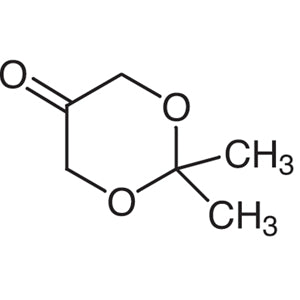
- TCI D2397 74181-34-3 2,2-Dimethyl-1,3-dioxan-5-one
- TCI G0159 93-14-1 Guaiacol Glycerol Ether
- TCI B2938 1830-78-0 Glycerol Dimethacrylate (mixture of 1,2- and 1,3-form) (stabilized with MEHQ)
- Organic synthesis is a primary application where Glycerol Formal is used to build complex molecules through carbon-carbon bond formation and substitution reactions.
- Polymer chemistry benefits from Glycerol Formal due to its ability to participate in condensation reactions, aiding in the creation of various polymeric materials.
- Analytical chemistry utilizes Glycerol Formal as a reagent in derivatization processes, enhancing the detectability of compounds in chromatographic analysis.
- Pharmaceutical research incorporates Glycerol Formal in the development of new drug molecules, leveraging its reactivity and functional group versatility.
- Industrial chemical processes employ Glycerol Formal for the synthesis of specialty chemicals, contributing to the production of high-value compounds.
| Brand | TCI |
|---|---|
| CAS number | 99569-11-6 |
| Molecular formula | — |
| Purity | — |
| Category | Chemistry > Building Blocks > Non-Heterocyclic Building Blocks |
| Pack sizes | 11 g, 100 g, 500 g |
| Physical form | Liquid |
| Storage | Store in a cool, dry place away from direct sunlight |
Glycerol Formal should be stored in a cool, dry place, away from direct sunlight and sources of heat. It is recommended to use airtight containers made of glass or polyethylene to prevent contamination and evaporation. Due to its reactivity, it should be handled with care, and appropriate personal protective equipment, such as gloves and safety goggles, should be worn during use. It is important to ensure good ventilation in the laboratory when working with this compound to minimize exposure. Proper labeling of containers is essential for safe handling and storage. Always follow standard laboratory safety protocols when working with reactive chemicals like Glycerol Formal.
—
Produk Terkait
-
GlycerolFormal(=1,3-Dioxan-5-ol) TCI G0391
Regular price Rp 2.174.550,00Regular price -
1,3-Bis[(2,2-dimethyl-1,3-dioxan-5-yl)oxy]-2-propanol TCI B3905
Regular price Rp 3.340.050,00Regular price -
2-Phenyl-1,3-dioxan-5-ol TCI P1422
Regular price Rp 3.155.250,00Regular price -
2,2-Dimethyl-1,3-dioxan-5-one TCI D2397
Regular price From Rp 2.650.200,00Regular price -
GuaiacolGlycerolEther TCI G0159
Regular price From Rp 505.050,00Regular price -
GlycerolDimethacrylate(mixtureof1,2-and1,3-form)(stabilizedwithMEHQ) TCI B2938
Regular price From Rp 584.850,00Regular price -
2-[5-[(Acryloyloxy)methyl]-5-ethyl-1,3-dioxan-2-yl]-2-methylpropylAcrylate(cis-andtrans-mixture)(stabilizedwithMEHQ) TCI A3441
Regular price From Rp 717.150,00Regular price -
2-Methylcyclohexanol(cis-andtrans-mixture) TCI M0194
Regular price From Rp 505.050,00Regular price

![847682-00-2 1,3-Bis[(2,2-dimethyl-1,3-dioxan-5-yl)oxy]-2-propanol - AMI Scientific](http://amiscientific.com/cdn/shop/files/TCI2510B3905.jpg?v=1768815545&width=533)


![87320-05-6 2-[5-[(Acryloyloxy)methyl]-5-ethyl-1,3-dioxan-2-yl]-2-methylpropyl Acrylate (cis- and trans- mixture) (stabilized with MEHQ) - AMI Scientific](http://amiscientific.com/cdn/shop/files/TCI_2d23138a-b518-415d-aefb-3428d352b070.png?v=1766990301&width=533)
![87320-05-6 2-[5-[(Acryloyloxy)methyl]-5-ethyl-1,3-dioxan-2-yl]-2-methylpropyl Acrylate (cis- and trans- mixture) (stabilized with MEHQ) - AMI Scientific](http://amiscientific.com/cdn/shop/files/TCI2510A3441_f179309e-2b81-4117-b739-ac1ecccfff63.jpg?v=1769055145&width=533)