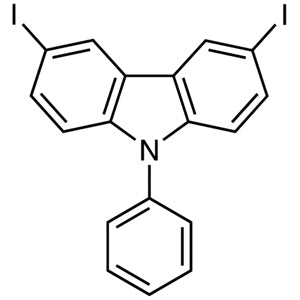
3,6-Diiodo-9-phenylcarbazole is a chemical compound classified under the category of heterocyclic building blocks. It plays a crucial role in laboratory settings by serving as a foundational material for the synthesis of complex organic compounds. This compound is widely used in chemical reactions to construct more intricate molecular structures, particularly in the fields of organic chemistry and pharmacology. Its versatility makes it an essential tool for researchers aiming to develop new compounds with specific functional properties.
The compound's unique chemical structure, featuring two iodine atoms attached at positions 3 and 6 of the carbazole ring, contributes to its high reactivity. This reactivity allows it to participate in various chemical reactions such as substitution, reduction, and condensation. Its ability to interact with a wide range of reagents makes it a preferred choice for synthetic chemists. The presence of iodine atoms also enhances its potential for further functionalization, making it a valuable intermediate in the creation of pharmaceutical and organic compounds.
In Indonesian laboratories, 3,6-Diiodo-9-phenylcarbazole is commonly used in scientific research, especially in the fields of organic chemistry and pharmacology. It is a key component in experiments aimed at synthesizing new compounds and exploring their properties. Many research institutions and universities in Indonesia rely on this compound as a building block for their experimental work, contributing to advancements in chemical science and drug development.
TCI brochures (PDF)
- Carbazoles 2025-06-27 · p. 5
- Building Blocks for Organic Semiconductor 2026-03-24 · p. 20
Related TCI products
- Organic synthesis applications benefit from this compound’s reactivity and structural versatility, enabling the creation of complex molecules.
- Pharmaceutical research utilizes its iodinated structure for the development of new drug candidates with tailored properties.
- Heterocyclic compound synthesis relies on its unique carbazole framework, which can be modified for various functional groups.
- Academic research in chemistry uses it as a fundamental building block for teaching and experimental studies.
- Industrial chemical processes incorporate it as an intermediate in the production of specialized organic compounds.
| Brand | TCI |
|---|---|
| CAS number | 57103-21-6 |
| Molecular formula | — |
| Purity | — |
| Category | Chemistry > Building Blocks > Heterocyclic Building Blocks |
| Pack sizes | Available in standard laboratory quantities as per supplier specifications |
| Physical form | Solid, crystalline appearance |
| Storage | Store in a cool, dry place away from light and moisture |
This compound should be stored in a cool, dry environment, away from direct light and moisture to maintain its chemical integrity. It is recommended to use airtight containers made of glass or high-density polyethylene to prevent contamination and degradation. Due to its reactivity, it should be handled in a well-ventilated area, and appropriate personal protective equipment such as gloves and safety goggles should be worn. Avoid exposure to incompatible substances, and ensure proper disposal following local regulations. Regular monitoring of storage conditions is advised to ensure the compound remains stable and suitable for use in laboratory applications.
—
Product Categories
Produk Terkait
-
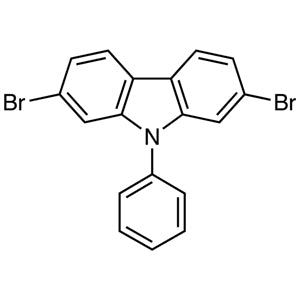
2,7-Dibromo-9-phenylcarbazole TCI D4832
Regular price From Rp 903.000,00Regular price -
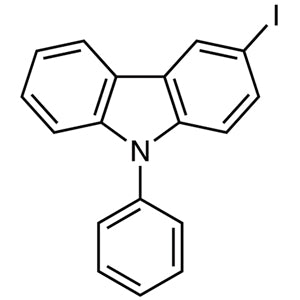
3-Iodo-9-phenylcarbazole TCI I0913
Regular price From Rp 955.500,00Regular price -
3-Bromo-6,9-diphenylcarbazole TCI B4795
Regular price From Rp 689.850,00Regular price -
3-(4-Bromophenyl)-9-phenylcarbazole TCI B4452
Regular price From Rp 477.750,00Regular price -
2-Bromo-9-phenylcarbazole TCI B4439
Regular price From Rp 1.961.400,00Regular price -
3-Bromo-9-phenylcarbazole TCI B3908
Regular price From Rp 980.700,00Regular price -
3,6-Dibromo-9-phenylcarbazole TCI D2981
Regular price From Rp 1.035.300,00Regular price -
9-Benzyl-3,6-dibromocarbazole TCI B4348
Regular price From Rp 1.749.300,00Regular price