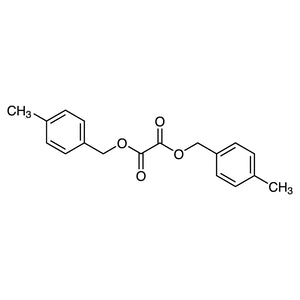
Bis(4-methylbenzyl) Oxalate is a chemical compound widely used in organic synthesis as a building block for creating complex molecular structures. It serves as a versatile reagent in laboratory settings, particularly in reactions involving carbon-carbon bond formation or functional group substitution. This compound is valued for its ability to participate in various synthetic pathways, making it a key component in the development of new organic compounds. Its chemical stability and controlled reactivity ensure predictable outcomes in experimental processes, which is essential for reliable research results.
The compound’s chemical properties make it a preferred choice for researchers. It exhibits relatively low reactivity under normal conditions, which simplifies handling and storage. Additionally, its high melting and boiling points allow it to remain stable during high-temperature reactions without degradation. These characteristics ensure consistency in experimental outcomes, making it ideal for use in demanding chemical processes. The compound’s predictable behavior and stability contribute to its reliability in both academic and industrial research environments.
In Indonesian laboratories, Bis(4-methylbenzyl) Oxalate is commonly used in organic chemistry research, particularly in universities and research institutions. Its role in constructing complex molecular frameworks is vital for students and scientists working on synthetic chemistry projects. The compound’s availability and reliability make it a standard material in chemical laboratories across Indonesia, supporting both educational and research activities.
Related TCI products
- Organic synthesis applications benefit from its role in constructing complex molecular frameworks through carbon-carbon bond formation and functional group substitution.
- It is ideal for functional group modification in compound development, offering controlled reactivity for targeted chemical transformations.
- The compound supports high-temperature reactions due to its high melting and boiling points, ensuring stability during demanding experimental conditions.
- It is used in academic research settings to teach and practice synthetic chemistry techniques to students and researchers.
- Its chemical stability and predictable behavior make it suitable for long-term storage and repeated use in laboratory experiments.
| Brand | TCI |
|---|---|
| CAS number | 18241-31-1 |
| Molecular formula | — |
| Purity | — |
| Category | Chemistry > Building Blocks > Non-Heterocyclic Building Blocks |
| Pack sizes | Available in standard laboratory quantities as per supplier specifications |
| Physical form | Solid |
| Storage | Store in a cool, dry place away from direct sunlight and incompatible materials |
Bis(4-methylbenzyl) Oxalate should be stored in a cool, dry environment to maintain its chemical stability. It is recommended to keep the compound in airtight containers to prevent moisture absorption and contamination. Due to its relatively low reactivity, it does not require special handling under normal laboratory conditions. However, it should be stored away from strong oxidizing agents and reactive substances to avoid unintended chemical interactions. The compound is generally safe to handle with standard laboratory precautions, including the use of gloves and proper ventilation. Its physical form as a solid makes it easy to manage and store in standard chemical cabinets. Regular inspection of storage conditions is advised to ensure long-term integrity and usability in research applications.
—
Produk Terkait
-
4-MethylbenzylAcetate TCI M1744
Regular price From Rp 1.060.500,00Regular price -
4-MethylbenzylPhenylKetone TCI M1639
Regular price From Rp 1.908.900,00Regular price -
Bis[3,4,6-trichloro-2-(pentyloxycarbonyl)phenyl]Oxalate TCI O0236
Regular price From Rp 2.199.750,00Regular price -
DiethylOxalate[forSpectrophotometry] TCI O0120
Regular price Rp 2.730.000,00Regular price -
DiphenylOxalate TCI O0111
Regular price From Rp 2.597.700,00Regular price -
DimethylOxalate TCI O0080
Regular price From Rp 530.250,00Regular price -
DiethylOxalate TCI O0078
Regular price From Rp 505.050,00Regular price -
DibutylOxalate TCI O0077
Regular price From Rp 584.850,00Regular price

![30431-54-0 Bis[3,4,6-trichloro-2-(pentyloxycarbonyl)phenyl] Oxalate - AMI Scientific](http://amiscientific.com/cdn/shop/files/TCI2510O0236.jpg?v=1767131634&width=533)
![95-92-1 Diethyl Oxalate [for Spectrophotometry] - AMI Scientific](http://amiscientific.com/cdn/shop/files/TCI2510O0120.jpg?v=1767131409&width=533)