TCI E0067 2-Ethyl-1-butene is a six-carbon alkene with a terminal double bond in which one carbon atom carries two substituents. Its structure is simple, but the terminal double bond is a reactive site that is easy to transform through a wide range of addition reactions. In the catalogue it is classified as a non-heterocyclic building block. This means it serves as a starting material or basic framework for building more complex organic molecules in laboratory synthesis, where a well-defined alkene unit is needed early in a synthetic route.
Chemists choose this compound for the characteristic reactivity of its double bond. As a 1,1-disubstituted alkene, it generally gives clear selectivity in electrophilic addition reactions that follow Markovnikov's rule. Reactions such as hydroboration give products with the opposite orientation. The two ethyl groups on the same carbon make the molecule symmetrical, so fewer product isomers are possible and reaction outcomes are easier to analyse and interpret. It is a highly volatile liquid, so it can be separated readily from reaction mixtures after use, which makes work-up and purification simpler.
In organic chemistry laboratories at Indonesian universities, 2-ethyl-1-butene is useful for practical classes and research that study alkene reactivity, reaction regioselectivity, and the behaviour of addition reactions on substituted double bonds. Research groups working on synthetic methodology can use it as a straightforward model substrate. Teaching laboratories can use it to show students how substitution patterns influence product formation, because its symmetrical structure keeps the set of possible products small and makes spectra and chromatograms easier to read.
Related TCI products
- TCI T0671 594-56-9 2,3,3-Trimethyl-1-butene
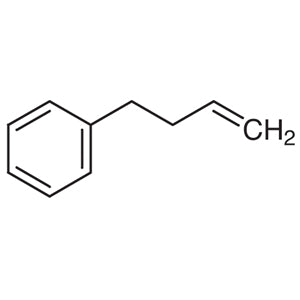
- TCI P0161 768-56-9 4-Phenyl-1-butene
- TCI P0067 513-35-9 2-Methyl-2-butene
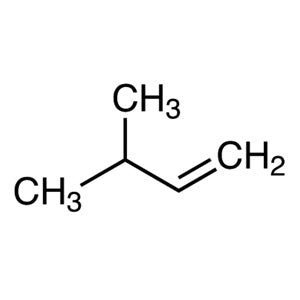
- TCI M2565 563-45-1 3-Methyl-1-butene (ca 125% in Tetrahydrofuran, ca 15mol/L)
- TCI M2563 563-45-1 3-Methyl-1-butene (ca. 15% in Dichloromethane, ca. 2.5mol/L)
- TCI M0708 513-35-9 2-Methyl-2-butene
- Electrophilic addition studies: the 1,1-disubstituted terminal double bond gives clear Markovnikov selectivity, so it works well for demonstrating and investigating regioselective additions in organic chemistry courses.
- Hydroboration experiments: hydroboration gives the opposite orientation to Markovnikov addition, so researchers and students can compare two complementary regiochemical outcomes on the same simple substrate.
- Building block for organic synthesis: as a non-heterocyclic building block, it provides a reactive alkene framework that can be functionalised and carried forward into larger, more complex organic molecules.
- Model substrate for methodology development: its symmetrical structure, with two ethyl groups on one carbon, limits the number of possible isomers, which simplifies product analysis when new reaction conditions are tested.
- Teaching laboratory practicals on alkene reactivity: its simple structure and easy removal as a volatile liquid make it suitable for undergraduate experiments that focus on reaction outcomes and product identification.
| Brand | TCI (product code E0067) |
|---|---|
| CAS number | 760-21-4 |
| Molecular formula | — |
| Purity | — |
| Category | Chemistry > Building Blocks > Non-Heterocyclic Building Blocks |
| Pack sizes | see the available pack options on the product page |
| Physical form | highly volatile liquid |
| Storage | keep tightly closed in a cool, well-ventilated area away from heat and ignition sources |
Because 2-Ethyl-1-butene is a highly volatile liquid, keep it in its original, tightly sealed container to limit evaporation and vapour build-up. Store the container in a cool, dry, well-ventilated area that is suitable for flammable organic liquids, away from heat, sparks, open flames, and strong oxidising agents. Handle the material in a fume hood, and wear appropriate personal protective equipment, including safety glasses, chemical-resistant gloves, and a laboratory coat. Use grounded equipment where appropriate, and keep containers closed when not in use. Before use, consult the supplier's Safety Data Sheet for detailed hazard, storage, and disposal information, and follow your institution's chemical safety procedures.
—
Produk Terkait
-
2,3,3-Trimethyl-1-butene TCI T0671
Regular price From Rp 961.000,00Regular priceRp 653.000,00Sale price From Rp 961.000,00 -
4-Phenyl-1-butene TCI P0161
Regular price From Rp 831.000,00Regular priceRp 565.000,00Sale price From Rp 831.000,00 -
2-Methyl-2-butene TCI P0067
Regular price From Rp 1.039.000,00Regular priceRp 706.000,00Sale price From Rp 1.039.000,00 -
3-Methyl-1-butene(ca125%inTetrahydrofuran,ca15mol/L) TCI M2565
Regular price From Rp 1.505.000,00Regular priceRp 1.024.000,00Sale price From Rp 1.505.000,00 -
3-Methyl-1-butene(ca.15%inDichloromethane,ca.2.5mol/L) TCI M2563
Regular price Rp 6.849.000,00Regular priceRp 4.659.000,00Sale price Rp 6.849.000,00 -
2-Methyl-2-butene TCI M0708
Regular price From Rp 598.000,00Regular priceRp 406.000,00Sale price From Rp 598.000,00 -
3-Methyl-1-butene(incylinderwithoutvalve)[Tousethisproductchargedincylinder,avalveisrequiredwhichissoldseparately(ProductCode:V0030)] TCI M0177
Regular price Rp 5.163.000,00Regular priceRp 3.512.000,00Sale price Rp 5.163.000,00 -
2-Methyl-1-butene TCI M0174
Regular price From Rp 3.191.000,00Regular priceRp 2.171.000,00Sale price From Rp 3.191.000,00