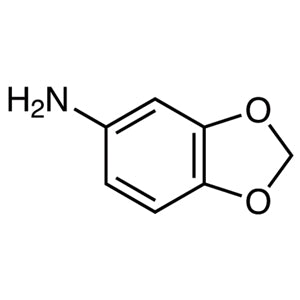
3,4-Ethylenedioxyaniline is a chemical compound widely used as a foundational building block in the synthesis of complex organic compounds. This versatile reagent plays a crucial role in laboratory settings, particularly in the development of heterocyclic and structurally intricate molecules. Its presence is essential in various chemical reactions, making it a key component in the creation of pharmaceuticals, industrial chemicals, and organic research materials. Due to its chemical stability and reactivity, it is highly valued for its ability to maintain performance under specific experimental conditions.
The compound’s unique molecular structure enables it to participate in substitution and addition reactions, facilitating the formation of new compounds. These chemical properties make it a preferred choice for chemists seeking reliable and consistent results in their experiments. Its ability to remain stable while still being reactive ensures that it can be used in a wide range of applications without compromising the integrity of the reaction. This balance of stability and reactivity is what sets it apart in the field of organic chemistry.
In Indonesian laboratories, 3,4-Ethylenedioxyaniline is commonly utilized in organic chemistry research, especially within academic and research institutions. It is an essential reagent for the development of new compounds with potential applications in pharmaceuticals, industry, and environmental science. Its widespread use in these contexts highlights its importance as a fundamental tool in chemical innovation and discovery.
Related TCI products
- TCI B2019 29668-44-8 3,4-Ethylenedioxybenzaldehyde
- TCI C0118 95-03-4 5-Chloro-2-methoxyaniline
- TCI A1356 28657-75-2 6'-Amino-3',4'-(methylenedioxy)acetophenone
- TCI M1378 7797-83-3 2,3-(Methylenedioxy)benzaldehyde
- TCI M0874 3162-29-6 3',4'-(Methylenedioxy)acetophenone
- TCI M0741 14268-66-7 3,4-Methylenedioxyaniline
- Synthesis of heterocyclic compounds due to its ability to form stable intermediates in ring-forming reactions.
- Organic research applications where complex molecular structures are required for drug development and material science.
- Industrial chemical production as a key building block in the manufacture of dyes, pharmaceuticals, and specialty chemicals.
- Environmental chemistry studies for the development of compounds used in pollution control and remediation.
- Academic teaching and experimentation in undergraduate and graduate-level organic chemistry courses.
| Brand | TCI |
|---|---|
| CAS number | 22013-33-8 |
| Molecular formula | — |
| Purity | — |
| Category | Chemistry > Building Blocks > Non-Heterocyclic Building Blocks |
| Pack sizes | Available in various quantities as per supplier guidelines |
| Physical form | Solid or liquid depending on the specific formulation |
| Storage | Store in a cool, dry place away from light and incompatible materials |
This compound should be stored in a cool, dry environment, away from direct sunlight and sources of heat. It is recommended to use airtight containers made of materials such as glass or polyethylene to prevent contamination and maintain stability. Due to its reactivity, it should be kept separate from strong oxidizing agents and strong acids. Laboratory personnel should wear appropriate personal protective equipment, including gloves and safety goggles, when handling this material. Proper ventilation is essential to minimize exposure to vapors, and all handling should be conducted in a well-ventilated fume hood to ensure safety.
—
Produk Terkait
-
3,4-Ethylenedioxybenzaldehyde TCI B2019
Regular price From Rp 582.750,00Regular priceRp 423.150,00Sale price From Rp 582.750,00 -
5-Chloro-2-methoxyaniline TCI C0118
Regular price From Rp 1.167.600,00Regular priceRp 831.600,00Sale price From Rp 1.167.600,00 -
6'-Amino-3',4'-(methylenedioxy)acetophenone TCI A1356
Regular price Rp 2.835.000,00Regular priceRp 1.998.150,00Sale price Rp 2.835.000,00 -
2,3-(Methylenedioxy)benzaldehyde TCI M1378
Regular price From Rp 2.491.650,00Regular priceRp 1.757.700,00Sale price From Rp 2.491.650,00 -
3',4'-(Methylenedioxy)acetophenone TCI M0874
Regular price Rp 3.365.250,00Regular priceRp 2.368.800,00Sale price Rp 3.365.250,00 -
3,4-Methylenedioxyaniline TCI M0741
Regular price From Rp 2.041.200,00Regular priceRp 1.442.700,00Sale price From Rp 2.041.200,00 -
4-Methyl-6,7-methylenedioxycoumarin TCI M0971
Regular price Rp 2.597.700,00Regular priceRp 1.832.250,00Sale price Rp 2.597.700,00 -
N-(4-Methoxybenzylidene)-4-hydroxyaniline TCI M0605
Regular price Rp 1.776.600,00Regular priceRp 1.257.900,00Sale price Rp 1.776.600,00