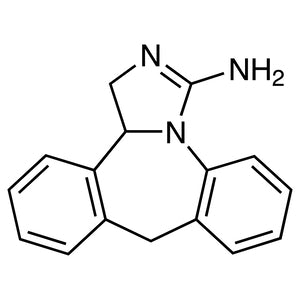
TCI E0799 Epinastine Hydrochloride is the hydrochloride salt form of epinastine, a compound recognized as a histamine H1 receptor antagonist and mast cell stabilizer. In the laboratory setting, this material is supplied as a pharmaceutical research reagent intended strictly for experimental use rather than as a medicinal preparation. Researchers employ it to study histamine signaling pathways, to evaluate allergic responses in cell and tissue models, and as a comparator compound when testing new antihistamine candidates under development at the preclinical stage.
The hydrochloride salt form is generally selected because it offers better aqueous solubility and solid-state stability than the corresponding free base, which makes weighing, stock solution preparation, and storage more practical and more reproducible from one experiment to the next. Its pharmacological selectivity toward the H1 receptor makes it a useful tool for distinguishing the contribution of histaminergic pathways from those of other mediators in experiments involving inflammatory responses. Because the compound has been studied extensively in the published literature, comparative data are relatively easy to locate.
In Indonesian laboratories, this reagent is typically used in university pharmacology and pharmacy departments, government research institutes, and private research facilities working on allergy, inflammation, and receptor pharmacology. It commonly appears in in vitro screening work, in method development for analytical laboratories, and in teaching laboratories where a well-characterized reference antihistamine is needed. The availability of published comparative data helps local research groups benchmark their experimental results against established findings.
TCI brochures (PDF)
- Immune System, Inflammation, Allergy Research Reagents 2025-05-26 · p. 4
- Immunology Research Reagents 2026-06-03 · p. 6
- Pharmaceutical Ingredients for Research and Experimental Use 2026-03-09 · p. 35
- Histamine signaling pathway studies — as a selective H1 receptor antagonist, it allows researchers to block a defined receptor and observe the downstream consequences within a signaling cascade.
- Allergic response evaluation in cell and tissue models — its dual role as an antagonist and mast cell stabilizer makes it suitable for probing multiple points in the allergic response.
- Comparator compound in preclinical antihistamine screening — its well-documented pharmacology provides a reliable benchmark against which new candidate molecules can be measured.
- Differentiation of inflammatory mediator pathways — receptor selectivity permits researchers to separate histaminergic contributions from those of other mediators in complex inflammatory experiments.
- Analytical method development and reference work — the stable salt form supports reproducible stock solution preparation needed when establishing and validating laboratory analytical procedures.
| Brand | TCI |
|---|---|
| CAS number | 108929-04-0 |
| Molecular formula | — |
| Purity | — |
| Category | Life Science > Biochemicals and Reagents > Pharmaceutical Research Reagents (for Experimental Use) |
| Pack sizes | available in standard research-scale pack sizes; please confirm the currently listed option when ordering |
| Physical form | hydrochloride salt (solid) |
| Storage | store according to the manufacturer's stated conditions on the product label and accompanying documentation |
Store the container tightly closed in a cool, dry place, protected from light and moisture, and follow the storage conditions indicated by the manufacturer on the product label and safety data sheet. Keep the material in its original container or in a suitable chemically compatible, clearly labelled vessel. Handle in a well-ventilated area or fume hood using standard personal protective equipment, including a laboratory coat, gloves, and eye protection. Avoid generating dust during weighing, and allow refrigerated material to reach room temperature before opening to reduce condensation. This product is intended for experimental research use only and must not be used for human or veterinary treatment. Dispose of residues in accordance with applicable laboratory waste procedures.
—
Product Categories
- Biochemicals and ReagentsPharmaceutical Research Reagents (for Experimental Use)Anti-allergic Ingredients (for Research and Experimental Use)
- Biochemicals and Reagents
- Cell BiologyImmune System, Inflammation, Allergy ResearchHistamine Receptor Antagonists
- Pharmaceutical Development and Drug Discovery ResearchPharmaceutical Research Reagents (for Experimental Use)Anti-allergic Ingredients (for Research and Experimental Use)
Produk Terkait
-
Epinastine TCI E1540
Regular price Rp 2.757.300,00Regular priceRp 1.943.550,00Sale price Rp 2.757.300,00 -
AzelastineHydrochloride TCI A2340
Regular price Rp 1.405.950,00Regular priceRp 998.550,00Sale price Rp 1.405.950,00 -
OlopatadineHydrochloride TCI O0361
Regular price Rp 10.758.300,00Regular priceRp 7.539.000,00Sale price Rp 10.758.300,00 -
PromethazineHydrochloride TCI P2029
Regular price Rp 1.563.450,00Regular priceRp 1.108.800,00Sale price Rp 1.563.450,00 -
LevocetirizineDihydrochloride TCI L0264
Regular price Rp 1.246.350,00Regular priceRp 887.250,00Sale price Rp 1.246.350,00 -
Desloratadine TCI D3787
Regular price Rp 1.351.350,00Regular priceRp 960.750,00Sale price Rp 1.351.350,00 -
Chlorcyclizine TCI C3867
Regular price Rp 5.962.950,00Regular priceRp 4.185.300,00Sale price Rp 5.962.950,00 -
ClemastineFumarate TCI C3816
Regular price Rp 2.730.000,00Regular priceRp 1.924.650,00Sale price Rp 2.730.000,00