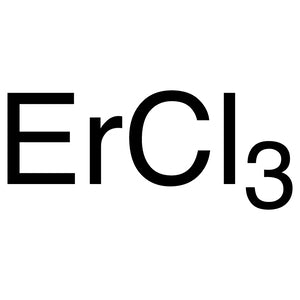
Erbium(III) Chloride (ErCl₃), with the CAS number 10138-41-7, is a chemical compound widely used in scientific and industrial applications, particularly in the fields of catalysis and inorganic chemistry. As a rare earth element compound, it plays a crucial role in laboratory settings by acting as a catalyst in various chemical reactions. Its ability to accelerate chemical processes without undergoing chemical changes makes it an essential reagent for researchers. This compound is commonly used in both academic and industrial laboratories to facilitate complex reactions and improve reaction efficiency.
One of the key reasons Erbium(III) Chloride is preferred is its solubility in both organic solvents and water, which allows for versatile use in different reaction conditions. Its stable crystalline structure also contributes to its reliability in laboratory applications. Additionally, its ability to interact with other ions enhances its utility in catalytic processes. These properties make it a valuable tool for chemists working in both research and development environments.
In Indonesian laboratories, Erbium(III) Chloride is frequently used in inorganic chemistry and catalysis research. Its availability and chemical properties make it a go-to compound for scientists aiming to optimize reaction conditions and improve the efficiency of chemical processes. Its role in accelerating reactions without being consumed makes it a critical component in many experimental setups.
TCI brochures (PDF)
- Metallic Salts 2025-11-06 · p. 3
- Inorganic chemistry research utilizes Erbium(III) Chloride to facilitate complex reactions and enhance reaction efficiency due to its catalytic properties.
- Catalysis studies benefit from this compound as it can act as a catalyst in various chemical transformations without undergoing chemical changes.
- Material synthesis experiments often employ Erbium(III) Chloride because of its solubility and reactivity, which are essential for creating new compounds.
- Analytical chemistry applications use this compound for its stability and reactivity, allowing for accurate and reproducible results in chemical analysis.
- Industrial chemical processes incorporate Erbium(III) Chloride to improve reaction rates and reduce the need for additional reagents, making it cost-effective for large-scale operations.
| Brand | TCI |
|---|---|
| CAS number | 10138-41-7 |
| Molecular formula | — |
| Purity | — |
| Category | Chemistry > Catalysis and Inorganic Chemistry > Rare Earth Elements |
| Pack sizes | Available in various sizes as per supplier specifications |
| Physical form | Solid |
| Storage | Store in a cool, dry place away from moisture and direct sunlight |
Erbium(III) Chloride should be stored in a cool, dry environment to maintain its chemical stability and prevent degradation. It is recommended to keep the compound in airtight containers to avoid exposure to moisture, which can affect its properties. Due to its reactivity, it should be handled in a well-ventilated laboratory setting to minimize inhalation risks. Proper personal protective equipment, such as gloves and safety goggles, should be worn when handling this compound. It is important to store it away from incompatible materials to ensure safety in the laboratory. Regular monitoring of storage conditions will help maintain the compound's integrity and effectiveness for research applications.
—
Produk Terkait
-
Samarium(III)Chloride TCI A3511
Regular price From Rp 1.988.700,00Regular priceRp 1.405.950,00Sale price From Rp 1.988.700,00 -
Praseodymium(III)Chloride TCI P2969
Regular price From Rp 1.670.550,00Regular priceRp 1.183.350,00Sale price From Rp 1.670.550,00 -
Neodymium(III)Chloride TCI N1226
Regular price From Rp 2.147.250,00Regular priceRp 1.517.250,00Sale price From Rp 2.147.250,00 -
Lanthanum(III)Chloride TCI L0428
Regular price From Rp 1.405.950,00Regular priceRp 998.550,00Sale price From Rp 1.405.950,00 -
Europium(III)Chloride TCI E1489
Regular price From Rp 2.147.250,00Regular priceRp 1.517.250,00Sale price From Rp 2.147.250,00 -
Cerium(III)ChlorideAnhydrous TCI C2058
Regular price From Rp 1.988.700,00Regular priceRp 1.390.200,00Sale price From Rp 1.988.700,00 -
Aluminum(III)Chloride TCI A1831
Regular price From Rp 795.900,00Regular priceRp 556.500,00Sale price From Rp 795.900,00 -
Ruthenium(III)ChlorideHydrate TCI R0074
Regular price From Rp 1.670.550,00Regular priceRp 1.183.350,00Sale price From Rp 1.670.550,00