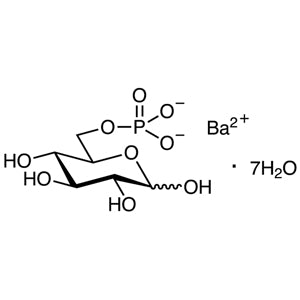
D-Glucose 6-Phosphate Barium Salt Heptahydrate is a chemical compound widely used in laboratory settings for biochemical and chemical research. It plays a crucial role in studying carbohydrate metabolism and enzymatic reactions due to its molecular structure that includes a phosphate group. This compound is often utilized as a substrate or cofactor in reactions that require phosphate energy, making it essential for metabolic pathway investigations. Its stability and reactivity make it a reliable choice for various analytical and synthetic processes in the laboratory.
The compound is valued for its chemical properties that enable participation in redox reactions and organic molecule synthesis. It exhibits good solubility in polar solvents such as water and ethanol, which facilitates its use in diverse analytical techniques. Its high purity and stability ensure consistent results in experiments requiring precision and accuracy. These characteristics make it a preferred material for researchers working in biochemical and biotechnological fields.
In Indonesian laboratories, D-Glucose 6-Phosphate Barium Salt Heptahydrate is commonly used in biochemistry, pharmacology, and environmental science research. It supports studies on enzyme activity, metabolic regulation, and molecular synthesis. Many research institutions and universities rely on this compound for experimental work that demands reliable and reproducible outcomes. Its versatility and chemical behavior make it an essential reagent in both academic and industrial research settings.
TCI brochures (PDF)
- Biochemical research utilizes this compound to study metabolic pathways and enzyme kinetics due to its phosphate functionality and solubility.
- Enzymatic reaction studies benefit from its role as a substrate or cofactor, enabling the investigation of energy transfer mechanisms in biological systems.
- Organic synthesis applications leverage its chemical reactivity and solubility in polar solvents for the creation of complex molecular structures.
- Environmental analysis incorporates this compound for the detection and quantification of phosphate-containing substances in various sample matrices.
- Pharmacological studies use it to examine the effects of phosphate-based compounds on cellular processes and drug metabolism.
| Brand | TCI |
|---|---|
| CAS number | 58823-95-3 |
| Molecular formula | — |
| Purity | — |
| Category | Chemistry > Chemical Biology > Glycoscience |
| Pack sizes | Available in various quantities as per supplier specifications |
| Physical form | Heptahydrate salt in crystalline form |
| Storage | Store in a cool, dry place away from moisture and direct sunlight |
This compound should be stored in a cool, dry environment to maintain its stability and prevent degradation. It is recommended to keep it in airtight containers to avoid exposure to moisture and humidity, which can affect its chemical integrity. Due to its hygroscopic nature, it is important to ensure that the storage area is well-ventilated and free from sources of heat. Laboratory personnel should wear appropriate personal protective equipment when handling the compound to ensure safety. Proper labeling of containers is essential to prevent cross-contamination and ensure safe handling during experiments. Regular monitoring of storage conditions will help maintain the quality and usability of the compound for research purposes.
—
Product Categories
Produk Terkait
-
1,6-Anhydro-beta-D-glucose TCI A1074
Regular price From Rp 1.298.850,00Regular price -
D-GlucoseDiethylMercaptal TCI G0259
Regular price Rp 1.881.600,00Regular price -
L-(-)-Glucose TCI G0226
Regular price From Rp 2.571.450,00Regular price -
D-(+)-Glucose TCI G0048
Regular price From Rp 452.550,00Regular price -
beta-D-Glucose(containsalpha-D-Glucose) TCI G0047
Regular price From Rp 1.431.150,00Regular price -
2-Deoxy-D-glucose TCI D0051
Regular price From Rp 1.431.150,00Regular price -
Arbutin TCI A0522
Regular price From Rp 452.550,00Regular price -
Teniposide TCI T3109
Regular price From Rp 1.485.750,00Regular price