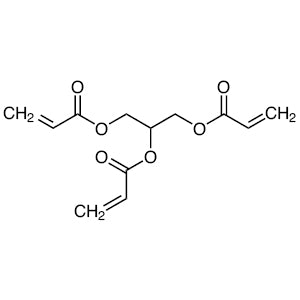
Glycerol Triacrylate (stabilized with MEHQ), with CAS number 5459-38-1, is a chemical compound widely used in laboratory settings for various synthetic reactions. It is an ester derived from acrylic acid and glycerol, featuring a complex molecular structure and high reactivity. This compound plays a crucial role in organic chemistry and material science, serving as a key building block for the synthesis of organic compounds and functional materials. Its versatility makes it an essential reagent in research and development activities across multiple scientific disciplines.
The compound’s stability is enhanced by the inclusion of MEHQ (methyl ethyl glycol hydroperoxide), which acts as a stabilizer to prevent oxidative degradation. This makes it suitable for long-term storage and use in environments where chemical stability is critical. Additionally, its high boiling and melting points ensure thermal stability, making it ideal for applications requiring controlled thermal conditions. The non-volatile nature of Glycerol Triacrylate also simplifies handling and storage, contributing to its reliability in laboratory settings.
In Indonesian laboratories, Glycerol Triacrylate is extensively used in research and development focused on organic chemistry and polymer technology. It is commonly found in studies related to material synthesis, polymer modification, and composite development. Its availability and chemical properties make it a preferred choice for scientists and researchers working on innovative material solutions and chemical processes.
- Organic synthesis applications benefit from Glycerol Triacrylate due to its high reactivity and ability to form cross-linked structures, making it ideal for polymerization reactions.
- Polymer research utilizes this compound as a crosslinking agent, enhancing the mechanical properties of synthetic polymers and improving their durability.
- Composite material development relies on Glycerol Triacrylate for its ability to bond with various matrix materials, contributing to the creation of advanced composite structures.
- Film and coating formulations use this compound for its ability to create flexible and durable films, suitable for industrial and laboratory applications.
- Material characterization studies benefit from its stable chemical properties, allowing for consistent results in analytical and testing procedures.
| Brand | TCI |
|---|---|
| CAS number | 5459-38-1 |
| Molecular formula | — |
| Purity | — |
| Category | Chemistry > Building Blocks > Non-Heterocyclic Building Blocks |
| Pack sizes | Available in various quantities as per supplier specifications |
| Physical form | Liquid |
| Storage | Store in a cool, dry place away from direct sunlight and sources of heat |
Glycerol Triacrylate should be stored in a cool, dry environment, away from direct sunlight and heat sources to maintain its chemical stability. It is recommended to use sealed containers made of inert materials such as glass or high-density polyethylene to prevent contamination and evaporation. Due to its reactive nature, it should be handled with appropriate personal protective equipment, including gloves and safety goggles. In laboratory settings, it is important to ensure good ventilation and to avoid contact with incompatible substances. Proper labeling and storage conditions are essential to ensure safety and maintain the integrity of the compound during handling and use.
—
Produk Terkait
-
TrimethylolpropaneTriacrylate(stabilizedwithMEHQ) TCI T0949
Regular price From Rp 505.050,00Regular price -
Propane-1,3-diylDiacrylate(stabilizedwithMEHQ) TCI P2898
Regular price From Rp 2.227.050,00Regular price -
NeopentylGlycolDiacrylate(stabilizedwithMEHQ) TCI N0790
Regular price From Rp 823.200,00Regular price -
Tricyclo[5210~2,6~]decanedimethanolDiacrylate(mixtureofisomers)(stabilizedwithMEHQ) TCI T4002
Regular price From Rp 1.273.650,00Regular price -
TripropyleneGlycolDiacrylate(stabilizedwithMEHQ) TCI T2389
Regular price From Rp 477.750,00Regular price -
GlycerolDimethacrylate(mixtureof1,2-and1,3-form)(stabilizedwithMEHQ) TCI B2938
Regular price From Rp 584.850,00Regular price -
GlycerolTrimethacrylate(stabilizedwithMEHQ) TCI G0495
Regular price Rp 3.605.700,00Regular price -
Diacetin(containsMono-,Tri-,Glycerol) TCI G0077
Regular price From Rp 505.050,00Regular price


![42594-17-2 Tricyclo[5.2.1.0~2,6~]decanedimethanol Diacrylate (mixture of isomers) (stabilized with MEHQ) - AMI Scientific](http://amiscientific.com/cdn/shop/files/TCI2510T4002.jpg?v=1767144579&width=533)