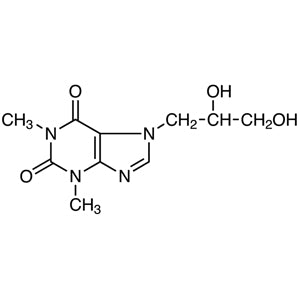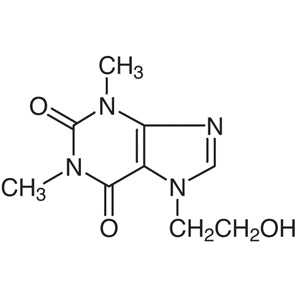
Etofylline is a chemical compound classified under the alkaloid category, widely utilized in scientific experiments related to biochemistry. As a derivative of theophylline, it exhibits distinct pharmacological properties that make it valuable for research purposes. In the laboratory, Etofylline serves as a key reagent for the synthesis of various compounds and is frequently employed in studies examining the effects of stimulants on the nervous system. Its role extends to pharmacological and biochemical investigations, where it helps in understanding the mechanisms of action of stimulant compounds.
Etofylline is known for its chemical stability under normal conditions, which simplifies its storage and long-term use. This stability ensures that the compound retains its quality over time, making it a reliable choice for repeated experiments. Additionally, Etofylline is non-toxic in small doses and does not readily react with other chemical substances, enhancing its safety profile in laboratory settings. These characteristics make it a preferred reagent for researchers aiming for consistent and reproducible results.
In Indonesian laboratories, Etofylline is commonly used in pharmacological, biochemical, and health sciences research. It plays a crucial role in experiments involving the testing of stimulant effects, especially in studies related to neurological and physiological responses. Its availability and reliability have made it a standard component in many research protocols across various scientific disciplines in Indonesia.
- Pharmacological research utilizes Etofylline to study stimulant effects on neural pathways and neurotransmitter activity.
- Biochemical experiments often employ Etofylline in the synthesis of complex organic compounds and in enzyme activity assays.
- Health sciences research incorporates Etofylline to investigate its potential therapeutic applications in respiratory and neurological disorders.
- Neurological studies use Etofylline to explore its impact on central nervous system function and stimulant-induced responses.
- Toxicology experiments benefit from Etofylline’s stability and non-toxicity, allowing for safe and controlled exposure studies.
| Brand | TCI |
|---|---|
| CAS number | 519-37-9 |
| Molecular formula | — |
| Purity | — |
| Category | Life Science > Biochemicals and Reagents > Alkaloids |
| Pack sizes | Available in various quantities as per standard laboratory supply |
| Physical form | Solid powder |
| Storage | Store in a cool, dry place away from direct sunlight |
Etofylline should be stored in a cool, dry environment to maintain its chemical stability and prevent degradation. It is recommended to keep the compound in a tightly sealed container to avoid moisture absorption and contamination. Since Etofylline is non-toxic in small doses, it poses minimal risk during routine handling, but standard laboratory safety protocols should still be followed. It is advisable to store it away from incompatible substances to prevent unintended chemical reactions. Proper labeling and secure storage are essential to ensure safe access and usage in laboratory settings.
—
Produk Terkait
-
8-Chlorotheophylline TCI C0293
Regular price From Rp 1.458.450,00Regular price -
7-(2,3-Dihydroxypropyl)theophylline TCI D3600
Regular price Rp 1.008.000,00Regular price -
Dimenhydrinate TCI D6336
Regular price From Rp 1.829.100,00Regular price -
Harmine TCI H0001
Regular price Rp 1.881.600,00Regular price -
HarmineHydrochloride TCI H0002
Regular price From Rp 795.900,00Regular price -
Hecogenin TCI H0003
Regular price From Rp 955.500,00Regular price -
HeneicosanoicAcid TCI H0010
Regular price From Rp 3.790.500,00Regular price -
Hentriacontane TCI H0012
Regular price From Rp 3.683.400,00Regular price