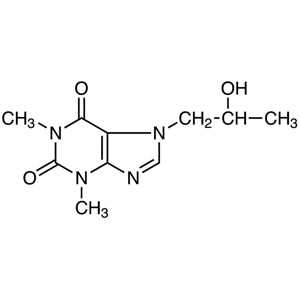
Proxyphylline is a xanthine derivative, part of the purine alkaloid family that also includes caffeine and theophylline. Structurally, it is theophylline carrying a 2-hydroxypropyl group on one of its nitrogen atoms, which gives it solubility behaviour distinct from its parent compound. In the laboratory, this material is generally used as a reference material or comparison compound in analytical work and biochemical research, as well as a test substance in basic pharmacological studies examining how xanthine derivatives behave toward biological systems.
The properties that make it a preferred choice are the clarity of its chemical identity and the consistency of its quality as a research-grade material. As a xanthine derivative, the compound carries a purine chromophore that produces characteristic ultraviolet absorption, making it readily detectable by high-performance liquid chromatography and by spectrophotometry — a practical advantage when developing analytical methods. The addition of the hydroxypropyl group improves its solubility in water compared with theophylline, which simplifies the preparation of stock solutions and serial standard solutions without relying on organic solvents in large proportions.
In Indonesian laboratories, this material is typically encountered in analytical and biochemical research settings where a well-characterised xanthine derivative is needed as a comparison standard. It supports method development work in chromatography and spectrophotometry, and serves as a test compound in fundamental pharmacological studies of purine alkaloids. Its research-grade consistency makes it suitable for academic, institutional, and laboratory-based investigative work where reproducible reference behaviour matters.
- Reference standard preparation — its clearly defined chemical identity and consistent research-grade quality make it reliable for preparing comparison standards used in routine analytical work.
- HPLC method development — the purine chromophore gives characteristic ultraviolet absorption, allowing straightforward detection and peak identification when establishing and validating chromatographic separation methods.
- Ultraviolet spectrophotometric analysis — the distinctive UV absorption of the xanthine ring structure supports direct spectrophotometric measurement and calibration curve construction in quantitative laboratory procedures.
- Basic pharmacological research — serves as a test substance in fundamental studies examining how xanthine derivatives interact with and behave toward biological systems under controlled conditions.
- Biochemical comparison studies — as a structural relative of caffeine and theophylline, it functions as a comparison compound in research exploring purine alkaloid structure and behaviour.
| Brand | TCI |
|---|---|
| CAS number | 603-00-9 |
| Molecular formula | — |
| Purity | — |
| Category | Life Science > Biochemicals and Reagents > Alkaloids |
| Pack sizes | available in standard TCI research-scale packaging; please confirm the required size when ordering |
| Physical form | — |
| Storage | keep in a tightly closed container in a cool, dry place away from direct light |
- Product code: H1430
Store the container tightly closed in a cool, dry, well-ventilated area, protected from direct sunlight and away from sources of heat or ignition. Keep the material in its original supplier container wherever possible, or transfer it only to clean, chemically compatible, clearly labelled containers with secure closures. Handle the substance in a well-ventilated laboratory space or fume hood, and wear appropriate personal protective equipment including a laboratory coat, gloves, and safety eyewear. Avoid generating or inhaling dust during weighing and transfer operations. Keep containers closed when not in use to limit exposure to moisture and atmospheric contaminants, and always consult the manufacturer's safety data sheet before handling.
—
Produk Terkait
-
TCI B5774 5,10-Bis(4,4,5,5-tetramethyl-1,3,2-dioxaborolan-2-yl)naphtho[1,2-c:5,6-c']bis([1,2,5]oxadiazole)
Regular price Rp 10.255.350,00Regular price -
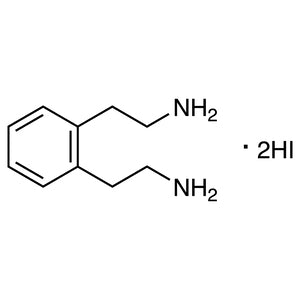
Dihydroiodide TCI B6569
Regular price From Rp 1.936.200,00Regular price -
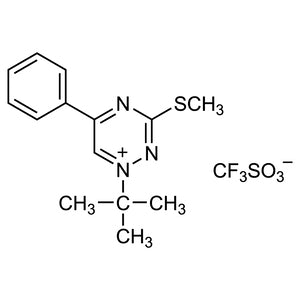
Trifluoromethanesulfonate TCI B7003
Regular price From Rp 1.936.200,00Regular price
![5,10-Bis(4,4,5,5-tetramethyl-1,3,2-dioxaborolan-2-yl)naphtho[1,2-c:5,6-c']bis([1,2,5]oxadiazole) - TCI B5774 - AMI Scientific](http://amiscientific.com/cdn/shop/files/TCI2510B5774.jpg?v=1769180228&width=533)