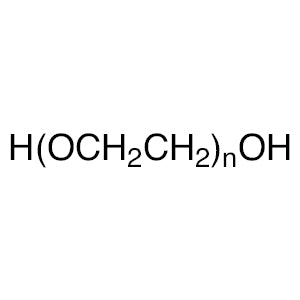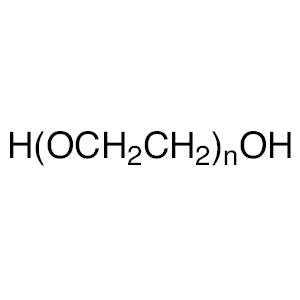
TCI H0543 Polyethylene Glycol 300 is a low molecular weight polyether built from repeating ethylene oxide units terminated by a hydroxyl group at each end of the chain. The figure three hundred in the product name indicates the average molecular weight of this grade, which places the material in the liquid range at room temperature. In the laboratory it serves as a co-solvent, a formulation vehicle, a lubricant and wetting agent, and as a starting material in PEGylation chemistry, meaning the attachment of polyethylene glycol chains to drug molecules, peptides, proteins, or material surfaces.
The properties that make this grade so useful are its complete miscibility with water and with many polar organic solvents, its low vapour pressure, and its non-volatile and comparatively chemically inert character. The terminal hydroxyl groups provide reactive handles for esterification, etherification, or activation into reactive derivatives used in biomolecule conjugation. PEG 300 is also recognised for its ability to raise the solubility of poorly water-soluble compounds, which is why it appears so frequently in the preparation of test solutions for pharmacological research.
In Indonesian laboratories this grade is typically drawn on by university research groups, pharmaceutical formulation units, and analytical and biotechnology facilities that need a dependable liquid polyethylene glycol for solubilising work and for conjugation chemistry. Because it is non-volatile and chemically undemanding to handle, it fits comfortably into routine bench work, whether the task is dissolving a difficult compound for a dosing study or serving as the base polymer in a PEGylation experiment.
TCI brochures (PDF)
- Drug Delivery System (DDS) Research Reagents 2025-01-29 · p. 2
- Biomaterials Research Reagents 2025-02-19 · p. 6
- Co-solvent preparation: PEG 300 dissolves readily in water and in many polar organic solvents, so it can carry poorly water-soluble compounds into solution without introducing a volatile component into the system.
- PEGylation chemistry: the material acts as a starting polymer for attaching polyethylene glycol chains to drug molecules, peptides, proteins, or material surfaces in conjugation work.
- Pharmacological test solution preparation: its capacity to increase the solubility of poorly water-soluble compounds makes it a routine choice when preparing dosing and screening solutions for research.
- Formulation vehicle work: the liquid state at room temperature combined with low vapour pressure allows it to function as a stable carrier medium in laboratory-scale formulation studies.
- Lubricant and wetting applications: PEG 300 spreads and wets surfaces well while remaining non-volatile and relatively chemically inert, which suits it to bench lubrication and wetting tasks.
| Brand | TCI |
|---|---|
| CAS number | 25322-68-3 |
| Molecular formula | — |
| Purity | — |
| Category | Chemistry > Chemical Biology > PEGylation |
| Pack sizes | available in the pack sizes listed on this product page |
| Physical form | liquid at room temperature |
| Storage | keep tightly closed, as the material is hygroscopic and will absorb atmospheric moisture |
Store TCI H0543 Polyethylene Glycol 300 in its original tightly closed container in a cool, dry place away from direct sunlight. Like other polyethylene glycols, this material is hygroscopic and will take up water vapour from the air, so containers should be closed promptly after every use and opened as briefly as possible. Glass or chemically compatible plastic containers with well-sealing caps are appropriate. Handle the material in a well-ventilated area, wear standard laboratory personal protective equipment including a lab coat, gloves, and eye protection, and use clean dry transfer tools to avoid introducing moisture or contaminants into the bulk. Wipe up spills promptly, since the liquid can leave slippery residues on bench and floor surfaces.
—
Product Categories
- Polymer/Macromolecule ReagentsPolymersSynthetic Polymers
- Biomaterials/Biocompatible Materials Research ReagentsMonomers and Macromonomers [Biomaterials/Biocompatible Materials Research Reagents]Diol Monomers [Biomaterials/Biocompatible Materials Research Reagents]
- Biomaterials/Biocompatible Materials Research ReagentsPolymers [Biomaterials/Biocompatible Materials Research Reagents]PEGs, PEGylation Reagents [Biomaterials/Biocompatible Materials Research Reagents]
- Biomaterials/Biocompatible Materials Research ReagentsPolymers [Biomaterials/Biocompatible Materials Research Reagents]Synthetic Polymers
Produk Terkait
-
PolyethyleneGlycol20000 TCI P2830
Regular price From Rp 477.750,00Regular priceRp 333.900,00Sale price From Rp 477.750,00 -
PolyethyleneGlycol11000 TCI P2829
Regular price Rp 477.750,00Regular priceRp 333.900,00Sale price Rp 477.750,00 -
PolyethyleneGlycol1000 TCI P2828
Regular price From Rp 477.750,00Regular priceRp 333.900,00Sale price From Rp 477.750,00 -
PolyethyleneGlycol2000 TCI P2034
Regular price From Rp 505.050,00Regular priceRp 352.800,00Sale price From Rp 505.050,00 -
PolyethyleneGlycol600 TCI P1187
Regular price From Rp 477.750,00Regular priceRp 333.900,00Sale price From Rp 477.750,00 -
PolyethyleneGlycol6000 TCI P0903
Regular price From Rp 477.750,00Regular priceRp 333.900,00Sale price From Rp 477.750,00 -
PolyethyleneGlycol4000 TCI P0885
Regular price From Rp 477.750,00Regular priceRp 333.900,00Sale price From Rp 477.750,00 -
PolyethyleneGlycol200 TCI P0840
Regular price From Rp 477.750,00Regular priceRp 333.900,00Sale price From Rp 477.750,00